
Goat Farming in Nepal: Cost, Profit and How to Start (2026)
Dashain 2026 prices, official shed and feed figures, what studies say a small herd really earns, and the help on offer

Last updated: 9 November 2026. Goat prices change with the season and the place, so check with buyers near you before you invest. This is general information, not financial or veterinary advice.
Quick answer
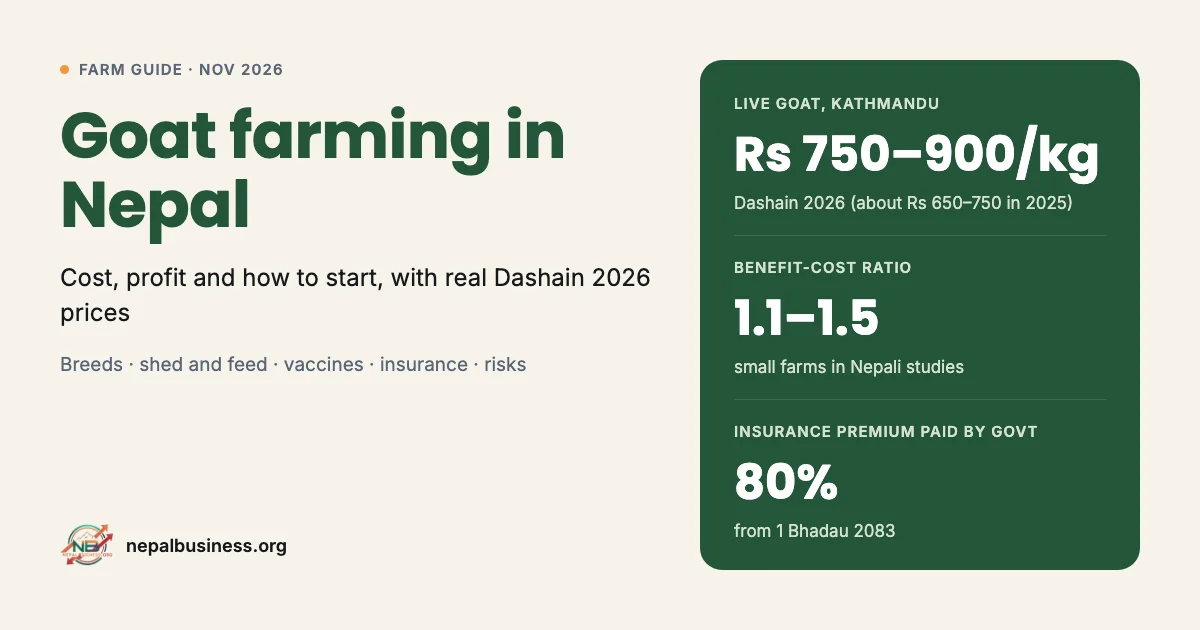
Goat farming (बाख्रा पालन) in Nepal sells into a large, steady market. At Dashain 2026, live goats sold for Rs 750 to Rs 900 a kg in Kathmandu, up from about Rs 650 to Rs 750 a year earlier, and goat meat reached Rs 1,600 to Rs 1,900 a kg.
The catch is the margin. Nepali studies put the benefit-cost ratio of small goat farms at only 1.1 to 1.5, and that is before counting the family's own work and fodder. In one 2025 survey in Banke, three in four goat-keeping households earned less than Rs 50,000 a year from goats. The farms that do well grow their own fodder, use a better buck, vaccinate, and sell in the weeks before Dashain.
Is goat farming profitable in Nepal in 2026?
It can be, but expect modest returns at a small scale. Here is what the published Nepali studies found:
| Study (data year) | Farms | Result |
|---|---|---|
| Banke, 2025 | Model 10-doe farm | Profit Rs 28,014, B:C 1.22 |
| Tanahun, 2024 | 86 homes, avg 8 goats | Benefit Rs 36,905 a year |
| Kathmandu, ~2022 | 84 small farms | B:C 1.49 (current year) |
| Kathmandu, ~2022 | 16 commercial | B:C 1.14 (current year) |
B:C is the benefit-cost ratio: 1.22 means Rs 1.22 back for every Rs 1 spent. Sources: Pandey, Gautam and Panta (2026); Poudel, Bhatta and Adhikari (2026); Bhatt and Neupane (2023). Full links are at the end.
Three things stand out:
- The well-known "Rs 28,014 profit" is a model, not an average. The Banke study built it for a 10-doe, 1-buck farm, selling 8 goats a year at Rs 19,500 each. It does not count the farmer's own labour or home-grown fodder. The same survey found that most real households earned far less.
- Bigger is not automatically better. In the Kathmandu study, the 16 registered commercial farms spent more per goat than small farms (Rs 6,564 against Rs 4,278), and the researchers found no significant difference in returns.
- Feed is the biggest cost. In Tanahun, feed was Rs 22,058 of a Rs 23,565 yearly cost. The government's goat manual says feed can be as much as half of a goat farm's cost.
Why the selling price matters most
The Banke model's yearly cost is Rs 1,27,986. Here is what happens to its profit if you change only the price of each of the 8 goats sold:
| Price per goat | Sales (8 goats) | Profit |
|---|---|---|
| Rs 15,000 | Rs 1,20,000 | Loss Rs 7,986 |
| Rs 19,500 | Rs 1,56,000 | Rs 28,014 |
| Rs 25,000 | Rs 2,00,000 | Rs 72,014 |
Our calculation from the model's published cost. Rs 15,000 to 20,000 is the normal Kathmandu price of a 25 kg Khari khasi, and Rs 25,000 to 30,000 is its price in the two weeks before Dashain 2026 (Kathmandu Post, 5 October 2026). The model's own cost rows add up to Rs 96,286, not the Rs 1,02,286 it prints, so treat the totals as approximate.
Every Rs 1,000 more per goat adds Rs 8,000 to the year's profit. Timing your sales for the Dashain window does more for profit than almost any saving on inputs.
Goat prices in Nepal: Dashain 2026
| Item | Dashain 2026 | Dashain 2025 |
|---|---|---|
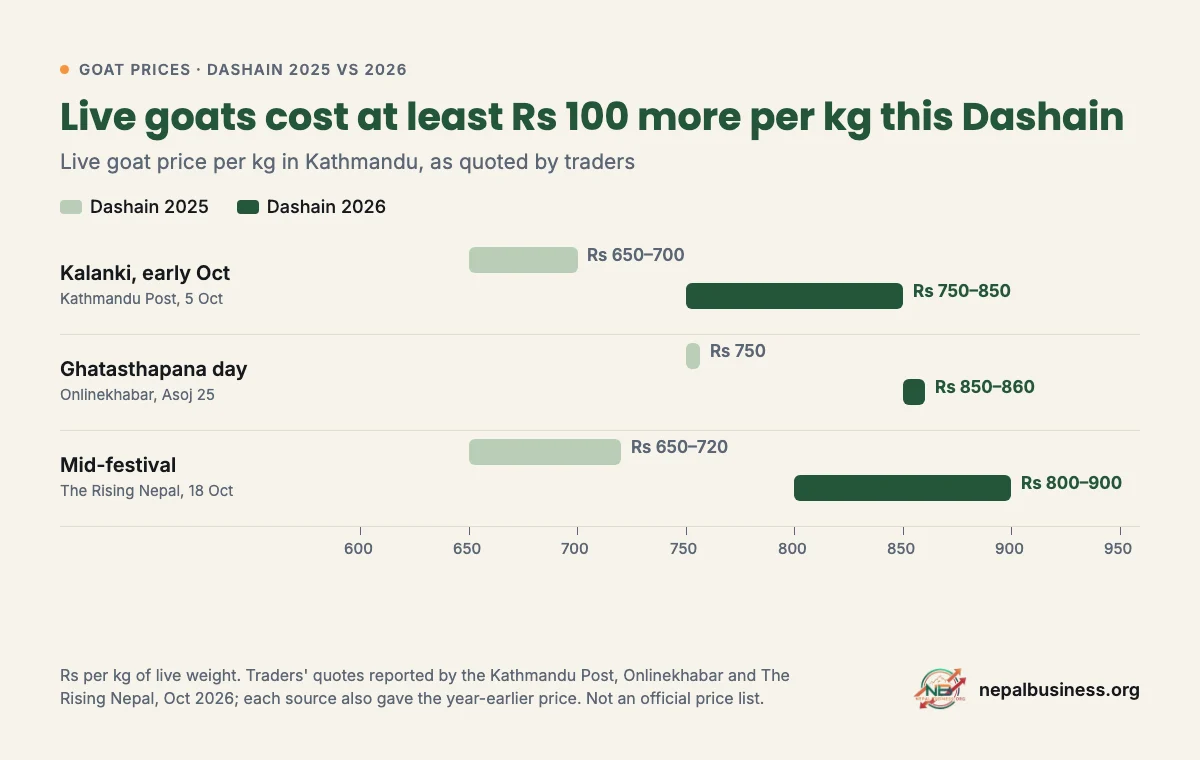
| Live goat, Kalanki | Rs 750–860/kg | Rs 650–750/kg |
| Live goat, mid-festival | Rs 800–900/kg | Rs 650–720/kg |
| Live goat, Chitwan | Rs 700–750/kg | at least Rs 50 less |
| Live chyangra, Kathmandu | Rs 1,250–1,350/kg | – |
| Goat meat, Kathmandu | Rs 1,600–1,900/kg | Rs 1,300–1,500/kg |
Sources: Kathmandu Post (5 Oct 2026), Onlinekhabar (Asoj 25, 2083), The Rising Nepal (18 Oct 2026), eKantipur (16 Oct 2026). These are traders' quotes, not an official price list.
- No government goat sales. The state-owned Food Management and Trading Company did not sell Dashain goats in 2026 or in 2025, so there is no official "Khadya rate" for either year.
- Meat was already expensive before Dashain. Kathmandu goat meat was Rs 1,250 to Rs 1,300 a kg early in 2026 and jumped to Rs 1,700 to Rs 1,750 in July after a bird flu outbreak (Kathmandu Post).
- Prices differ by place. Sunsari's District Administration Office capped goat meat at Rs 1,100 a kg on 15 October 2026, the price it said had applied there since Magh 2082.
- Traders take a cut. In 2025, traders bought from farmers at Rs 600 to Rs 650 a kg and sold at Rs 700 to Rs 750 (eKantipur).
How big is the goat market in Nepal?
- Nepal had 15.29 million goats in fiscal year 2080/81, and about 24.4 lakh farm holdings keep goats, according to the Department of Livestock Services.
- Goats gave 86,280 tonnes of meat that year, about 19% of all meat produced in Nepal (our calculation from the same book).
- Official customs data record no live goat imports from India in 2081/82 or 2082/83. The only recorded imports were 680 goats from China in 2081/82. A goat farmers' federation leader says Indian goats are smuggled in, but there are no official figures for that.
- Traders say the Kathmandu Valley eats about 5 lakh goats a year, many of them at Dashain (Kathmandu Post). Other traders give lower Dashain numbers, so treat these as estimates.
Which goat breed is best in Nepal?
Government and research sources point beginners to the same plan: keep local Khari does and use a better buck, often a Boer. Khari does breed well and survive local conditions; a Boer buck adds growth to their kids.
| Breed | Where | Adult doe / buck |
|---|---|---|
| Khari | Hills, 300–1,500 m | 15–25 / 25–35 kg |
| Terai | Terai | up to 18 / 32 kg |
| Sinhal | 1,500–2,500 m | up to 34 / 42 kg |
| Chyangra | Above ~2,500 m | about 27–40 kg |
| Jamunapari | Kept in Nepal | 38 / 45 kg |
| Boer × Khari | Up to ~2,100 m | ~35 kg at 1 year |
Weights from the Gorkha District Livestock Service Office goat manual; the Boer cross figure (34.68 kg at 12 months) is from Surkhet field data (Sapkota et al., 2025).
- Khari is the common hill goat. In Surkhet field records, Khari does kidded first at about 14.5 months and again about every 10 months, with 1.44 kids per kidding (Bhattarai et al., 2022).
- Boer crosses grow faster. First-cross kids in Surkhet weighed about 28 kg at 6 months and 35 kg at a year. NARC's Goat Research Station at Bandipur says demand for Boer bucks is higher than for local ones; it handed out 142 goats in 2080/81, 45 of them pure Boer (Ratopati).
- Two Boer claims do not hold up. You will read that Boer goats always have twins and resist disease better. The Surkhet study found no breed difference in litter size, and a National Livestock Breeding Office officer warns that Boer goats cope less well with parasites and disease than local goats.
- Price of a Boer buck: Rohini Rural Municipality in Rupandehi paid Rs 50,000 per Boer buck when it bought 12 for local goat groups in June 2025 (eKantipur). We found no current price list, so compare two or three sellers and ask your local livestock office.
How to build a goat shed: official space and floor
The space table below is from the Gorkha District Livestock Service Office goat manual, which credits it to the government's Central Sheep and Goat Promotion Office.
| Goat | Inside shed | Open yard |
|---|---|---|
| Kid, up to 3 months | 0.2–0.3 m² | 0.4–0.6 m² |
| Young, 3–9 months | 0.6–0.75 m² | 1.2–1.5 m² |
| Young, 9–12 months | 0.75–1.0 m² | 1.5–2.0 m² |
| Adult doe | 1.5–2.0 m² | 3–4 m² |
| Breeding buck | 2.5–3.0 m² | 5–6 m² |
For 20 does and 1 buck, that is about 32 to 43 m² inside plus space for kids (our calculation).
- Raise the floor. Suryodaya Municipality's farming guide says to build the floor 3 to 5 feet above the ground. Use slats with gaps narrower than a finger so kids do not break their legs, and clean dung from under the shed at least twice a week.
- Separate pens for kids, pregnant does, the buck and castrated males, plus a separate shed for sick goats and newly bought goats.
- Keep out cold and predators. Cover the sides with jute sacks in winter. In the hills, shut goats in at night: in Gorkha, the forest office says 90% of the animals killed by wild animals are goats and buffalo calves, mostly taken by leopards.
The Banke study's model used Rs 60,000 for a shed for 10 does and a buck in 2025. Material and labour costs vary a lot, so get local quotes.
What to feed goats, and how much
| Per goat, per day | Amount |
|---|---|
| Green fodder, adult | 4–6 kg |
| Green fodder, growing kid | 2–3 kg |
| Concentrate (दाना), adult | about 250 g |
| Concentrate, pregnant doe or buck | about 500 g |
| Clean water | 5 litres |
From the Gorkha goat manual. Add 1 kg of salt and 1 kg of mineral mixture to every 100 kg of concentrate.
- Grow fodder before you buy goats. Twenty does and a buck need roughly 100 kg of green fodder and 105 litres of water a day (our calculation).
- Fodder trees: ipil-ipil, badahar, kimbu, tanki, koiralo, nimaro and khanyu. Grasses and fodder crops: napier, stylo, berseem and oats.
- Home-mix concentrate: the manual suggests 3 parts grain or bran (maize, wheat) to 1 part oilcake (पिना) or legume.
Vaccines and goat health
| Vaccine | First dose | Repeat |
|---|---|---|
| PPR (पीपीआर) | After 3 months of age | Every 3 years |
| FMD (खोरेत) | After 4 months of age | Every year |
Schedule from the Gorkha goat manual's table, credited to the Central Sheep and Goat Promotion Office.
- PPR vaccine is free from district Veterinary Hospital and Livestock Service Expert Centres and municipal livestock offices. Syangja alone gave 96,937 free PPR doses to goats and sheep in 2082/83 (Gorkhapatra).
- Ask your local vet about other vaccines. Officials also recommend vaccinating against enterotoxaemia (६ मासे रोग), which mainly kills kids under a year old. We did not find an official Nepali schedule for it, or for HS or goat pox, so get the schedule and doses from your district Veterinary Hospital and Livestock Service Expert Centre.
- Deworm on a technician's advice, as Suryodaya Municipality's guide says. Do not copy doses from the internet.
- Common problems: PPR, pneumonia, diarrhoea, bloat, hoof rot, stomach worms and external parasites (Gorkha goat manual).
Breeding: bucks, kidding and when to sell
- One buck per 20 to 30 does (official sources give 20, 25 or 25 to 30).
- Mate does at about 8 months or 18 kg. Pregnancy lasts about 150 days, and well-fed does can kid 3 times in 2 years.
- Change your breeding buck every 12 to 15 months so he does not mate his own daughters.
- Castrate males young (the manual says before 3 months). The manual expects goats to be sold after 8 to 10 months; Tanahun farmers sold at an average of about 15 months and 20.5 kg in 2024.
- Sell by weight. Weigh your goats before you talk price, so a trader cannot price a heavy goat as a light one.
Real goat farmers in Nepal: what the news reports
These are success stories reported in the news, not averages. Most of these farmers got a grant or a subsidised buck, and none reported a net profit.
- Kul Bahadur Pun, Myagdi: began with 2 goats in 2078 BS and now has 48. He sells 15 to 20 a year for Rs 15,000 to Rs 20,000 each. He received a Rs 5 lakh shed grant and a Boer buck at a 75% subsidy, and repaid a Rs 10 lakh loan (Onlinekhabar, Baisakh 2083).
- Krishna Gauchan, Myagdi: started with 5 goats on a Rs 38,150 loan plus Rs 15,000 of seed money, and 2 of the first 5 died. His herd peaked at 120 and is now 70. He received Rs 1.5 lakh of shed support (Ratopati).
- Bhuwani Poudel, Myagdi: grew from 9 goats to more than 60 and sells 35 to 40 a year for up to Rs 5 lakh (Ratopati).
- The Budha brothers, Dang: grew from 8 goats to 75 and sell about Rs 10 lakh worth a year, but say little is left after costs. 54 of their goats died of disease in one year, a loss of more than Rs 2.5 lakh (Onlinekhabar, Baisakh 2082).
How to start a goat farm in Nepal: 8 steps
- Plan your fodder first. Check how much grass and fodder-tree land you have. Feed is the biggest cost, and buying all of it rarely pays.
- Get trained. Ask your municipality's livestock section or the district Veterinary Hospital and Livestock Service Expert Centre about training. NARC's Goat Research Station at Bandipur, Tanahun, also trains commercial farmers. Only 13.7% of goat households in the Banke survey had any formal training.
- Get listed and registered. Make sure your family is listed in the government's farmer listing programme (किसान सूचीकरण) at your local level; 26.45 lakh farm families had been listed by Asar 2083. Then register the farm with your municipality's agriculture or livestock section. Suryodaya Municipality's guide says a registered commercial goat business is needed for government support. Rules and fees differ by municipality, so ask yours.
- Build the shed to the space figures above, with a raised slatted floor and a separate pen for new or sick goats.
- Buy healthy stock. Suryodaya Municipality's guide suggests starting a commercial farm with at least 20 does and 1 buck, choosing healthy 6 to 12-month doelings or does that have kidded once. Buy local does where you can.
- Quarantine and vaccinate. Keep new goats apart, and get them vaccinated against PPR. In Dolakha in August 2025, PPR killed 13 goats in a week on a farm that had brought goats in from another district.
- Insure the herd. Since 1 Bhadau 2083, the government pays 80% of the premium (details below).
- Keep records and sell by weight. Note every birth, death, feed purchase and sale. Plan to have goats ready for Dashain, when prices are highest.
Do goat farmers pay VAT or need a PAN?
Live goats and fresh, chilled or frozen goat meat are exempt from VAT under Schedule 1 of the VAT Act 2052 (Group 3, live animals and animal products), as amended up to the Finance Act 2083. The exemption does not apply when a hotel or restaurant sells them. For PAN and income tax, ask your local Inland Revenue Office. If you set up a firm or company, read our guide to business registration in Nepal. In Bagmati Province, industry registration and renewal moved online in September 2026, although commercial firms still need to visit the office.
What government support is there for goat farmers?
Livestock insurance: the government pays 80%
Under the Ministry of Agriculture's new premium subsidy procedure, in force from 1 Bhadau 2083 (about 17 August 2026), the government pays 80% of the insurance premium on a policy's sum insured up to Rs 1 crore, and 50% on any amount above Rs 1 crore. Goat insurance (बाख्रा बीमालेख) is on the procedure's list of covered policies. You pay only your share when the insurer issues the policy, and you sign a declaration that you get no other government subsidy for the same thing. Policies are issued through the Nepal Insurance Authority's online Agriculture and Livestock Insurance System.
- Insurers usually need the goats to be healthy, vaccinated and ear-tagged, and a claim needs a vet's report.
- The sum insured, premium rate and claim rules follow the government's Agriculture, Livestock and Herb Insurance Directive 2079. A 2024 Nepali study says livestock premiums are typically about 5% of the sum insured, with 90% paid out on death. That is for livestock in general, so ask the insurer for the goat rate.
Concessional loans: check before you count on one
Under the 2082 procedure, the government pays 3 percentage points of the interest on concessional agriculture and livestock loans of up to Rs 5 crore, and banks can charge at most their base rate plus 1.5%. But in August 2025, eKantipur reported that banks had not issued new concessional loans for about two and a half years because about Rs 10 billion of government interest subsidy was unpaid. We found no report that this has been fixed, so ask your bank whether it is lending under the scheme now. See our guide to business loans for startups in Nepal.
Local grants and subsidised bucks
Most real help for small goat farmers comes from municipalities and district livestock offices, and it changes each fiscal year, which starts on 1 Shrawan (mid-July):
- Shed grants: Rs 5 lakh and Rs 1.5 lakh went to two of the Myagdi farmers above.
- Subsidised Boer bucks: Mangala Rural Municipality gave one at a 75% subsidy, and Rohini Rural Municipality bought 12 for goat groups.
- Herder allowances: Narharinath Rural Municipality in Kalikot pays Rs 10,000 a year to households with more than 50 goats (eKantipur, January 2026).
The FY 2083/84 budget also offers a 40% incentive subsidy for new agriculture or livestock businesses, but only for investments of at least Rs 2 crore, so it does not help a small farm. The old Prime Minister Agriculture Modernization Project has been restructured under a new name, and we could not confirm its current goat grant rates. Ask your local livestock section early in the fiscal year what is on offer.
What are the biggest risks in goat farming?
- Disease. One outbreak can wipe out several years of profit: the Dang farm lost 54 goats in a year. In August 2026, parts of Arghakhanchi were sealed after PPR was confirmed in goats (Ratopati).
- Buying in sick goats. Outbreaks often arrive with goats brought from elsewhere. Quarantine new stock.
- Leopards and wild animals. Government relief is up to Rs 10,000 per goat under the 2069 directive (as reported in July 2025), which is less than a 25 kg goat sells for.
- Feed and knowledge. Farmers in the Banke and Tanahun studies named feeding and nutrition among their top problems.
- Middlemen and prices. Traders set prices, and local authorities can cap meat prices, as Sunsari did at Rs 1,100 a kg.
- Floods and landslides. In 2026, they disrupted the supply of goats from villages to Kathmandu, and crops, livestock and fisheries have lost Rs 43.39 billion to disasters since 2074 BS (Onlinekhabar).
Tips from the numbers
- Price your goats for Dashain. In 2026, a 25 kg Khari khasi fetched Rs 25,000 to Rs 30,000 just before Dashain against Rs 15,000 to Rs 20,000 at other times.
- Do not plan on news success stories. Most of those farmers had grants. The survey averages are a safer guide.
- Your own fodder is your profit. Studies only show a profit because home-grown fodder and family labour are not counted.
- Insure and vaccinate from day one. PPR vaccine is free and the premium is 80% subsidised.
- Keep records. Our AI prompts for businesses include prompts that turn notebook records into a clean sheet.
Frequently asked questions
Is goat farming profitable in Nepal?
Yes, but margins are thin for small herds. Nepali studies put the benefit-cost ratio at about 1.1 to 1.5, and in a 2025 Banke survey three in four goat-keeping households earned under Rs 50,000 a year from goats. Selling before Dashain and growing your own fodder make the biggest difference.
What is the price of a goat in Nepal?
At Dashain 2026, live goats sold for about Rs 750 to Rs 900 a kg in Kathmandu and Rs 700 to Rs 750 in Chitwan. A 25 kg Khari khasi sold for Rs 25,000 to Rs 30,000 in the two weeks before Dashain and Rs 15,000 to Rs 20,000 at other times (Kathmandu Post).
What is the price of goat meat (mutton) in Nepal?
In Kathmandu, about Rs 1,250 to Rs 1,300 a kg early in 2026, Rs 1,700 to Rs 1,750 from July, and Rs 1,600 to Rs 1,900 at Dashain. Sunsari capped it at Rs 1,100 a kg in October 2026.
Which goat breed is best for beginners in Nepal?
Local Khari does with a better buck, often a Boer. Khari does breed often and suit local conditions; Boer cross kids reached about 35 kg at a year in Surkhet.
How many goats do I need to start a commercial goat farm?
Suryodaya Municipality's guide suggests at least 20 does and 1 buck, depending on how much fodder and grazing you have. Many families start smaller to learn first.
How much space does a goat need?
About 1.5 to 2 m² inside the shed for an adult doe and 2.5 to 3 m² for a buck, plus about twice that in an open yard, according to the government's goat space table.
Is the PPR vaccine free in Nepal?
Yes. PPR vaccine is free at district Veterinary Hospital and Livestock Service Expert Centres and municipal livestock offices. Give it after 3 months of age and repeat every 3 years.
Does the government subsidise goat insurance?
Yes. Since 1 Bhadau 2083, the government pays 80% of the premium for sums insured up to Rs 1 crore and 50% above, and goats are covered.
Does Nepal import goats from India?
Not according to official customs records: they show no live goat imports from India in 2081/82 or 2082/83, and only 680 goats from China in 2081/82. Farmer groups allege smuggling, but there are no official figures.
Related guides
- Poultry farming in Nepal: cost, profit and how to start
- Mushroom farming in Nepal: cost, profit and how to start
- Dairy business in Nepal
- 270 business ideas for Nepal
- Business loans for startups in Nepal
Sources
- District Livestock Service Office Gorkha, Goat Farming Technical Manual (with JICA, about 2018; tables credited to the Central Sheep and Goat Promotion Office)
- Suryodaya Municipality, livestock: goat (FAQ)
- Pandey, Gautam and Panta, goat farming in Khajura, Banke, Journal of Agriculture and Forestry University 7(1), June 2026
- Bhatt and Neupane, economics of goat enterprises in Kathmandu, IJSSM 10(2), April 2023
- Poudel, Bhatta and Adhikari, goat farming in Vyas, Tanahun, Sudurpaschim Spectrum, February 2026
- Bhattarai et al., reproductive performance of goats in Surkhet, JAFU, 2022
- Sapkota et al., growth of Boer cross goats in Surkhet, JAFU, 2025
- National Livestock Breeding Office Pokhara, breeding bulletin (2079)
- Department of Livestock Services, Livestock and Fisheries Statistics 2080/81
- Department of Customs, foreign trade statistics 2081/82 and 2082/83
- The Kathmandu Post, Mutton prices at a record high (5 October 2026) and surging food prices (3 August 2026)
- Onlinekhabar, Dashain goat market (Asoj 25, 2083)
- The Rising Nepal, Dashain goat and meat prices (18 October 2026)
- eKantipur, no Dashain goat sales by the Food Management and Trading Company (1 October 2026)
- eKantipur, Chitwan goat and chyangra prices (16 October 2026)
- eKantipur, Sunsari goat meat price cap (16 October 2026)
- eKantipur, domestic goats for Dashain 2025 (27 September 2025)
- eKantipur, Boer bucks for Rohini farmers (9 June 2025)
- Ratopati, high demand for Boer goats (27 January 2025)
- Onlinekhabar, Kul Bahadur Pun, Myagdi (Baisakh 2083)
- Ratopati, Krishna Gauchan, Myagdi and Bhuwani Poudel, Myagdi (2026)
- Onlinekhabar, goat farmers in Dang (Baisakh 2082)
- Onlinekhabar, farmer listing programme (21 Asar 2083)
- Nepal Law Commission, मूल्य अभिवृद्धि कर ऐन, २०५२ (VAT Act 2052), Schedule 1, Group 3 (as amended up to the Finance Act 2083)
- eKantipur, online industry registration in Bagmati (22 September 2026)
- Ministry of Agriculture, Forest and Environment, कृषि, पशुपन्छी तथा जडीबुटी बीमाको प्रिमियममा अनुदान उपलब्ध गराउने कार्यविधि, २०८३ (premium subsidy procedure; in force from 1 Bhadau 2083)
- Onlinekhabar, report on the insurance premium subsidy procedure 2083 (9 Bhadau 2083)
- Mishra and Singh, agricultural and livestock insurance in Nepal, NPI JST, 2024
- eKantipur, concessional loan procedure 2082 (29 August 2025)
- eKantipur, what the 2083/84 budget offers farmers (29 May 2026)
- eKantipur, herder allowance in Kalikot (3 January 2026)
- eKantipur, PPR deaths in Dolakha (4 August 2025)
- Ratopati, PPR in Arghakhanchi (14 August 2026)
- eKantipur, wildlife damage relief in Gorkha (13 July 2025)
- Gorkhapatra, free vaccines in Syangja (Saun 2083)
- Onlinekhabar, farm insurance subsidy and disaster losses (October 2026)
Join the Discussion
Share your thoughts and engage with our community.
Loading comments...
Log in to join the discussion
Register on the platform, verify your email, then comment on this article.