
Mushroom Farming in Nepal: Cost, Profit and How to Start (2026)
Official growing figures, real 2026 Kalimati prices month by month, and why the month you sell matters most

Last updated: 7 November 2026. Mushroom prices change every week, so check today's Kalimati price and talk to your buyers before you invest. This is general information, not financial advice.
Quick answer
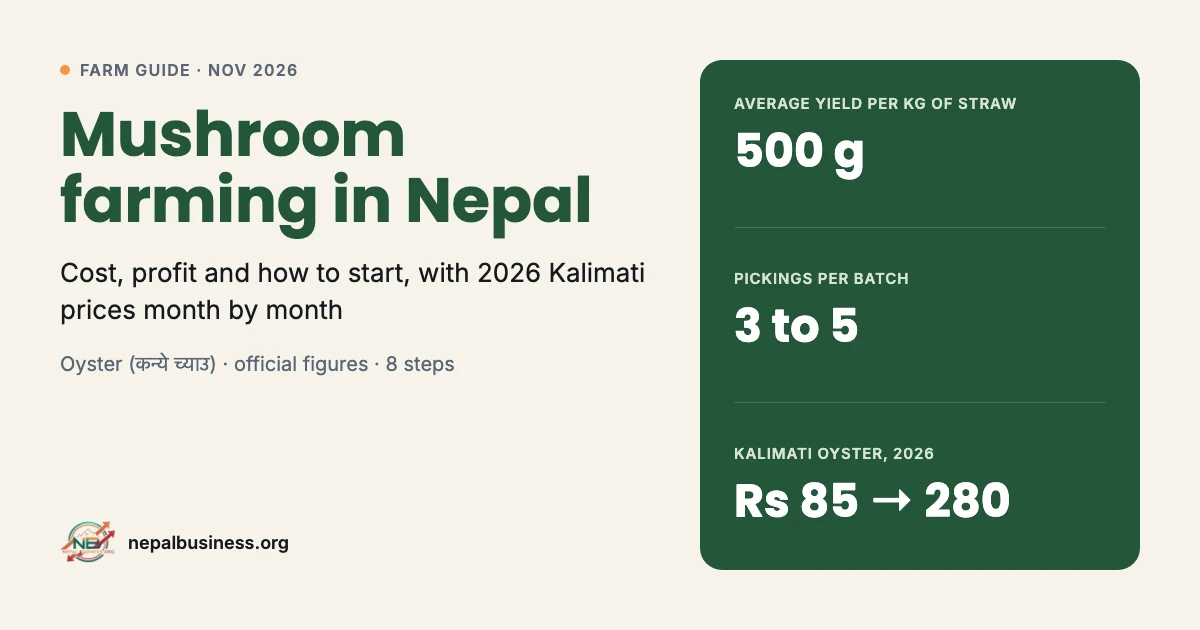
Oyster mushroom (कन्ये च्याउ) is the easiest mushroom to start with in Nepal. It grows on chopped rice straw in a shaded room. Spawn costs Rs 310 to Rs 450 a kg, and one kilogram of straw gives about 500 g of mushroom on average, or 1 kg for skilled growers, according to the Bagmati Province Agriculture Training Centre.
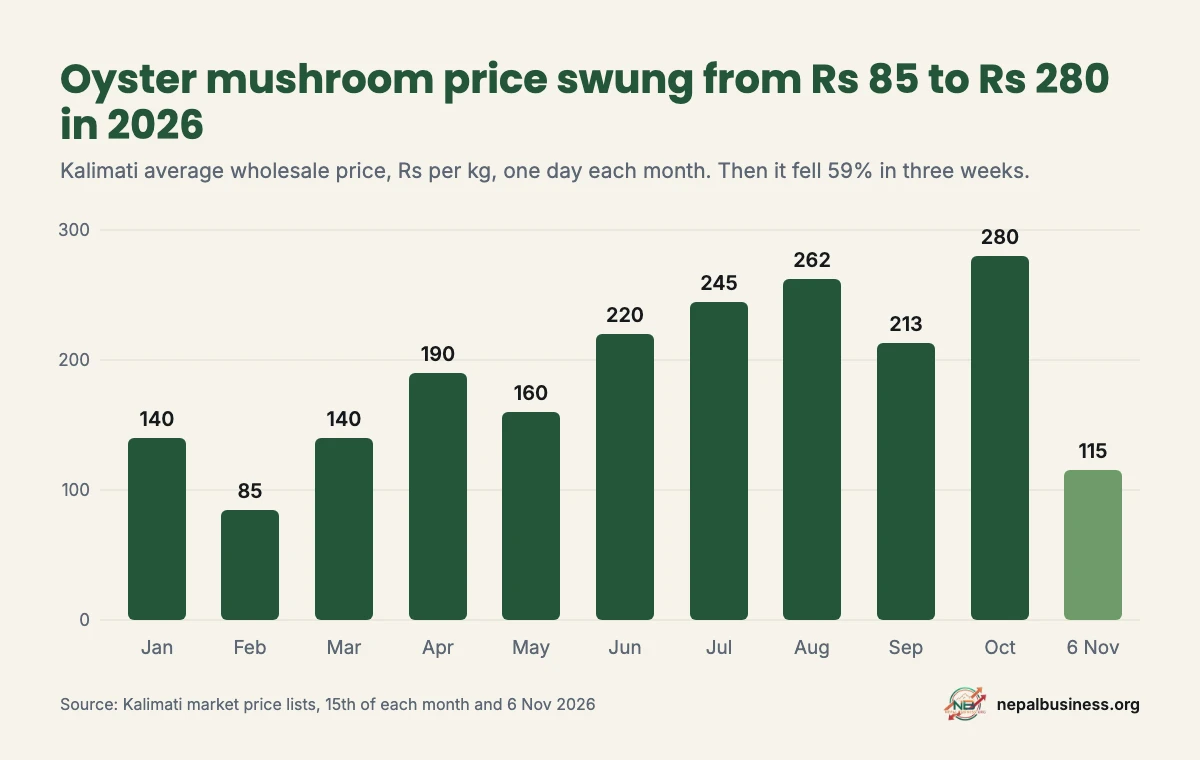
The hard part is price. At Kalimati, the wholesale price of oyster mushroom moved between Rs 85 and Rs 280 a kg in 2026, and it fell 59% in three weeks this autumn. The same harvest can earn more than three times as much in one month as in another, so plan when and where you will sell before you start.
Is mushroom farming profitable in Nepal in 2026?
It can be, but the money is in selling well. About 35,000 farmers grow mushrooms in Nepal, and the government marked its first National Mushroom Day on 15 Poush 2082 to promote eating and exporting more of them. In fiscal year 2081/82, Nepal exported 17,198 kg of mushrooms worth about Rs 1.01 crore and imported 2,262 kg of fresh button mushroom worth about Rs 6.71 lakh, with dried mushroom exports rising, OnlineKhabar reported. Mushrooms still make up only 0.15% of Nepal's agricultural output.
The catch is how much the price moves. We pulled Kalimati's official price list for one day in each month of 2026:
| Date (2026) | Oyster (कन्य) | Button (डल्ले) |
|---|---|---|
| 15 Jan | Rs 140 | Rs 460 |
| 15 Feb | Rs 85 | Rs 365 |
| 15 Mar | Rs 140 | Rs 375 |
| 15 Apr | Rs 190 | Rs 375 |
| 15 May | Rs 160 | Rs 353 |
| 15 Jun | Rs 220 | Rs 338 |
| 15 Jul | Rs 245 | Rs 388 |
| 15 Aug | Rs 262 | Rs 380 |
| 15 Sep | Rs 213 | Rs 525 |
| 15 Oct | Rs 280 | Rs 475 |
| 6 Nov | Rs 115 | Rs 280 |
Average wholesale price per kg on each date, from the Kalimati Fruits and Vegetables Market price lists. See today's prices on our daily prices page.
In 2026, oyster mushroom was cheapest from November to March and dearest from June to October. Across these 11 dates the average was about Rs 186 a kg. The price fell from Rs 280 on 15 October to Rs 115 on 6 November, a drop of 59% in about three weeks.
Which mushroom should a beginner grow?
| Type | Kalimati 2026 | Spawn |
|---|---|---|
| Oyster (कन्ये) | Rs 85–280 | Rs 310–450/kg |
| Button (गोब्रे/डल्ले) | Rs 280–525 | Rs 600/kg |
| King oyster (राजा) | Rs 290–318 | Ask seller |
| Shiitake (सिताके) | Rs 800–1,000 | Rs 600–800/kg |
Spawn prices from Mushroom Seed Nepal and Research Center, checked 6 November 2026. Oyster: Rs 450 for 1 kg, Rs 3,100 for 10 kg (bags included). Shiitake: Rs 800 for 1 kg, Rs 6,000 for 10 kg.
- Oyster grows on chopped rice straw (wheat, maize or mustard stalks also work) and needs little equipment. Start here.
- Button sells for more, but it needs compost that takes 28 to 45 days to prepare and a cool 15 to 18 °C room to fruit, according to Suryodaya Municipality's farming guide. Treat it as a second step.
- Shiitake sells for Rs 800 or more, but it is slow and costly to start. A Khotang farmer grows it on 1,000 wooden logs that cost Rs 700 each, Rs 7 lakh in total. He started three years ago, earned his first Rs 2.4 lakh last year from 300 kg sold at Rs 800, and expects real profit only from next year, eKantipur reported in December 2025.
How much does it cost to start a mushroom farm in Nepal?
Oyster mushroom has three kinds of cost.
1. Spawn (seed)
The Bagmati Province Agriculture Training Centre's guide says you need 1.25 kg of spawn for every 50 to 60 kg of straw. For 100 kg of straw that is about 2.1 to 2.5 kg of spawn: around Rs 650 to Rs 775 at the 10 kg-pack rate, or Rs 1,350 if you buy three 1 kg packs.
2. Straw and running costs
We could not find any published price per kg of straw in Nepal, recent or old, so ask local farmers or straw sellers before you budget. Two Nepali studies from 2021 show where the money goes:
- A survey of 30 oyster mushroom farmers in Chitwan found that spawn made up about 77% of total costs and straw about 9% (Acharya and Tiwari, 2021).
- Farmers in Chandragiri, Kathmandu, said straw has to be brought from the Terai and is costly to transport, and that poor-quality straw lowers their harvest (Acharya and Dhungel, 2021).
These figures are from 2021. Prices have risen since then, so expect your 2026 costs to be higher. The official guide notes that pre-cut straw is now sold in markets. Also budget for fuel to heat water for treating the straw, plastic bags, rope, water, packing and transport.
3. Room and equipment (one time)
A clean, shaded room you can keep humid, plus:
- a sickle or cutter to chop straw
- a drum and a fire or stove to soak straw in hot water (or a steam set-up)
- plastic bags (the guide suggests 12 × 18 or 16 × 26 inches) and strong rope
- a hand sprayer for watering
- a thermometer and humidity meter
Prices for these vary by town, so get two or three local quotes. Start in a room you already have before you think about a plastic tunnel.
How much can one batch of oyster mushroom earn?
Here is what 100 kg of straw can bring in, using the official average yield (500 g per kg of straw), the skilled-grower yield (1 kg per kg) and three real 2026 Kalimati prices:
| Price per kg | 50 kg harvest | 100 kg harvest |
|---|---|---|
| Rs 115 (6 Nov) | Rs 5,750 | Rs 11,500 |
| Rs 186 (2026 avg) | Rs 9,300 | Rs 18,600 |
| Rs 280 (15 Oct) | Rs 14,000 | Rs 28,000 |
These are sales, not profit. From them, take away your spawn (about Rs 650 to Rs 1,350), straw, fuel, bags, transport and your own time. Kalimati prices are wholesale prices at the Kathmandu market; what you receive depends on where and to whom you sell.
Two things stand out. Skill doubles the harvest from the same straw. And the month you sell can more than double the price. A beginner selling an average harvest in November earns about a fifth of what a skilled grower earns selling in October.
Work out your own numbers
- Straw you will use (kg) × 0.5 = your likely harvest in kg as a beginner.
- Harvest × the price your buyer will actually pay = your sales.
- Sales − spawn − straw − fuel − bags − transport = your profit for the batch.
How to start a mushroom farm in Nepal: 8 steps
- Get trained first. Ask your municipality's agriculture section or the nearest Agriculture Knowledge Centre (कृषि ज्ञान केन्द्र) about training. Spend a day on a working farm before you buy anything.
- Find buyers before you grow. Ask restaurants, hotels and vegetable shops near you what they pay, how much they need each week and how they want it packed. Kalimati is your fallback.
- Prepare the room. Oyster mushroom grows at 20 to 28 °C. Cool-season varieties suit 18 to 22 °C and warm-season varieties 22 to 30 °C, so choose your variety for your season. Keep humidity around 70 to 80%.
- Buy spawn from a known producer. The official guide warns that spawn quality varies in Nepal because producers import their starter cultures from many countries, and this changes yields. Buy from growers other farmers recommend.
- Prepare the straw. Cut clean, dry, mould-free straw into pieces 3 to 4 fingers long. Soak it in water heated to 60 to 80 °C for half an hour (or treat it with steam), then drain it until a squeezed handful wets your hand but does not drip.
- Fill and incubate the bags. Fill the bags in layers 2 to 3 fingers thick, with about a spoonful of spawn around the edge of each layer. Tie the bags tightly, make small air holes, and keep them in a warm, dark room. In 20 to 22 days the straw turns white.
- Grow and harvest. Cut open or remove the plastic and water lightly once or twice a day. Small mushrooms appear in 4 to 5 days and are ready about 4 to 5 days later. Pick by holding the base and twisting gently. You can pick 3 to 5 times, 7 to 10 days apart.
- Sell fresh, dry the surplus. Fresh mushrooms do not keep long, so plan sales before each picking. Dried oyster sells too: one Bhaktapur seller lists 200 g at Rs 300. If you sell packaged or dried products, read our guide to selling food online in Nepal for the licence rules.
What are the biggest risks in mushroom farming?
- Price swings. In 2026 the Kalimati oyster price ranged from Rs 85 to Rs 280 and fell 59% in about three weeks.
- Infection in the bags. Mould and flies can spoil bags; the Kathmandu Post notes that infections in plastic bags can cut production. Clean straw treatment and a clean room are your best defence.
- Middlemen. Kathmandu growers surveyed in 2021 said middlemen took about half of the market price. Selling direct keeps more of it for you.
- Uneven spawn. Spawn quality varies between producers, which changes yields.
- Poor air. If the room lacks fresh air, caps do not open, stems grow long and the price you get falls, the official guide says.
- Wild mushrooms. Never sell wild mushrooms alongside your crop. Studies cited by OnlineKhabar count about 100 poisonous species in Nepal.
What government support is there for mushroom farmers?
- Agriculture Knowledge Centres give technical help and, in some districts, subsidies. In Dadeldhura the centre supports commercial growers with straw, plastic tunnels and water tanks, eKantipur reported in December 2025. One grower there produces about 20,000 kg a year worth up to Rs 40 lakh, and sells about Rs 10 lakh of spawn a year.
- Provincial governments co-fund larger projects. In Khotang, the province put Rs 13 lakh into a Rs 29 lakh mushroom spawn centre in fiscal year 2079/80.
- NARC training. The Nepal Agricultural Research Council at Khumaltar trained farmers from Khotang, Ilam, Kathmandu, Rukum, Rolpa and Doti to produce mushroom spawn; the Khotang farmer now makes his own shiitake spawn instead of importing it.
- Your municipality. Local agriculture programmes are set each fiscal year, which begins on 1 Shrawan (mid-July), so ask your ward or municipality early in the year what is on offer and what documents they need.
Thinking of making spawn yourself? The official guide puts a farmer-level spawn lab at about Rs 8 to 10 lakh and a commercial one at Rs 25 to 30 lakh. For loans, see our guide to business loans for startups in Nepal.
Tips from the numbers
- Do not judge the business on a winter batch. November to March had the lowest prices in 2026.
- Learn before you scale. Going from 500 g to 1 kg of mushroom per kg of straw doubles your harvest at no extra cost.
- Sell direct where you can. The gap between Rs 115 and Rs 280 is bigger than anything you can save on inputs.
- Keep records from day one. Note straw, spawn, kilograms picked and money received for each batch. Our AI prompts for businesses include prompts that turn notebook records into a clean sheet.
Frequently asked questions
Is mushroom farming profitable in Nepal?
It can be, mainly if you sell well. In 2026 the Kalimati price of oyster mushroom ranged from Rs 85 to Rs 280 a kg, and a skilled grower gets twice the harvest of a beginner from the same straw. Plan buyers and timing first.
How much mushroom does 1 kg of straw give?
About 500 g of oyster mushroom on average, and 1 kg or more for experienced growers, according to the Bagmati Province Agriculture Training Centre.
Which mushroom is best for beginners in Nepal?
Oyster mushroom (कन्ये च्याउ). It grows on straw, needs simple equipment, and you can pick it 3 to 5 times from one batch.
What is the price of mushroom in Nepal today?
On 6 November 2026, Kalimati's wholesale price was Rs 100 to Rs 130 a kg for oyster, Rs 260 to Rs 300 for button and Rs 800 to Rs 1,000 for shiitake. Check today's price on our prices page.
When does oyster mushroom sell for the most?
In 2026, Kalimati prices were highest from June to October (Rs 213 to Rs 280) and lowest from November to March (Rs 85 to Rs 140).
How long does one batch take?
About 20 to 22 days for the spawn to spread through the straw, then 8 to 10 days to the first picking, then 3 to 5 pickings 7 to 10 days apart. Plan for roughly two to three months per batch.
Where can I buy mushroom spawn in Nepal?
From spawn producers in the Kathmandu Valley and in many districts. Ask your Agriculture Knowledge Centre and other growers which producers they trust.
Related guides
- Poultry farming in Nepal: cost, profit and how to start
- How to sell food online in Nepal
- How much it costs to start a business in Nepal
- Business loans for startups in Nepal
Sources
- Kalimati Fruits and Vegetables Market Development Board, daily wholesale price lists (dates in the table, collected 6 November 2026)
- Bagmati Province Agriculture Training Centre, Bhandara, च्याउको उत्पादन प्रविधि (mushroom production technology)
- Suryodaya Municipality, vegetable crops: mushroom (FAQ)
- Mushroom Seed Nepal and Research Center, spawn and product prices (checked 6 November 2026)
- OnlineKhabar, first National Mushroom Day, farmer numbers and trade figures (15 Poush 2082)
- eKantipur, Dadeldhura mushroom farmers (13 December 2025)
- eKantipur, Khotang shiitake farmer (28 December 2025)
- The Kathmandu Post, Mushroom farming: from cultural taboo to a thriving enterprise (29 January 2025)
- Acharya, R. and Tiwari, U., Economic analysis of mushroom enterprise in Chitwan district, Nepal, Archives of Agriculture and Environmental Science 6(4), 2021
- Acharya, K. R. and Dhungel, B. D., Problems and prospectus of mushroom farming in Nepal, Management Dynamics 24(1), Tribhuvan University, 2021
Join the Discussion
Share your thoughts and engage with our community.
Loading comments...
Log in to join the discussion
Register on the platform, verify your email, then comment on this article.