
50 AI Prompts for Nepali Businesses: Copy, Paste and Save Hours (2026)
Ready-to-use ChatGPT, Claude and Gemini prompts for posts, customer replies, pricing, bookkeeping, staff and official letters, with Nepali versions

Last updated: 6 November 2026. AI plans and prices change often, so check the price shown in your own account before you pay.
Quick answer
A good AI prompt tells the AI who it is, what you sell, who the customer is, and what you want back. The 50 prompts below already do that. Copy one, replace everything in [square brackets] with your own details, and paste it into ChatGPT, Claude or Gemini. The free version of any of the three is enough for almost all of them.
They are grouped by job: social media posts, customer messages, product listings, pricing, bookkeeping, staff, official letters, foreign clients and planning. Prompts marked नेपाली also have a Nepali version you can paste instead.
New to AI tools? Start with our guide to 10 practical ways to use AI in a Nepali small business, then come back here for the exact words to type.
How do you use these prompts?
- Fill every bracket. "[your shop]" should become "Sharma Kirana Pasal, Lalitpur". The more real detail you give, the less generic the answer.
- Say what is wrong and ask again. If the first answer is too long or too formal, reply "shorter", "simpler Nepali" or "sound like a friendly shopkeeper, not a company". This works better than starting over.
- Check facts and numbers yourself. AI can add up wrongly, invent a law or quote an old fee. Anything about tax, fees or rules must be checked on the official website or with your accountant.
- Save the prompts that work. Keep your edited versions in a phone note or a Google Doc so next month takes two minutes.
You can write any prompt in Nepali, in English, or in Romanized Nepali (Nepali typed in English letters). Ask for the answer in the script your customers use. Most Facebook customers in Nepal write Romanized Nepali, while printed notices and official letters should be in Devanagari.
Do you need a paid AI plan?
Usually no. The free versions limit how many messages you can send in a few hours, and some give you a smaller model, but every prompt in this list works on a free account. Pay only when you hit the limit most days, or when you often upload long files, many bill photos or spreadsheets.
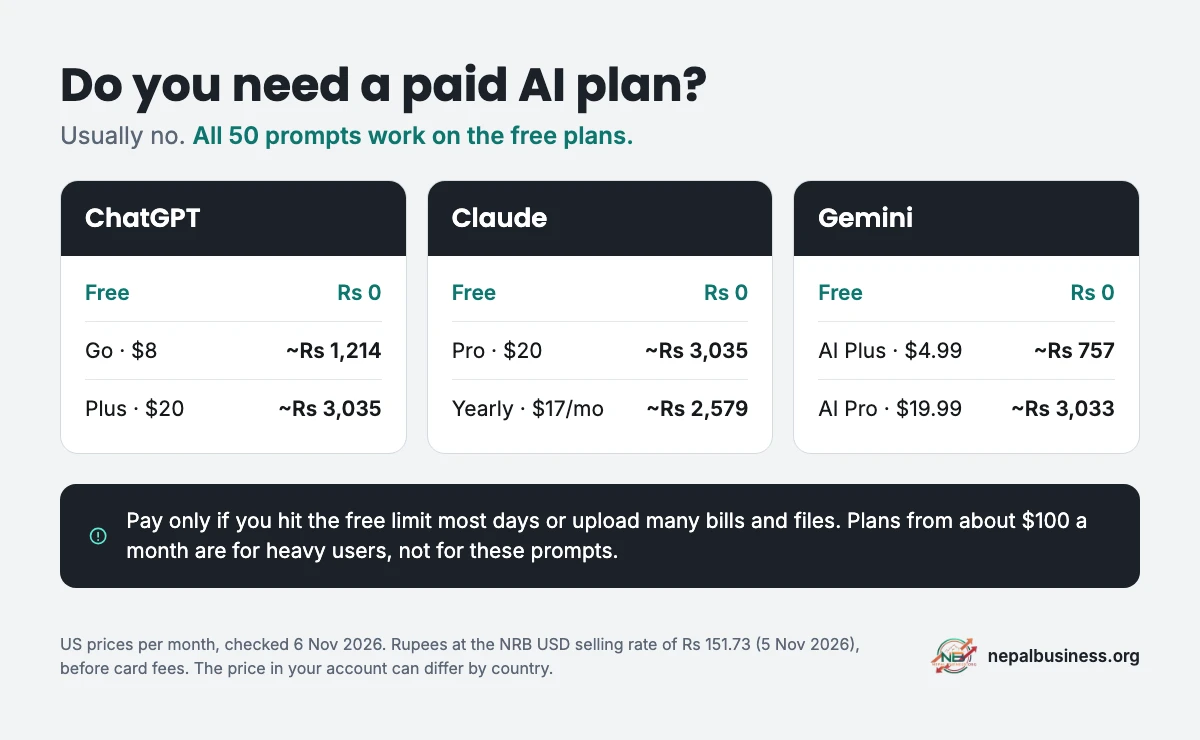
| Plan | USD/month | About Rs |
|---|---|---|
| ChatGPT Free | $0 | 0 |
| ChatGPT Go | $8 | 1,214 |
| ChatGPT Plus | $20 | 3,035 |
| Claude Free | $0 | 0 |
| Claude Pro | $20 | 3,035 |
| Claude Pro, yearly | $17 | 2,579 |
| Gemini Free | $0 | 0 |
| Google AI Plus | $4.99 | 757 |
| Google AI Pro | $19.99 | 3,033 |
US prices, checked 6 November 2026. Rupee amounts use the Nepal Rastra Bank USD selling rate of Rs 151.73 (5 Nov 2026) and do not include your bank's card fees. Claude Pro yearly is billed as $200 once a year. Prices can differ by country, so check the price shown in your own account before you pay. Plans from about $100 a month (ChatGPT Pro, Claude Max, Google AI Ultra) are for heavy users; you do not need them for these prompts.
Paying from Nepal needs a dollar card or an international card. Our AI for small business guide explains the options.
Social media prompts (1–8)
1. Plan a week of Facebook posts
I run [type of business] called [name] in [city], Nepal. My customers are mostly [who: e.g. college students, office workers, mothers buying for family]. Plan 7 Facebook posts for next week. Mix: 2 offers, 2 useful tips related to what I sell, 1 behind-the-scenes post, 1 customer story, 1 question to start comments. For each post give: the day, the post text in Romanized Nepali (under 60 words), and an idea for the photo I should take with my phone.2. Write a short video script (नेपाली)
Write a 30-second TikTok/Reels script for my [product or service] in [city]. Start with a hook in the first 3 seconds that makes people stop scrolling. Then show the problem, the product, and the price (Rs [price]). List each shot I should film on my phone, the words I say, and the text to put on screen. End with a clear call to action: [order on Messenger / visit our shop / call]. Write the spoken lines in simple Nepali.नेपाली:
मेरो [सामान वा सेवा] को लागि ३० सेकेन्डको टिकटक/रिल्स स्क्रिप्ट लेखिदिनुहोस्। पहिलो ३ सेकेन्डमै मान्छेलाई रोक्ने कुरा राख्नुहोस्। त्यसपछि समस्या, सामान र मूल्य (रु [मूल्य]) देखाउनुहोस्। मैले फोनमा खिच्नुपर्ने हरेक दृश्य, बोल्ने शब्द र स्क्रिनमा लेख्ने अक्षर छुट्टाछुट्टै लेख्नुहोस्। अन्त्यमा "[मेसेन्जरमा अर्डर गर्नुहोस् / पसलमा आउनुहोस्]" भन्नुहोस्। सरल नेपाली भाषा प्रयोग गर्नुहोस्।3. Festival or occasion post
Write 3 short Facebook posts for [festival or occasion: Tihar, Teej, Chhath, Nepali New Year, Valentine's Day, school admission season] for my [business]. One wishes customers only (no selling). One announces our offer: [offer details, last date]. One reminds people 1 day before the offer ends. Keep the tone warm and local, not like a big company. Suggest 1 photo idea for each.4. Facebook ad in three versions
I want to boost a Facebook post with a budget of Rs [amount] for [number] days. Product: [product, price]. Target customer: [age, area, interest]. Write 3 different versions of the ad: one that leads with the price, one that leads with the problem it solves, and one that leads with a customer review. For each, give a headline (under 8 words), the main text (under 40 words) and the button I should choose. Then tell me which version you would test first and why.5. Caption and hashtags
Write an Instagram caption for this photo: [describe the photo]. Business: [name, city]. Keep it under 30 words in Romanized Nepali, add one emoji at most, and end with a question. Then give 8 hashtags: 3 about Nepal or my city, 3 about the product, and 2 that are small and specific (not huge ones like #love).6. Reply to a bad public comment
A customer posted this comment on our Facebook page: "[paste comment]". What actually happened: [your side, honestly]. Write a short public reply that stays calm, says sorry for their experience without blaming them, shows we take it seriously, and invites them to message us to fix it. Do not argue or share private details. Give one version in English and one in Romanized Nepali.7. One post, four platforms
Here is a Facebook post I already wrote: "[paste post]". Rewrite it for: 1) an Instagram caption, 2) a 15-second TikTok voice-over, 3) a WhatsApp status (under 20 words), 4) a WhatsApp broadcast message to regular customers (friendly, under 50 words, with how to order). Keep the same offer and facts.8. Turn a review into a post
A customer sent us this review (they agreed we can share it): "[paste review]". Turn it into a Facebook post that thanks them, highlights the one thing they liked most, and gently invites new customers to try [product or service]. Do not exaggerate or add anything they did not say. Under 50 words.Customer message prompts (9–16)
9. Quick replies for WhatsApp Business (नेपाली)
I sell [products] from [city]. Write 8 WhatsApp Business quick replies for these questions: price list, delivery inside Kathmandu Valley, delivery outside the valley, payment (eSewa, Khalti, bank transfer, cash on delivery), shop location and hours, return or exchange, stock available or not, and how long delivery takes. For each, give a short shortcut name (like /price) and the reply in Romanized Nepali, under 300 characters. Use these facts: [delivery charges, hours, return rule, payment details without account numbers].नेपाली:
म [शहर] बाट [सामान] बेच्छु। ह्वाट्सएप बिजनेसका लागि यी प्रश्नहरूको छोटो तयार जवाफ लेखिदिनुहोस्: मूल्य सूची, उपत्यकाभित्र डेलिभरी, उपत्यका बाहिर डेलिभरी, भुक्तानी (इसेवा, खल्ती, बैंक, क्यास अन डेलिभरी), पसलको ठेगाना र समय, फिर्ता वा साटफेर, स्टक छ कि छैन, र डेलिभरी कति दिनमा हुन्छ। हरेक जवाफको लागि /price जस्तो छोटो नाम र ३०० अक्षरभन्दा छोटो जवाफ दिनुहोस्। यी जानकारी प्रयोग गर्नुहोस्: [डेलिभरी शुल्क, समय, फिर्ता नियम]।10. Greeting and away message (नेपाली)
Write two automatic messages for my business [name]. 1) A greeting for people who message us for the first time: thank them, say what we sell, and ask what they are looking for. 2) An away message for when we are closed ([closed hours and days]): say when we will reply and how to order anyway. Both under 40 words, friendly, in Nepali (Devanagari) and Romanized Nepali.नेपाली:
मेरो व्यवसाय [नाम] का लागि दुई वटा स्वचालित सन्देश लेखिदिनुहोस्। १) पहिलो पटक सन्देश पठाउनेलाई: धन्यवाद भन्ने, हामी के बेच्छौँ भन्ने, र उहाँलाई के चाहिएको हो सोध्ने। २) पसल बन्द हुँदा ([बन्द हुने समय र दिन]): कहिले जवाफ दिन्छौँ र अहिले पनि कसरी अर्डर गर्न सकिन्छ भन्ने। दुवै ४० शब्दभन्दा छोटो र मिलनसार भाषामा।11. Say sorry for a late delivery
A customer's order [order details] was promised for [date] but will arrive on [new date] because [honest reason]. They are upset. Write a short message that apologises clearly, gives the new date, and offers one of these: [free delivery next time / Rs X off / cancel with full refund]. Sound sincere, not robotic. Romanized Nepali, under 60 words.12. Remind someone who owes you money (नेपाली)
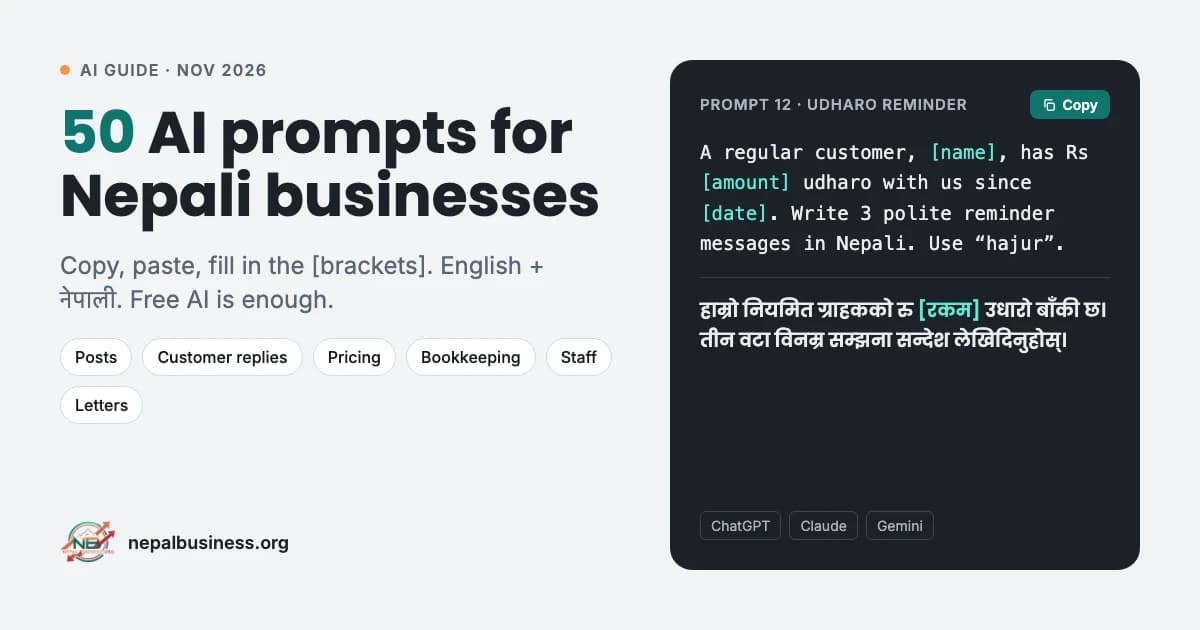
A regular customer, [name], has Rs [amount] udharo (credit) with us since [date]. I want to keep the relationship good. Write 3 reminder messages: a gentle first reminder, a clearer second one a week later, and a firm but polite final one that asks for a payment date. Include our payment options: [eSewa / Khalti / bank / cash]. Nepali, respectful (use "hajur").नेपाली:
हाम्रो नियमित ग्राहक [नाम] को [मिति] देखि रु [रकम] उधारो बाँकी छ। सम्बन्ध नबिग्रने गरी तीन वटा सम्झना सन्देश लेखिदिनुहोस्: पहिलो नरम सम्झना, एक हप्तापछि अलि स्पष्ट दोस्रो, र भुक्तानी गर्ने मिति माग्ने विनम्र तर दृढ अन्तिम सन्देश। भुक्तानीका तरिका पनि राख्नुहोस्: [इसेवा / खल्ती / बैंक / नगद]। "हजुर" प्रयोग गरी आदरपूर्वक लेख्नुहोस्।13. Order confirmation message
Make a message template I can copy for every order. It should confirm: customer name, items and quantity, total in Rs, delivery charge, payment method, delivery address and the expected delivery day, and ask the customer to reply "OK" to confirm. Keep blanks like [NAME] that I fill in. Short lines, easy to read on a phone, Romanized Nepali.14. Understand a confusing message
A customer sent me this message and I am not sure what they want: "[paste message]". First, explain in one line what they are probably asking for. Then list anything that is unclear. Then write a short reply that answers what we can and politely asks about the unclear part. My business: [type, what we sell].15. Find your most common questions
Below are customer messages from the last month (names and phone numbers removed). Group them into the 10 most common questions, from most to least frequent. For each, write a clear standard answer using our facts: [prices, delivery, hours, return rule]. I will use these in Facebook page FAQs and WhatsApp quick replies.

[paste messages]
16. Follow up with people who asked but did not buy
Many people message us asking the price of [product] and then go quiet. Write 3 different follow-up messages I can send 1–2 days later. They should be friendly, not pushy, answer a doubt they might have (quality, size, delivery time, trust), and give one easy next step. Under 40 words each, Romanized Nepali. Never pretend stock is running out if it is not.Set up automatic replies in 5 steps
The AI writes the messages; your Facebook page and WhatsApp send them. Neither step costs money.
- Run prompts 9, 10 and 15 and edit the answers until they sound like you.
- Facebook and Instagram: open Meta Business Suite, go to Inbox, then Automations. Turn on an instant reply (use the greeting from prompt 10), an away message, and frequently asked questions (use prompt 15).
- In the same inbox, save your quick answers from prompt 9 as saved replies so you can insert them with one tap.
- WhatsApp Business app: open Business tools. Set the greeting message and away message, then add quick replies with the shortcut names from prompt 9. Typing "/" in a chat then shows them.
- Read your inbox every day anyway. Complaints, refunds and anything about money should always get a reply from a real person.
Menu names can change a little between app versions.
Product and listing prompts (17–22)
17. Online shop or Daraz listing
Write a product listing for [product] for my online store / Daraz shop. Details: [size, material, color, what is in the box, price, warranty]. Give: 1) a title that uses the words a Nepali buyer would actually search, with no ALL CAPS and no fake claims, 2) 5 short highlight points, 3) a description of about 100 words, 4) 5 search keywords. Do not invent features I did not list.18. Phone photo shot list
I sell [product] and take photos with a [phone model] in [where: small shop, home]. Give me a shot list of 6 photos that will help it sell online: angles, background, light (I have [window light / tube light]), what to place next to it to show size, and one lifestyle photo idea. Keep the equipment under Rs 1,000 total.19. Stand out from a competitor
Here is how a competitor describes a similar product: "[paste their description]". Here is mine: "[paste yours]". Price: theirs Rs [X], mine Rs [Y]. Tell me honestly where mine looks weaker, then list 3 real differences I can point out (only from the facts I gave). Rewrite my description to make those differences clear, without attacking the competitor.20. Size chart and care guide (नेपाली)
Make a simple size chart for [clothing or shoe type] using these measurements: [paste measurements]. Then write care instructions (washing, drying, ironing, storage) for [material]. Give both in English and Nepali (Devanagari), formatted so I can put them on a card inside the package.21. Menu descriptions
I run a [café / restaurant / momo shop] in [area]. Write menu descriptions for these items: [list items and main ingredients]. Each one: name in English and Nepali, a description under 15 words that makes it sound tasty but true, and a mark for veg, non-veg and spicy. Suggest which 3 items to highlight as "house special" based on [your best sellers or profit].22. Business or product name ideas
Suggest 15 names for my [business or product] in [city]. It sells [what] to [who]. I want names that are easy to say in Nepali and English, easy to spell when someone searches on Facebook, and not too similar to big brands. For each name, give one line on the feeling it creates. Remind me to check the name with the Office of the Company Registrar and on Facebook before I use it.Pricing and costing prompts (23–27)
For any prompt that uses your numbers, ask the AI to "show the calculation step by step" and check one line with a calculator. Our discount calculator and percentage calculator help.
23. How many sales to break even
My monthly fixed costs: rent Rs [X], salaries Rs [X], electricity and internet Rs [X], loan EMI Rs [X], other Rs [X]. I sell [product] at Rs [price], and each one costs me Rs [cost] in materials and packaging. Show step by step: 1) my profit on each unit, 2) how many units I must sell per month and per day to cover fixed costs, 3) how many to earn Rs [target] profit a month. Then give 3 ways to reach that number faster.24. Retail and wholesale prices
My cost for [product] is Rs [cost] per piece. Retail price is Rs [price]. Shops want to buy from me wholesale. Suggest a wholesale price for 10+, 50+ and 100+ pieces that still leaves me at least [X]% margin, and show the profit per piece at each level. Also write a short price list message I can send to shopkeepers.25. Is this discount worth it?
I sell [product] at Rs [price] with a cost of Rs [cost]. I want to give [X]% off for [occasion]. Calculate step by step: my new profit per unit, and how many more units I must sell to make the same total profit as without the discount. Normally I sell [number] per week. Tell me plainly if this discount is a good idea, and suggest one alternative (like a free gift or bundle) that protects my margin.26. Announce a price increase
I have to raise the price of [product] from Rs [old] to Rs [new] from [date] because [honest reason: supplier price, fuel, rent]. Write a short Facebook post and a WhatsApp message for regular customers. Be honest and brief, thank them, and give them a reason to buy now at the old price before [date]. No drama, no long excuses.27. Delivery charges by area
I deliver from [area] using [own bike / rider company / courier]. My costs: [fuel per trip, rider pay, courier rates by district]. Help me set simple delivery charges for: inside my area, rest of Kathmandu Valley, and outside the valley. Show my cost vs the charge for each, suggest a free-delivery minimum order amount, and write it as a short table I can post.Bookkeeping prompts (28–33)
AI is good at tidying messy records into tables. It is not your accountant. Use these to get your records ready, then let a registered accountant or tax professional handle VAT returns and tax filing. Read every number the AI copies from a photo, because it can misread handwriting.
28. Bill photo to table
I am uploading photos of purchase bills. For each bill, put one row in a table with these columns: date (as written on the bill), seller name, seller PAN/VAT number, bill number, items in short, amount before VAT, VAT amount, total. If something is unclear or cut off, write "CHECK" in that cell instead of guessing. At the end, give the total of each money column.29. Notebook sales to a Google Sheet
Here are my daily sales from my notebook, written however I wrote them: [paste or type]. Turn them into a table I can paste into Google Sheets with columns: date, item, quantity, price per unit, total, payment method (cash / QR / credit). Then tell me the exact formulas to add for: daily total, monthly total, and total by payment method.30. Monthly profit summary
Here is my sales and expense data for [month]: [paste the table]. Give me: total sales, total expenses by category, profit, profit as a percent of sales, my 3 biggest expenses, and how this month compares with [last month's numbers if you have them]. Then 3 short, practical suggestions. Show your calculations so I can check them.31. Sort a bank or wallet statement
Below is my bank / eSewa / Khalti statement for [month] (I removed account numbers). Put each transaction into one category: sales received, stock purchase, rent, salary, utilities, transport, loan payment, owner's personal use, other. Show a total for each category. List any transaction you could not place so I can check it.

[paste statement]
32. Get ready for your accountant
I run [business type], [VAT registered / PAN only]. My accountant does my monthly VAT and yearly tax. Based on the table below, list: 1) bills that look like they are missing a PAN/VAT number or bill number, 2) months that look incomplete, 3) questions I should ask my accountant this month. Do not tell me how much tax I owe; just help me prepare.

[paste table]
33. Credit (udharo) list
Here is my udharo list: customer name, amount, date given, any partial payments: [paste]. Make a clean table sorted by oldest unpaid first. Add a column for days overdue and a column for total still due. Mark anyone over [60] days. Then give me the total money outside the business and suggest a simple rule for giving credit next time.Staff and hiring prompts (34–38)
34. Job ad
Write a job ad for a [position] at my [business] in [area]. Duties: [list]. Hours: [hours, days off]. Salary: Rs [range] plus [meals, festival bonus, other]. Must have: [skills]. Nice to have: [skills]. Write a short Facebook version in Nepali and a longer version in English for job sites. Include how to apply. Do not add requirements I did not mention.35. Interview questions
I am hiring a [position] for my [business]. Give me 8 interview questions: 3 about past experience, 3 "what would you do if..." situations from real life in my kind of business (for example [a customer shouts / cash does not match / stock goes missing]), and 2 about reliability. For each, tell me what a good answer and a worrying answer sound like.36. Simple staff rules (नेपाली)
Write simple, fair staff rules for my [business] with [number] staff, on one page in Nepali. Cover: working hours and late arrival, leave and how to ask for it, phone use during work, handling cash, cleanliness, how we talk to customers, and what happens if a rule is broken. Respectful tone, short points, easy to print and put on the wall.नेपाली:
[संख्या] जना कर्मचारी भएको मेरो [व्यवसाय] का लागि एक पानाको सरल र न्यायपूर्ण नियम नेपालीमा लेखिदिनुहोस्। यसमा कामको समय र ढिलो आउँदा, बिदा र बिदा माग्ने तरिका, कामको बेला फोन प्रयोग, नगद व्यवस्थापन, सरसफाइ, ग्राहकसँग बोल्ने तरिका, र नियम तोडेमा के हुन्छ भन्ने कुरा समेट्नुहोस्। आदरपूर्ण भाषा, छोटा बुँदा, भित्तामा टाँस्न मिल्ने गरी।37. Train a new staff member
Make a first-week training plan for a new [position] at my [business]. Day by day: what they learn, who teaches them, and a small task to show they understood. Include 5 common customer situations with the right way to handle each, written as short role-play scripts in Romanized Nepali.38. Weekly shift roster
Make a weekly shift roster for [number] staff: [names and when each cannot work]. The shop is open [hours, days]. At least [number] people must be there at busy times ([busy hours]). Each person needs one day off a week and no more than [X] hours a week. Show it as a table, then point out any day where the rules cannot all be met.Bank, loan and government prompts (39–42)
AI can draft and explain. It cannot tell you the current fee or the exact document list for an office, because those change. Always confirm on the office's own website or by phone. Our guides to company registration in Nepal and business loans for startups list the official sources.
39. Ward office application (नेपाली)
Write a formal application in Nepali to the ward office of [municipality], ward no. [number], asking for a recommendation letter (सिफारिस) for [purpose: business registration / bank loan / address proof]. My details: [name, address, business name]. Use the normal format: date in Bikram Sambat, "श्रीमान् वडा अध्यक्षज्यू", subject line, short body, list of attached documents, and my name and signature line at the bottom.नेपाली:
[नगरपालिका] वडा नं. [नम्बर] को वडा कार्यालयमा [प्रयोजन: व्यवसाय दर्ता / बैंक ऋण / ठेगाना प्रमाणित] का लागि सिफारिस माग्ने औपचारिक निवेदन नेपालीमा लेखिदिनुहोस्। मेरो विवरण: [नाम, ठेगाना, व्यवसायको नाम]। सामान्य ढाँचा प्रयोग गर्नुहोस्: विक्रम संवत्मा मिति, "श्रीमान् वडा अध्यक्षज्यू", विषय, छोटो व्यहोरा, संलग्न कागजातको सूची, र तल निवेदकको नाम र दस्तखत गर्ने ठाउँ।40. Explain a government notice in plain words
Here is a notice / circular I received: "[paste text or upload photo]". Explain in simple words: 1) what it is about, 2) whether it applies to a business like mine ([type, size, VAT or PAN]), 3) what I need to do and by when, 4) what happens if I do not. If anything is unclear in the notice, say so. Do not guess deadlines that are not written in it.41. Checklist before an office visit
I need to [task: renew my business registration / change my shop address / register for VAT] in [city]. Make a checklist of the documents and photocopies people usually need, questions to ask at the counter, and things to carry (photos, stamp, pen). Mark clearly which items I must confirm on the office's official website because rules and fees change.42. Cash-flow table for a loan officer
A bank asked for my business cash flow. Here are my monthly sales and expenses for the last 6 months: [paste]. Make a clean cash-flow table with money in, money out, net cash for each month, and the average. Then write a short, honest paragraph explaining any bad month (reason: [explain]) and how I will pay the EMI of Rs [amount] from future cash flow.Foreign client and supplier prompts (43–46)
43. Reply to a foreign buyer's inquiry
A buyer from [country] emailed: "[paste email]". We make [product] in Nepal. Write a professional reply in clear, simple English: thank them, answer their questions using these facts [MOQ, price per piece in USD, production time, shipping options], ask the 3 questions we need before giving a final quote, and suggest a short video call. Under 180 words.44. Quote with clear terms
Create a simple quotation for [client] for [service or product]. Items: [list with quantity and price in USD]. Add: what is included and not included, delivery time, number of revisions (for services), payment terms ([e.g. 50% advance, 50% on delivery]), how they can pay, and how long the quote is valid. Format it so I can paste it into Google Docs. Remind me to check with my bank how to receive foreign payments in Nepal properly.45. Chase an unpaid invoice politely
A client in [country] has not paid invoice [number] for USD [amount], due on [date]. We have a good relationship. Write 2 emails: a friendly reminder now, and a firmer one in 10 days that mentions the pause of further work until payment. Professional, short, no emotional language.46. Tell your product's story to tourists or export buyers
Here is the story of our product in my words (Nepali or English): "[paste]". Rewrite it in natural English for tourists and foreign buyers in about 120 words. Keep every fact true, explain any Nepali word they might not know (like dhaka, lokta, chhurpi), and end with one line about who made it and where. Avoid clichés like "nestled in the Himalayas".Ideas and planning prompts (47–50)
47. 90-day plan
My business: [what, where, how long running]. Current monthly sales: Rs [X]. Goal in 90 days: [goal]. Time I can give: [hours per week]. Budget for growth: Rs [X]. Make a 12-week plan with one main focus per week and 3 specific tasks for each week. Be realistic for a one-person or small team business in Nepal, and tell me which tasks matter most if I fall behind.48. Customer survey
I want feedback from my customers using a Google Form. Write 8 short questions (mostly multiple choice, 2 open questions) to learn: why they chose us, what they almost did not like, what else they would buy from us, how they found us, and a fair price for [new product idea]. Write each question in English and Romanized Nepali. Then write a WhatsApp message asking customers to fill it, offering [small reward].49. Compare yourself with nearby competitors
There are [number] similar businesses near me in [area]: [name each and what you know: prices, location, reviews, what customers say]. My business: [same details]. Make a simple comparison table, then tell me: what they do better, what I do better, one gap none of us fill, and 3 small changes I can make this month. Use only the facts I gave you.50. Weekly review
Ask me these questions one at a time and wait for my answer each time: What sold best this week? What did not sell? Which post or message got the most response? What problem took most of my time? What did customers complain about or ask for? After my answers, give me a 5-line summary, one thing to stop, one thing to keep doing, and one thing to try next week.What should you never paste into an AI chat?
- Passwords, PINs and OTP codes, including eSewa, Khalti and mobile banking.
- Full bank account numbers, card numbers and citizenship or passport numbers. Remove them from statements before you upload.
- Customers' phone numbers, addresses and private chats with names still in them. Replace names with "Customer A".
- Anything you would not want a stranger to read. Free and paid AI accounts store your chats. In ChatGPT you can turn off "Improve the model for everyone" under Settings, Data controls; in Claude, turn off "Help improve Claude" under Settings, Privacy.
Also, never post AI text without reading it. Check names, prices, dates and anything about the law. Customers forgive a simple post; they do not forgive a wrong price or a fake promise.
Frequently asked questions
Which AI is best for writing in Nepali?
ChatGPT, Claude and Gemini can all read and write Devanagari Nepali and Romanized Nepali. Quality changes with each update, so try the same prompt in two of them and keep the one whose Nepali sounds more natural to you. For official letters, ask a Nepali speaker to read it once before printing.
Can AI read handwritten bills and notebook pages?
Often yes, if the photo is clear, flat and well lit. It still misreads numbers sometimes, which is why prompt 28 tells the AI to write "CHECK" instead of guessing. Always compare totals with the original bill.
Is it okay to use AI for a ward office or bank application?
Yes. You are the one signing it, so read every line and make sure every fact is true. AI only saves you the time of finding the right words and format.
Do these prompts work on the free version?
Yes. All 50 were written to work on free accounts. Uploading many photos or long statements may hit the free limit faster, in which case wait a few hours or split the work.
Why does the AI give a different answer every time?
That is normal. AI writes a fresh answer each time. If you like one version, copy it and save it. If you want small changes, ask for them in the same chat instead of starting again.
Can I share these prompts?
Yes. Share the link to this page with other business owners, or copy the prompts you need. A link back to nepalbusiness.org helps us keep making free guides.
Related guides
- AI for small business in Nepal: 10 practical ways
- AI tools every business owner in Nepal should use
- How to sell food online in Nepal
- Digital marketing cost in Nepal
- How much it costs to start a business in Nepal
Sources
- Anthropic, Claude plans and pricing (checked 5 Nov 2026)
- OpenAI, ChatGPT pricing (checked 6 Nov 2026)
- Google, Gemini subscriptions (checked 6 Nov 2026; prices shown by country)
- TechRepublic, Google AI Plus price drops to $4.99 (June 2026)
- Nepal Rastra Bank, foreign exchange rates (USD selling Rs 151.73, 5 Nov 2026)
Join the Discussion
Share your thoughts and engage with our community.
Loading comments...
Log in to join the discussion
Register on the platform, verify your email, then comment on this article.