
Business Loans for Startups in Nepal (2083): Subsidised Loans, Bank Rates and How to Apply
Compare the government-subsidised loans, the Startup Enterprise Loan and regular bank SME loans, with real interest rates and a step-by-step application guide.

Last updated: 24 October 2026 (7 Kartik 2083). Loan rules and bank rates change often, so confirm the latest figures with your bank before you apply.
Most new businesses in Nepal start with savings or money from family. When that runs out, there are three realistic ways to borrow: a government-subsidised loan, the government's Startup Enterprise Loan, or a regular business loan from a bank. They differ a lot in how much you can borrow, what you really pay, and what the bank wants as security. This guide compares all three with current figures and shows how to apply.
Quick answer
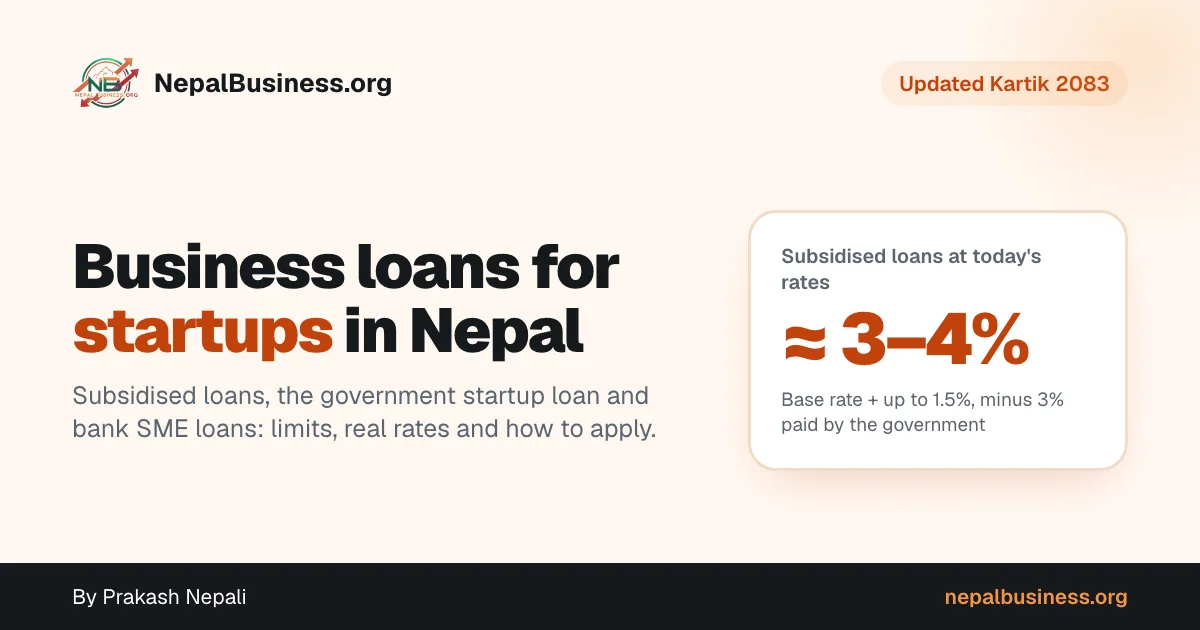
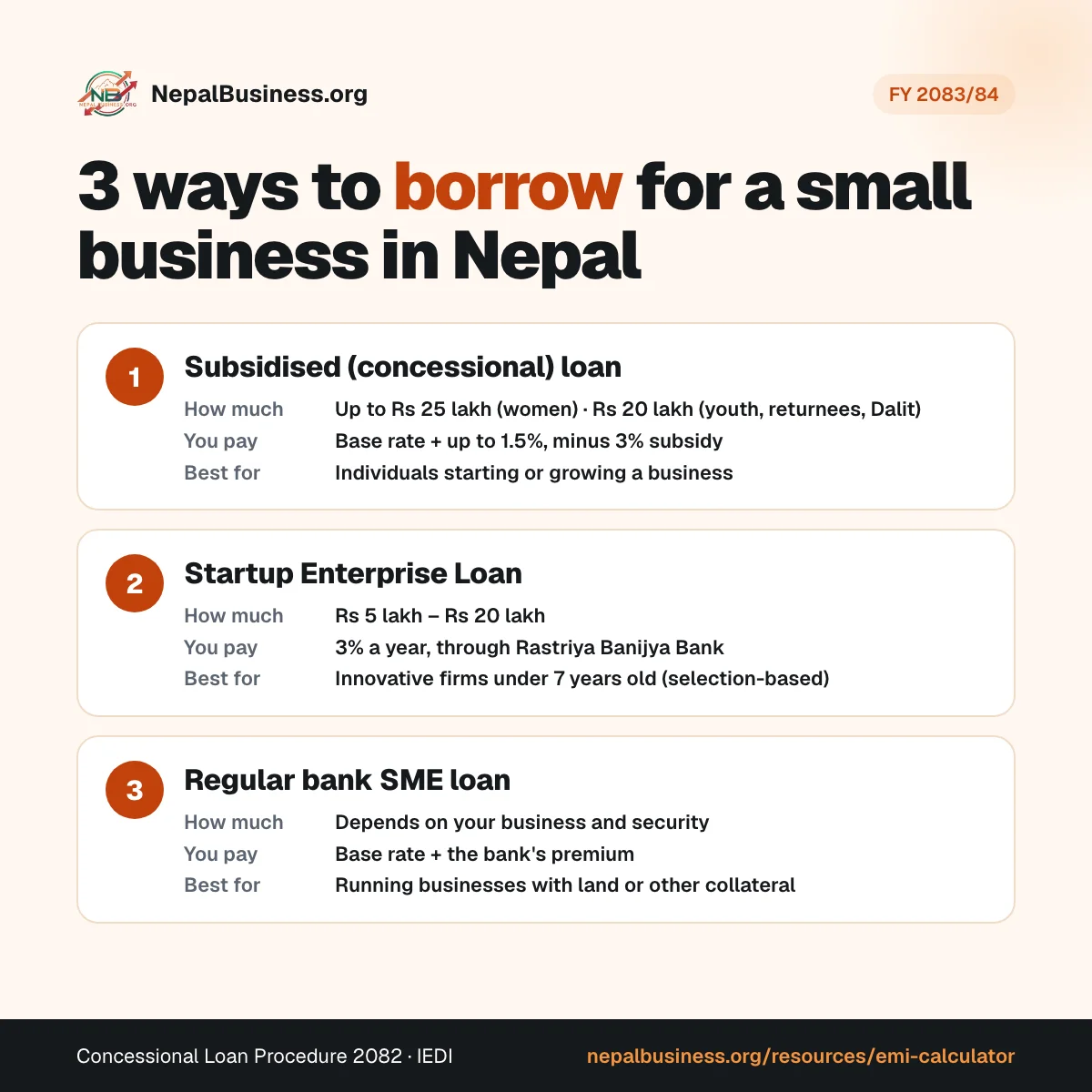
- Subsidised (concessional) loans: up to Rs 25 lakh for women entrepreneurs and up to Rs 20 lakh for educated youth, young people returning from foreign employment and Dalit entrepreneurs. The bank can charge its base rate plus up to 1.5%, and the government pays 3 percentage points for up to five years. At today's base rates you pay roughly 3–4%.
- Startup Enterprise Loan: Rs 5 lakh to Rs 20 lakh at 3% a year for innovative businesses under seven years old. It is selection-based and competitive: 1,301 of 10,244 applications were shortlisted in the 2026 round.
- Regular bank business (SME) loans: no fixed limit, but banks usually want land, a building or a fixed deposit as security. You pay the bank's base rate plus its premium.
How business loan interest works in Nepal
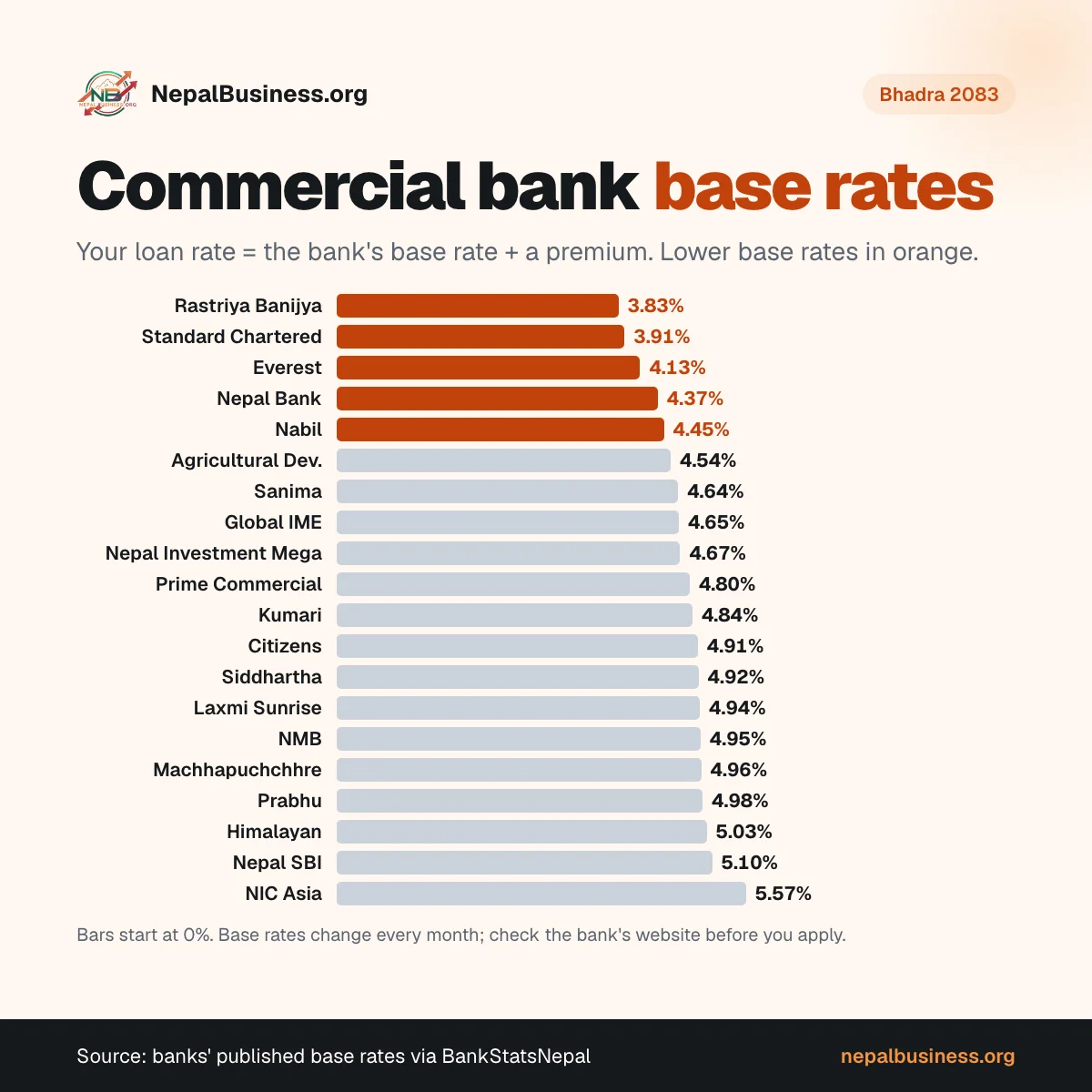
Every bank in Nepal sets a base rate each month, based on its own cost of funds. Your loan rate is that base rate plus a premium that the bank adds for the type of loan and how risky it thinks you are. Most business loans have a floating rate, so your EMI can go up or down when the base rate changes.
In Bhadra 2083, commercial bank base rates ranged from 3.83% at Rastriya Banijya Bank to 5.57% at NIC Asia Bank. Most banks were between 4.5% and 5%.
Two things to keep in mind:
- A low base rate doesn't guarantee the cheapest loan. Ask for the premium as well, and for fees such as the service charge, the property valuation fee and the early repayment fee.
- Base rates change every month. Banks publish their latest base rate and interest spread on their websites. Compare this month's figures, not last month's.
Option 1: Government-subsidised (concessional) loans
Known in Nepali as sahuliyatpurna karja (सहुलियतपूर्ण कर्जा), these are ordinary bank loans where the government pays part of the interest. They now run under the Concessional Loan Interest Subsidy Procedure, 2082, which replaced the older 2075 procedure and raised most loan limits.
Who can borrow, and how much
| Category | Maximum loan |
|---|---|
| Women entrepreneurs | Rs 25 lakh |
| Educated youth (project loan) | Rs 20 lakh |
| Youth returning from foreign employment | Rs 20 lakh |
| Dalit community enterprise development | Rs 20 lakh |
| Commercial agriculture and livestock | Rs 5 crore |
| Housing for natural disaster victims | Rs 5 lakh |
What you actually pay
The bank can charge at most its base rate plus 1.5%. The government then pays 3 percentage points of that interest, and you pay the rest. The subsidy lasts for up to five years.
Example: at a bank with a 4.65% base rate, the highest rate allowed is 4.65% + 1.5% = 6.15%. The government pays 3%, so you pay about 3.15%.
| Rs 10 lakh loan over 5 years | Monthly EMI | Total interest |
|---|---|---|
| Subsidised, you pay 3.15% | Rs 18,035 | about Rs 82,000 |
| Same loan without subsidy, 6.15% | Rs 19,403 | about Rs 1.64 lakh |
| Regular loan at 9% | Rs 20,758 | about Rs 2.45 lakh |
Try your own numbers with our free EMI calculator.
Security (collateral)
The rules let some concessional categories be lent without land as security, for example against the business project itself or a personal or group guarantee. The bank still decides what it will accept, so ask early what security it wants for your category.
How popular are they?
Very. In Shrawan 2083, the first month of this fiscal year, banks approved Rs 65.4 billion in concessional loans to 43,051 borrowers. Women entrepreneurs were the largest group by number, with 24,178 borrowers, followed by commercial agriculture and livestock.
How to apply
- Register your business (sole proprietorship, partnership or company) and get a PAN. See our guide to company registration in Nepal.
- Write a simple business plan: what you will sell, your costs, expected sales and how you will repay the loan.
- Visit a bank or financial institution that offers concessional loans and ask for the application form for your category.
- Submit the form with your citizenship certificate, business registration, PAN, business plan and any documents your category needs, such as proof of returning from foreign employment or academic certificates.
- The bank assesses the plan, decides on security and approves the loan. Use the money only for the purpose it was approved for.
Option 2: The Startup Enterprise Loan
This is a separate government programme for innovative businesses. The Industrial Enterprise Development Institute (IEDI) selects the startups and Rastriya Banijya Bank pays out the loans, under the Startup Enterprise Loan Operation Procedure, 2082.
Key terms in the 2026 round
- Loan amount: Rs 5 lakh to Rs 20 lakh. The maximum was cut from Rs 25 lakh.
- Interest: 3% a year.
- Security: selected startups don't need to pledge land. The project itself is assessed instead.
- Selection: proposals need at least 50 marks. They are scored on feasibility, innovation, sustainability, and social and economic impact.
Who is eligible
- Registered in Nepal before the call for proposals is published
- Less than seven years old
- Annual transactions of no more than Rs 15 crore
- Paid-up capital and annual income below Rs 50 lakh
- Fixed capital, not counting land and buildings, under Rs 2 crore
- No more than 10 employees
How competitive is it?
In the 2026 round, IEDI received 10,244 proposals, shortlisted 1,301 and planned to lend to about 500 startups. Fewer than one applicant in 20 got a loan, so treat it as a bonus rather than your only plan.
How to apply
- Watch for the call for proposals on IEDI's website (iedi.org.np) and in national newspapers. The application window is short, usually about three weeks.
- Prepare a full project proposal in IEDI's format. Explain what is new about your idea, who will buy it, your costs and how the loan will be repaid.
- Submit online or at IEDI's office in Tripureshwor, Kathmandu.
- If you are shortlisted, submit the requested documents by the deadline. Selected applicants are told by phone or SMS and must contact the bank within 30 days.
- After you get the loan, use it only as proposed, pay instalments on time and send quarterly progress reports.
Option 3: Regular bank business (SME) loans
If you don't qualify for a subsidised loan, or need more money, a regular business loan is the standard route. Banks offer working capital loans for stock, salaries and running costs, term loans for machines, vehicles and fit-out, and overdrafts for short gaps in cash flow.
What banks usually ask for
- Business registration certificate and PAN or VAT certificate
- Tax clearance and financial statements (audited accounts for larger loans)
- A business plan or projected cash flow
- Citizenship certificates of the owners and any guarantors
- Collateral, such as land or a building valued by the bank's valuer, or a fixed deposit
- Recent bank statements
Questions to ask every bank
- What premium will you add to the base rate for my loan?
- Is the rate floating, and how often can it change?
- What are the service charge, valuation fee and early repayment fee?
- How long will approval take?
Put each offer into the EMI calculator to compare the monthly payment and the total interest side by side.
Which bank is best for a startup loan?
There is no single best bank. In Bhadra 2083 the lowest base rates were at Rastriya Banijya Bank (3.83%), Standard Chartered (3.91%), Everest Bank (4.13%), Nepal Bank (4.37%) and Nabil Bank (4.45%). But the total cost also depends on the premium, the fees and whether the bank lends to businesses of your size and type.
A practical approach: start with the bank that already holds your business account, because it can see your transactions. Then get written offers from two or three other banks and compare them on total cost, not just the rate.
Mistakes to avoid
- Using the money for something else. Subsidised and startup loans must be used for the approved purpose. Misuse can cost you the subsidy and lead to other penalties.
- Forgetting that the subsidy ends. The interest subsidy lasts up to five years. Plan for the full rate after that.
- Comparing base rates only. Always compare premium and fees too.
- Borrowing more than your cash flow can repay. Work out the EMI before you sign, and keep a few months of instalments in reserve.
- Missing reports. Startup loans need quarterly progress reports, and banks may inspect your business.
Planning your startup budget? See how much it costs to start a business in Nepal and our financial planning guide.
Frequently asked questions
Can I get a business loan in Nepal without collateral?
Sometimes. Startups selected for the Startup Enterprise Loan don't need to pledge land, and some concessional loan categories can be secured by the project or a guarantee. Regular bank loans usually need collateral.
What is the interest rate on concessional loans in Nepal?
The bank can charge its base rate plus up to 1.5%. The government pays 3 percentage points, so at current base rates borrowers pay roughly 3–4%.
How much can a woman entrepreneur borrow at a subsidised rate?
Up to Rs 25 lakh under the Concessional Loan Interest Subsidy Procedure, 2082.
How long does the interest subsidy last?
Up to five years. After that you pay the bank's full rate.
Do I need a registered business to apply?
Yes. All three routes need a registered business with a PAN.
Where can I check the latest bank base rates?
Each bank publishes its base rate and interest spread on its website every month.
This article is general information, not financial advice. Loan terms are set by each bank and can change. Confirm everything with the bank before you sign.
Join the Discussion
Share your thoughts and engage with our community.
Loading comments...
Log in to join the discussion
Register on the platform, verify your email, then comment on this article.