
Dairy Business in Nepal 2026: Cost, Profit & Farmer Lessons

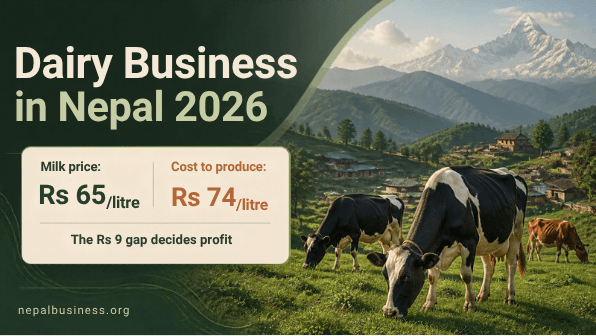
Dairy farming in Nepal is profitable only when your cost of producing a litre of milk stays below the price you are paid for it. The government's minimum buying price is Rs 65 per litre, but a 2023 study of 150 Kathmandu Valley dairy households found an average production cost of Rs 74.25 per litre. The farmers who succeed close that Rs 9 gap with cheaper feed, higher yield and income beyond raw milk.
Is dairy farming profitable in Nepal in 2026?
Yes, but not by default. Most small farms with one or two animals barely break even, and some lose money on every litre.
The price floor: The government's minimum purchase price for raw milk is Rs 65 per litre for milk with 4% fat and 8% solids-not-fat (SNF) (myRepublica).
The average cost: Kathmandu Valley households kept about 2 milking animals each and spent Rs 74.25 to produce one litre (Value Chain Analysis of Milk in Kathmandu Valley).
Cows vs buffalo: In Kaski, buffalo farming returned Rs 1.81 for every Rs 1 spent, against Rs 1.18 for cattle(Trends in Agricultural Sciences).
Bhanubhakta Parajuli, a cow farmer interviewed on YouTube, says the same thing from the farm: without a milk price based on production cost, farmers often sell below what it costs them to produce.
The rest of this guide shows what each cost is, and how four working farmers keep theirs below the milk price.
How much are dairy farmers paid for milk in Nepal?
Farmers are paid by fat and SNF content, with Rs 65 per litre as the official minimum for standard 4% fat, 8% SNF milk. Buffalo milk earns more because it carries more fat.
Who sets the price | What it means for you |
|---|---|
Government minimum | Rs 65/litre for 4% fat, 8% SNF raw milk |
Cooperatives and private dairies | Test each delivery for fat and SNF; low-fat milk earns less than the floor |
Dairy Development Corporation (DDC) | Buys at the government rate, but has delayed farmer payments for months |
Plan for late payment. In September 2026, DDC raised prices for ghee, paneer and other products but not the raw milk price, and Koshi farmers were still waiting months for payment (The Rising Nepal). Keep at least 3 months of feed money in hand.
What does it cost to start a dairy farm in Nepal?
Your total depends on herd size, breed and whether you already own land, so plan each cost item separately.Animals and the shed are the biggest one-time costs; feed is the biggest monthly cost.
Cost item | Type | What decides the amount |
|---|---|---|
Cows | One-time | Roughly Rs 65,000 to Rs 3,50,000 per cow, depending on breed, age, milk yield and pregnancy |
Shed | One-time | Loose housing with space to move costs more than a tie-stall, but cuts injury and disease |
Floor mats and scraper | One-time | Optional at small scale; both farms profiled below use them |
Chaff cutter and milk cans | One-time | Basic equipment for any farm above 2 to 3 cows |
Feed | Monthly | Green grass and silage are cheaper than bought concentrate |
Vet care, AI, insurance | Monthly or yearly | Livestock insurance protects a loan-funded herd |
Labour | Monthly | Family labour at small scale; Parajuli estimates about 5 hours of work a day |
Working capital | Reserve | 3 months of feed, because milk payments can be late |
Don't copy old starting costs. Sudip Gautam started with 2 cows and Rs 50,000 to 1 lakh, but that was about 18 years ago. Cow, feed and building prices are far higher today.
Jersey or Holstein: which breed should beginners choose?
Jersey is usually the easier choice for a first farm; Holstein gives more milk but needs better feed and management.
Breed | Strength | Watch out for |
|---|---|---|
Jersey | Easier to manage long-term (Parajuli); milk has higher fat, which raises the price per litre | Lower volume per cow |
Holstein | Highest milk volume; used by Sudip Gautam's 400-cattle farm | Needs high-quality feed and comfortable housing |
Buffalo | Highest fat milk; most profitable in the Kaski study | Lower volume, slower breeding |
Whichever breed you choose, buy animals with a known milk record. A cheap cow giving 5 litres a day costs more per litre than a costly one giving 15.
Who are the four farmers in this guide?
Each one runs a working farm in Nepal and has spoken publicly about how they make it pay.
Farmer | Location | Farm | Background |
|---|---|---|---|
Sudip Gautam | Jhapa | About 400 cattle, Holstein and Jersey | Former security guard in South Africa; about 18 years in dairy |
Ang Phurba Salaka Sherpa | Sundarijal, Kathmandu | Salaka Dairy Farm, nearly 200 cows | 10 years' experience; trained in Israel through MASHAV |
Bhanubhakta Parajuli | Nepal | Commercial cow farm | Grass-first feeding; vocal on milk pricing |
Dr. Bhaneshwar Pokharel | Madi, Chitwan | Greenhouse vegetables and vermicompost | Former research director in Denmark; trains about 1,000 farmers a year |
How do successful dairy farmers cut feed costs?
They feed mostly green grass, silage and roughage, and buy only the concentrate they need. Feed is the largest running cost, so this is the biggest lever.
Grass first: Parajuli feeds mainly green grass and fodder instead of heavy concentrates and supplements. He says this cuts unnecessary spending and helps prevent mastitis.
Own silage: Sudip Gautam feeds silage made from chopped corn stalks, topped up with mustard cake, cornmeal, salt and minerals.
Even rations: Sudip uses machinery so every cow gets the same feed, wherever it stands in the shed.
If you have land, grow your own fodder before buying more cows. Bought feed is what pushes the cost per litre above Rs 65.
How do modern dairy farms raise milk yield?
They let cows move freely, keep sheds clean and track every animal's health, because a stressed or sick cow gives less milk.
Loose housing: Sudip's early tie-stall shed gave him knee sores, mastitis and only 10 to 12 litres per cow. After moving to loose housing with automatic floor scrapers, his herd grew to about 400 cattle.
Comfort: Salaka Dairy Farm uses cow mats and automated feed and water systems.
Health data: Salaka cows wear electronic neck collars that send health data to a mobile app, and the owner keeps wall charts of each cow's fertility, health and milk records.
Milking parlour: Salaka can milk 12 cows at once, which cuts labour as the herd grows.
A starter version costs little: a notebook record per cow, daily cleaning, and space to move do most of what the expensive systems do.
How can a dairy farm earn money beyond milk?
Sell manure or compost, package your own milk, or train other farmers. Extra income protects you when the milk price stays flat.
Extra income | Who does it |
|---|---|
Manure sold as fertiliser | Parajuli calls it a second income source |
Vermicompost | Salaka runs a large vermicompost plant; Dr. Pokharel makes all his crop fertiliser this way |
Own packaged milk | Salaka bags milk on-site with its own packaging machine |
Paid training stays | Sudip hosts farmers for 5 to 10 days; Dr. Pokharel trains about 1,000 a year |
What loans can you get for dairy farming in Nepal?
Nepal Rastra Bank's subsidized credit scheme lets agriculture and livestock farmers borrow up to Rs 5 crore at a reduced interest rate, valid until mid-July 2030 (Ashar 2087 BS) (NEPSE Trading).
Loan | Limit | Key terms |
|---|---|---|
Agriculture and livestock subsidized loan (NRB) | Up to Rs 5 crore | Government pays part of the interest; standard bank documents still required |
Youth returning from foreign employment (NRB) | Up to Rs 25 lakh | Separate subsidized category for returnee workers |
Nepal Bank Saral Krishi Karja | Rs 3 lakh to Rs 20 lakh | Base rate + 0.5%, with a 5% interest subsidy for up to 5 years (Nepal Bank) |
Collateral: Banks lend under the scheme against the land used for the farm, or against the crops (myRepublica).
Borrow in stages. Sudip Gautam scaled his farm with loans from Krishi Bikas Bank (Agricultural Development Bank) taken piece by piece, not as one big loan. Expand only after the current herd covers its own costs.
What mistakes cause dairy farms in Nepal to fail?
The common failures are high-cost feed, poor housing, unrecorded animals, no cash reserve and no plan for calves.
Tying cows in tight stalls: causes knee sores and mastitis (Sudip Gautam's early farm).
Buying all feed: pushes cost per litre above the Rs 65 milk price.
No records: you can't spot a cow that costs more than it earns.
No reserve: DDC and cooperatives can pay months late.
Ignoring calf costs: Parajuli calls raising calves a heavy financial burden.
Expecting government help after a loss: Parajuli says local livestock offices often don't know farm conditions; build your own vet contact before you need it.
Where can you learn dairy farming before investing?
Spend time on a working farm before you buy your first cow.
Sudip Gautam's farm, Jhapa: hosts aspiring farmers for 5 to 10 days of hands-on training.
Salaka Dairy Farm, Sundarijal: the owner offers to share knowledge with anyone interested.
Dr. Bhaneshwar Pokharel's farm, Madi, Chitwan: a training centre with housing and a kitchen; mainly crops and vermicompost.
Frequently asked questions
How much does a cow cost in Nepal?
Roughly Rs 65,000 to Rs 3,50,000, depending on breed, age, milk yield and whether she is pregnant.
What is the milk price for farmers in Nepal?
The government minimum is Rs 65 per litre for milk with 4% fat and 8% SNF; actual prices depend on fat and SNF test results.
Is buffalo farming more profitable than cow farming?
In a Kaski study, yes: buffalo returned Rs 1.81 per Rs 1 spent against Rs 1.18 for cattle.
Can returnees from abroad get a dairy loan?
Yes. Nepal Rastra Bank's subsidized scheme has a separate category for youth returning from foreign employment, up to Rs 25 lakh.
How many hours a day does dairy farming take?
Parajuli estimates about 5 hours of dedicated work a day on his farm.
Related guides: 270 business ideas for Nepal · How to register a company in Nepal · How much money to start a cafe in Nepal
Join the Discussion
Share your thoughts and engage with our community.
Loading comments...
Log in to join the discussion
Register on the platform, verify your email, then comment on this article.