Wholesale Market in Nepal (2026): Where Shops Buy Stock, by Product
Asan, Indrachowk, Mahabouddha and New Road for clothes and cosmetics, Kalimati for vegetables, and a 5-step way to find a supplier for anything else.

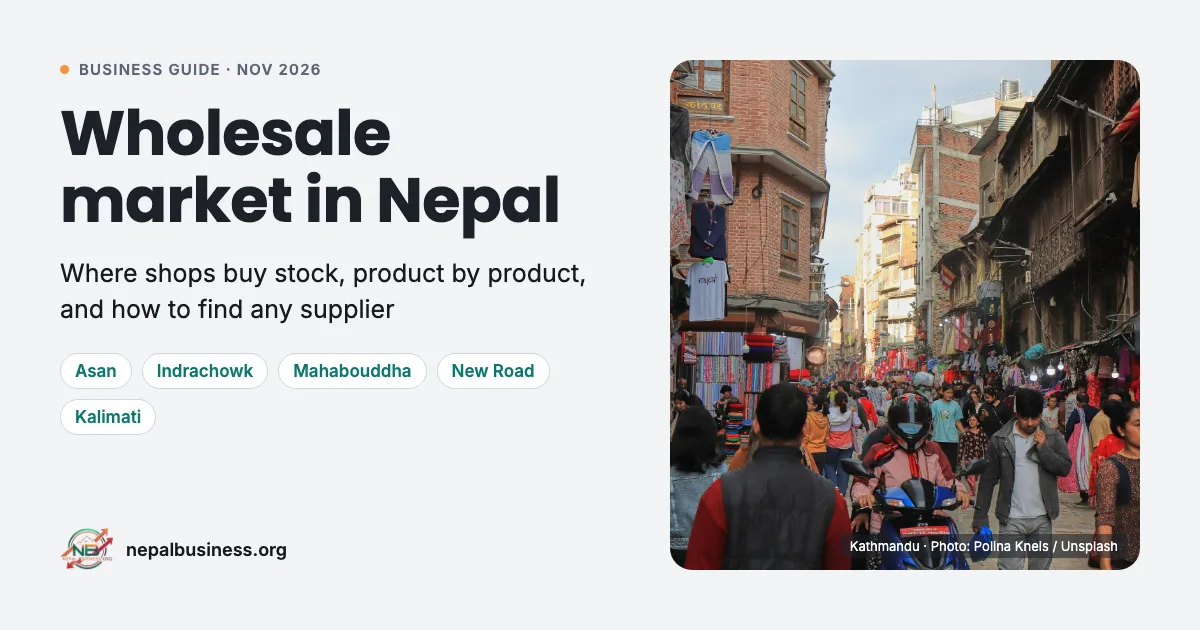
Last updated: 26 November 2026 (10 Mangsir 2083). Every market below comes from a named news report or official source, listed at the end. We name a market only when a source confirms it.
If you run a shop in Nepal, your profit starts with where you buy stock. Most goods reach you through a simple chain: a manufacturer or importer sells to a distributor or wholesaler, and the wholesaler sells to you. This guide shows where that wholesale trade happens, product by product, and how to find a supplier when no market is famous for what you sell.
Quick answer
- Clothes and small accessories: retailers buy in the old-city wholesale area of Kathmandu: Asan, Indrachowk and Mahabouddha, and the lanes behind Ranjana Complex on New Road.
- Cosmetics: wholesalers trade from New Road, Kathmandu.
- Vegetables and fruit: Kalimati in Kathmandu, and the new Chhapakaiya market in Birgunj.
- Outside Kathmandu: the border cities of Birgunj, Biratnagar, Bhairahawa and Nepalgunj serve as the main distribution centres.
- Anything else (mobile accessories, stationery, baby products and more): start from the product label and ask for the distributor. The step-by-step method is below.
How wholesale works in Nepal
Most products move in three steps: manufacturer, then distributor or wholesaler, then retailer. The US government's commercial guide for Nepal calls this the "three-fold" system and names Kathmandu and four border cities as the major distribution centres.
Imports shape the whole market. Customs data quoted in the same guide shows that up to 60% of goods arriving by truck or rail enter Nepal through the Raxaul–Birgunj crossing.
Timing matters too. Clothing wholesalers told Onlinekhabar in 2022 that retailers from inside and outside the Kathmandu Valley stock up during Sorha Shraddha, the fortnight before Dashain. If you plan a festival range, buy early. Our list of Dashain and Tihar business ideas shows what sells in that season.
Wholesale markets in Nepal by product
Use this table to find where to start. Each row names its source, so you can see how recent the information is.
| What you sell | Where to buy (start here) | Source and year |
|---|---|---|
| Men's and women's readymade clothes | Asan, Indrachowk, Mahabouddha; behind Ranjana Complex, New Road | Onlinekhabar, 2022 |
| Belts, socks and small accessories | Asan–Indrachowk–Mahabouddha area | Onlinekhabar, 2022 |
| Cosmetics and personal care | New Road, Kathmandu | Kathmandu Post, 2026 |
| Spices and dry fruits | Spice shops on the road from Asan towards Kel Tole (ask about bulk rates) | Kantipur, 2026 |
| Vegetables and fruit | Kalimati, Kathmandu; Chhapakaiya, Birgunj | Kalimati Market; Kantipur, 2025 |
| Imported goods in general | Distributors in Birgunj, Biratnagar, Bhairahawa, Nepalgunj and Kathmandu | US Commercial Guide, 2026 |
| Mobile accessories, stationery, jewellery, baby products, bike parts and others | No single confirmed market. Use the 5-step method | — |
Kathmandu's main wholesale areas
Asan, Indrachowk and Mahabouddha
These three neighbouring areas in old Kathmandu form the best-known wholesale zone for clothes and everyday goods. Onlinekhabar visited in 2022 and found wholesalers selling men's readymade clothes, women's readymade clothes, and items such as belts, socks and masks. Retailers from inside and outside the valley buy here.
People have bought and sold goods in Asan for about 300 years, Kantipur reports. Traders from outside the city once came here to buy rice, chiura and pulses wholesale. Spice shops still line the road from Asan towards Kel Tole.
Tip before you go: Kathmandu Metropolitan City runs a "Vehicle Free Asan" day every Saturday. As of April 2026, it stops vehicles from entering Asan from Kamalakshi, Bhotahiti and Mahabouddha, and visitors park at places such as the Dharahara underground parking and walk in. If you need a vehicle to carry stock, plan your trip for another day.
New Road
New Road sits next to Asan and holds wholesale shops for clothes and cosmetics. In 2022, a men's readymade wholesaler traded from behind Ranjana Complex. In August 2026, the Kathmandu Post quoted a cosmetics wholesaler on New Road. Cosmetics demand keeps growing: Nepal imported cosmetic products worth Rs 13.004 billion in 2025/26, up from Rs 11.25 billion the year before, according to Department of Customs data reported by the Post.
Kalimati (vegetables and fruit)
Kalimati is Kathmandu's wholesale market for vegetables and fruit. It opened on Asoj 15, 2043 BS, and the Kalimati Fruits and Vegetable Market Development Committee runs it today. The committee publishes the minimum, maximum and average wholesale price of each item every day.
You can see today's Kalimati prices, along with gold and the NEPSE index, on our Today's Prices in Nepal page. Our mushroom farming guide uses the same data to show how wholesale prices move through the year.
Wholesale markets outside Kathmandu
Outside the valley, the big border cities work as distribution hubs. The US Commercial Guide names Birgunj, Biratnagar, Bhairahawa and Nepalgunj as Nepal's major distribution centres, alongside Kathmandu. If your shop is far from Kathmandu, ask distributors in the nearest of these cities first.
Birgunj also has a new market for fresh produce. In December 2025 (Mangsir 2082), Birgunj Metropolitan City opened the Chhapakaiya Vegetable and Fruit Wholesale Market on Railway Road, ward 2. The first phase cost Rs 70 lakh and has 28 shutters in 14 units, with electricity, water, toilets, drainage and security, Kantipur reported.
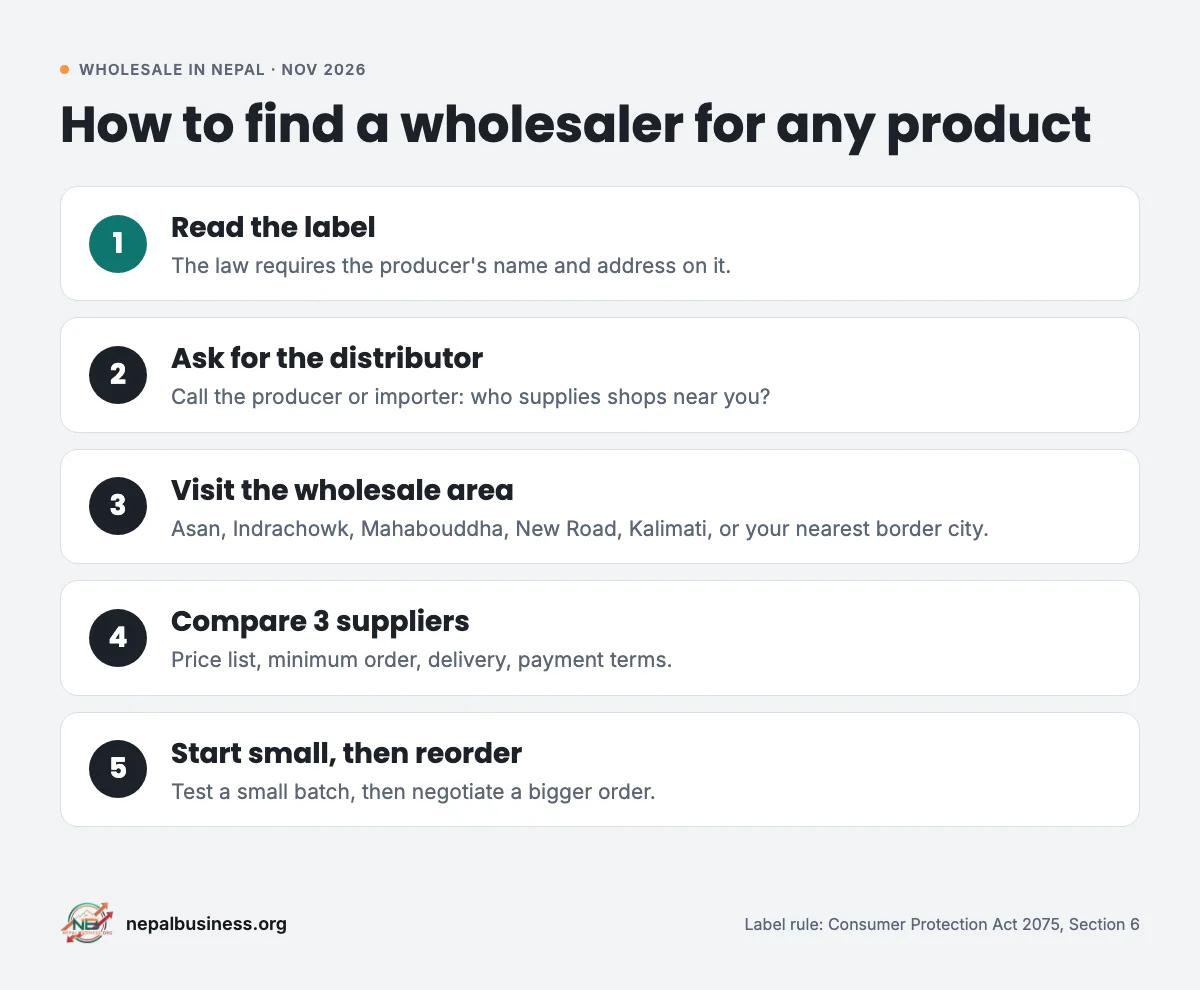
How to find a wholesaler for any product: 5 steps
Many products have no famous market. For those, follow the supply chain backwards from a product your customers already buy.
- Read the label. Nepal's Consumer Protection Act 2075 requires the producer's name and address on the label. For imported goods, the importer prepares the label in Nepali or English. That name tells you which company to contact.
- Ask the company for its distributor. Call or message the producer or importer and ask who supplies retailers in your area. Most manufacturers sell through distributors or wholesalers, not straight to shops.
- Visit the nearest wholesale area. Use the table above for clothes, cosmetics, spices and fresh produce. Outside Kathmandu, start with distributors in your nearest border city.
- Compare at least three suppliers. Ask each one for its price list, minimum order, delivery cost and payment terms, and write the answers down.
- Start small, then reorder. Buy a small first batch, see what sells, and only then negotiate a bigger order.
Want to import stock yourself instead? You will need an EXIM code for most shipments. Our EXIM code guide explains who is exempt and how to apply.
Checklist before you buy wholesale
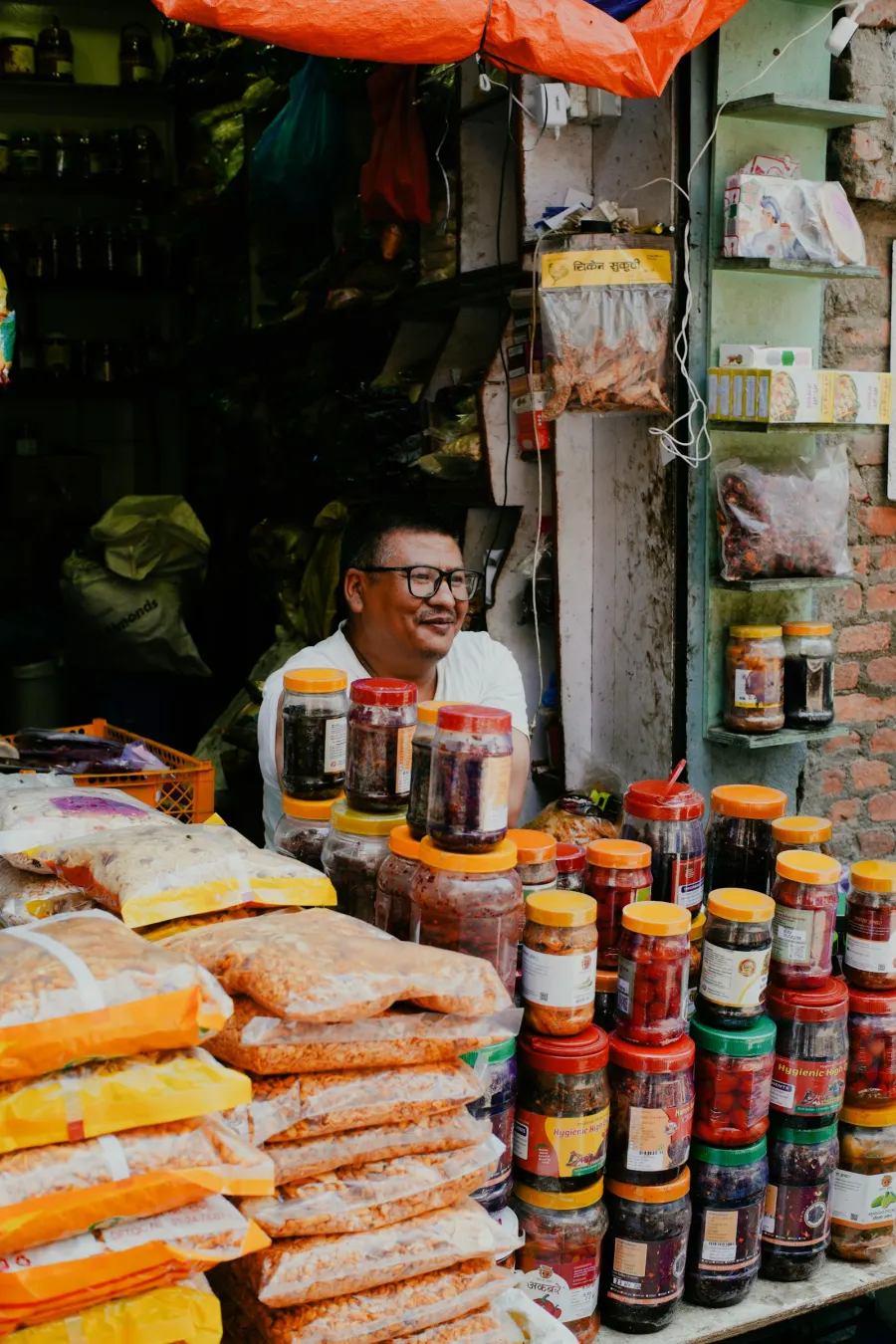
- Check every label. The law bans the import, sale and distribution of goods without a proper label (Section 6(4) of the Consumer Protection Act). Loose vegetables and fruit are the exception, but imported produce still needs a label.
- Read the maximum retail price (MRP). The label must show the MRP including all taxes. The gap between your wholesale price and the MRP is your margin, so check it before you agree a deal.
- Check dates and batch numbers. The label must show the manufacture date and batch number, and a use-by date for goods with a shelf life.
- Get a proper bill. Ask for a bill with the seller's PAN or VAT number. Our Nepal tax guide explains PAN and VAT, and our post on the bill lottery and invoicing shows why proper bills matter.
- Agree credit terms in writing. Wholesalers told Onlinekhabar in 2022 that many retailers ask for goods on credit (udharo). Each supplier sets its own terms, so write down the amount and due date.
Wholesale prices in Nepal: the national index
Nepal Rastra Bank (NRB) measures wholesale price changes with the National Wholesale Price Index. The central bank tracks the prices of 262 items across 24 market centres, the Kathmandu Post reports. NRB's latest annual figures show wholesale prices rose 4.30% on average in 2025/26 (a preliminary figure), after 3.84% in 2024/25.
| Fiscal year | Wholesale price inflation (annual average) |
|---|---|
| 2023/24 | 3.92% |
| 2024/25 | 3.84% |
| 2025/26 (preliminary) | 4.30% |
Source: Nepal Rastra Bank, Macroeconomic Indicators of Nepal, Mid-July 2025/26. The index shows the national trend; your own supplier's prices can move faster or slower.
Before you open your shop
Wholesale buying works best once you have registered your shop and set a clear budget. Our step-by-step guide on how to start a small business in Nepal covers registration, and our cost to start a business in Nepal guide shows the fees. Still choosing what to sell? Browse our 270 business ideas for Nepal.
Frequently asked questions
Where is the wholesale market in Kathmandu?
The main wholesale area sits in old Kathmandu: Asan, Indrachowk and Mahabouddha, with New Road next to them. For vegetables and fruit, the wholesale market is Kalimati.
Where can I buy clothes wholesale in Nepal?
Start in Asan, Indrachowk and Mahabouddha, and the lanes behind Ranjana Complex on New Road. Wholesalers there sell men's and women's readymade clothes to retailers from inside and outside the valley.
Where is the cosmetic wholesale market in Nepal?
Cosmetics wholesalers trade from New Road in Kathmandu. Check every product's label, MRP and use-by date before you buy.
Where can I find mobile accessories wholesale in Nepal?
We found no reliable source that names one market for mobile accessories, so we don't name one. Read the label on a brand that sells well, ask the importer for its distributor, and compare at least three suppliers.
Where can I check today's wholesale vegetable prices?
The Kalimati market committee publishes daily wholesale prices on its website. You can also see them on our Today's Prices page.
What is the national wholesale price index of Nepal?
It is Nepal Rastra Bank's measure of wholesale price changes, based on 262 items in 24 market centres. Wholesale prices rose 4.30% on average in 2025/26, according to NRB's preliminary figure.
Can I buy wholesale on credit in Nepal?
Some suppliers give credit, and each one sets its own terms. Agree the amount and due date in writing before you take the goods.
Do I need an EXIM code to buy from a wholesaler?
No. You need an EXIM code only when you import or export goods yourself, and small shipments are exempt. Buying from a Nepali wholesaler does not need one.
Sources
- Onlinekhabar: होलसेल बजारमा सन्नाटा, व्यापारी भन्छन्– ठाउँ छोड्न मात्र बाँकी छ (4 Asoj 2079)
- Kantipur: असन : क्रय–विक्रयको अजम्बरी चक्र (12 Baishakh 2083)
- Kathmandu Post: Cosmetic imports rise as demand grows in Nepal (23 August 2026)
- कालीमाटी फलफूल तथा तरकारी बजार विकास समिति: daily wholesale prices
- Kantipur: वीरगन्जमा छपकैया तरकारी तथा फलफूल थोक बजार संचालनमा (21 Mangsir 2082)
- US International Trade Administration: Nepal Country Commercial Guide, Distribution and Sales Channels (15 June 2026)
- Consumer Protection Act 2075 (English translation), Section 6
- Nepal Rastra Bank: Macroeconomic Indicators of Nepal, Mid-July 2025/26
- Kathmandu Post: wholesale price index coverage (26 July 2026)
Markets change. Call a supplier before you travel, and check prices and terms yourself before you pay. Know a wholesale market we should add? Tell us and we'll check it.
Join the Discussion
Share your thoughts and engage with our community.
Loading comments...
Log in to join the discussion
Register on the platform, verify your email, then comment on this article.