
Business Ideas in Nepal 2026: 270 Ideas, Top 10 and Costs by Budget
Start-up costs by budget, the fastest-growing sectors, registration costs, government loans and the risks most lists leave out.

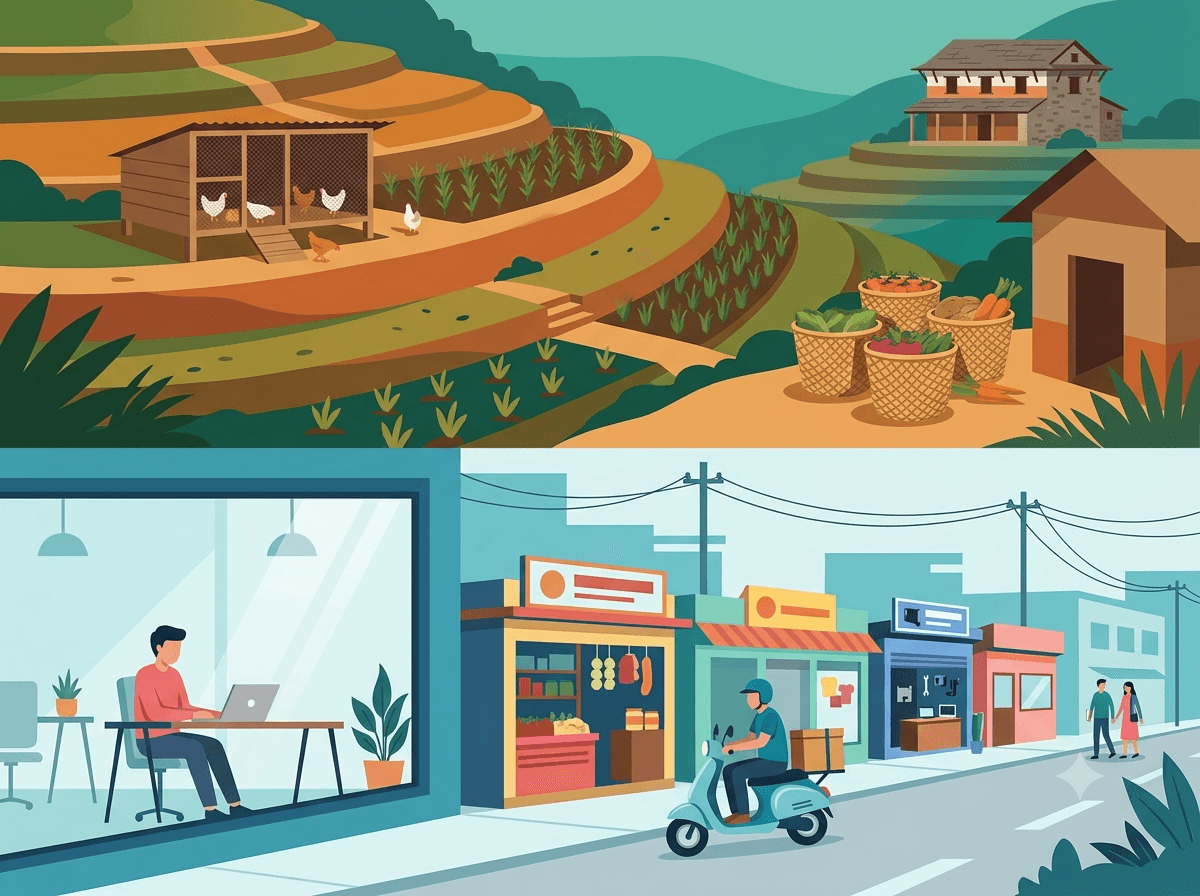
Last updated: 31 October 2026. Costs and figures were checked in October 2026 and change over time. Always get local quotes before you invest.
Looking for a business to start in Nepal? This guide has 270+ ideas sorted by rural and urban fit. Unlike most lists, it also tells you what the most popular ideas actually cost to start, which sectors are growing according to official data, what registration costs, which government loans exist, and the risks most lists leave out.
Where we give a rupee figure, we say what scale it assumes and where it comes from. Where no reliable figure exists, we say so instead of guessing.
Quick answer: which business is best in Nepal?
There's no single best business. The best one is the one that fits your budget, your skills and your location. Based on start-up cost, real demand and the evidence on returns:
- Under Rs 1 lakh: oyster mushroom farming, off-season vegetables in a plastic tunnel, home tuition, freelancing, home tiffin service, or selling online with QR payments.
- Rs 1–5 lakh: a small goat herd, beekeeping (10+ hives), broiler poultry (500 birds), a kirana or stationery shop, or a basic beauty parlour.
- Rs 5–20 lakh: a kiosk or small cafe, a commercial cloud kitchen, or a full salon.
- Fastest-growing area you can join with little money: businesses built on digital payments and online selling. QR payments in Nepal more than tripled in two years (Nepal Rastra Bank).
Returns from small businesses in Nepal are usually modest, not dramatic. University studies on goats, mushrooms, bees and dairy show roughly Rs 1.2 to Rs 2.5 back for every Rs 1 spent. The stories of farmers earning Rs 30 lakh a year are real, but they are the exceptions.
Top 10 business ideas in Nepal for 2026
How we picked them: each idea has a sourced start-up cost a beginner can afford, real demand behind it, and evidence that people make money from it. We left out ideas that look risky on current numbers (see "Layer poultry" in the reality check).
| # | Business idea | Small-scale start-up cost | Best for |
|---|---|---|---|
| 1 | Off-season vegetables in a plastic tunnel | About Rs 60,500 for one tunnel and first crop | Village or peri-urban land |
| 2 | Oyster mushroom farming | About Rs 9,000 per 100-bag cycle | A spare room, any area |
| 3 | Goat farming | Rs 1.3–3.5 lakh for 10 does + 1 buck | Rural, hill or Terai |
| 4 | Beekeeping | About Rs 10,000 per modern hive | Hills, near forests and crops |
| 5 | Broiler poultry | About Rs 2.5–3.1 lakh for 500 birds | Near towns and markets |
| 6 | Online selling with QR payments | Rs 20,000–50,000 of starting stock | Anyone, from home |
| 7 | Freelancing and IT services | Under Rs 10,000 if you own a laptop | People with digital skills |
| 8 | Home tiffin or cloud kitchen | Rs 30,000–50,000 from a home kitchen | Cities and towns |
| 9 | Repair services (mobile, appliances) | Rs 2–8 lakh for a small shop | Towns and city outskirts |
| 10 | Kiosk or small cafe | Rs 5–10 lakh (kiosk), Rs 10–25 lakh (15–30 seats) | Busy urban locations |
Notes on the table:
- Tunnel vegetables: one 20 × 6 m bamboo tunnel cost about Rs 35,800, plus about Rs 24,715 for a tomato crop, in a Tribhuvan University study in Chandragiri. A Parbat farmer with ten tunnels reports earning about Rs 2.2 lakh a month, but that's one success story, not a typical result.
- Oyster mushroom: about Rs 9,000 per cycle for straw, spawn and bags (blog estimate). A Chitwan study found Rs 2.54 back per Rs 1 spent. Oyster mushrooms sold for about Rs 200–250/kg.
- Goats: you can start with 2–3 goats for Rs 30,000–50,000 (blog). A 2025 study in Banke found an average net profit of about Rs 28,014 per farm a year, which is a steady side income rather than a full salary.
- Beekeeping: a modern hive costs about Rs 10,000 (dZi Foundation). Chitwan studies show Rs 1.8–2.17 back per Rs 1 spent.
- Broilers: the cost covers a simple shed, equipment and the first batch (one unsourced blog). Profit depends heavily on feed prices and disease. In the 2024 poultry census, 51.2% of farms reported disease losses and only 4.1% had insurance.
- Online selling: QR payments in one month rose from 20.8 million in mid-2024 to 69.6 million in mid-2026 (NRB). All online sellers, including those selling only on Facebook or TikTok, must register under the E-Commerce Act 2081.
- Freelancing and IT: Nepal's IT services exports are estimated at about USD 1 billion a year and growing about 20% (industry estimate by NAS-IT, not official data).
- Home kitchen: Rs 30,000–50,000 assumes you use your own kitchen and equipment (blog). A rented commercial kitchen costs Rs 4–12 lakh. Food businesses may need a licence under the Food Hygiene and Quality Act 2081.
- Repairs: Rs 2–8 lakh for a small shop (blog). Owner-operators in news reports earn about Rs 40,000–50,000 a month.
- Cafe: see our full cafe cost guide for a line-by-line budget.
Business ideas in Nepal by budget
All figures are rough starting costs for a small, beginner-scale version, excluding land. Costs in Kathmandu are usually higher. "(blog)" means the figure comes from a single Nepali business blog that doesn't cite sources, so treat it as an estimate.
Business ideas under Rs 1 lakh
- Oyster mushroom farming: about Rs 9,000 per 100-bag cycle in a room you already have (blog).
- Off-season vegetables in one plastic tunnel: about Rs 60,500 including the first crop (Tribhuvan University study).
- Goat farming, minimal start: Rs 30,000–50,000 for 2–3 goats (blog).
- Beekeeping, 5–8 hives: about Rs 10,000 per hive (dZi Foundation).
- Vermicompost: about Rs 15,000 per bed in running costs (blog).
- Fruit-sapling nursery: about Rs 25,000–35,000 of inputs (blog). Saplings take at least 18 months to be ready for sale.
- Homestay in your existing house: registration about Rs 5,000–12,000 depending on rooms (law-firm guide). Room upgrades, bedding and toilets cost extra, and rules on the number of rooms differ by province.
- Home tuition: under Rs 10,000 (blog).
- Freelancing or digital services: under Rs 10,000 if you already own a laptop (blog).
- Online tutoring: Rs 10,000–30,000 for a microphone and good internet (blog).
- Selling on Facebook, Instagram or TikTok: Rs 20,000–50,000 of starting stock (blog), plus E-Commerce Act registration.
- Home tiffin service: Rs 30,000–50,000 from your own kitchen (blog).
- One-person digital marketing agency: Rs 50,000–1 lakh (blog).
- Your own online store: a .com.np domain is free for Nepali citizens; shared hosting costs about Rs 200–800 a month. Stock is the real cost.
Business ideas from Rs 1 lakh to Rs 5 lakh
- Broiler poultry, 500 birds: about Rs 2.5–3.1 lakh for a simple shed, equipment and the first batch (blog).
- Goat herd, 10 does + 1 buck with a raised shed: about Rs 1.3–3.5 lakh (blogs).
- Beekeeping, 10+ hives: about Rs 1–1.4 lakh.
- Kiwi orchard, 1–3 ropani: about Rs 1–1.5 lakh per ropani (news features). There's no income for 3–4 years.
- Kirana (grocery) shop: Rs 1–2 lakh (blog), before rent.
- Stationery and photocopy shop: Rs 1–2 lakh (blog), before rent.
- Basic beauty parlour: sources range from Rs 0.5 lakh to Rs 5 lakh for a basic set-up.
- Small coaching or training centre: Rs 75,000–2 lakh (blog), before rent.
- Tailoring or mobile repair shop: Rs 2–8 lakh (blog), so it can fall in the next band too.
Business ideas from Rs 5 lakh to Rs 20 lakh
- Takeaway kiosk cafe: Rs 5–10 lakh (our cafe guide).
- Small sit-down cafe, 15–30 seats: Rs 10–25 lakh (same guide).
- Commercial cloud kitchen: Rs 4–12 lakh (blog).
- Commercial bakery: Rs 3–12 lakh (blog).
- Full beauty salon: about Rs 10 lakh (Republica, older figure).
- Travel agency as a firm: at least Rs 5 lakh capital plus a Rs 5 lakh bank guarantee, so likely Rs 10 lakh+ (law-firm guide, based on 2005 rules).
- Layer poultry, 500 birds: Rs 5–7 lakh (blog), but read the reality check first.
Business ideas above Rs 20 lakh
- Trekking agency as a private limited company: Rs 25 lakh minimum capital plus a Rs 5 lakh bank guarantee (law-firm guides, based on 2005 rules).
- Premium cafe: Rs 25 lakh+.
- Cold storage: large public and commercial projects cost from about Rs 5 crore up to more than Rs 25 crore. We found no reliable cost for a small cold room.
- Commercial gym: news reports describe Rs 1–6 crore projects. We found no reliable cost for a small gym.
Ideas we couldn't price reliably
We found no credible Nepali start-up cost for a small dairy (2–5 animals), digging a fish pond, button mushroom, photography, event management, a car or bike wash, print-on-demand, selling handicrafts online, a small gym or a momo stall. Get two or three supplier quotes before you plan a budget for these.
The hidden cost: rent. Small shops in prime Kathmandu areas are listed at about Rs 45,000 to Rs 1.4 lakh a month, and landlords usually want several months in advance. That alone can push a "Rs 1–2 lakh" shop idea past Rs 5 lakh. Outside the main markets, rents are much lower.
Fastest-growing businesses in Nepal
Official data shows which sectors are growing, according to the National Statistics Office's preliminary estimates for FY 2082/83 (mid-July 2025 to mid-July 2026), when the whole economy grew about 3.85%:
| Sector | Growth in FY 2082/83 |
|---|---|
| Electricity and gas (hydropower) | 20.93% |
| Finance and insurance | 9.16% |
| Transport and storage | 5.79% |
| Hotels and restaurants | 3.12% |
| Manufacturing | 2.83% |
| Construction | 2.31% |
| Agriculture | 1.58% |
The fastest-growing sectors, hydropower and finance, need big capital, so they aren't small-business ideas. But several fast-growing trends are open to small businesses:
- Digital payments and online selling. In one month (Asar) QR payments rose from 20.8 million worth Rs 61.7 billion in 2024 to 69.6 million worth Rs 189.9 billion in 2026, while ATM and card use fell (Nepal Rastra Bank). Online shops, delivery services and anything that takes QR payments benefit.
- IT freelancing and services. Industry estimates put IT exports at about USD 1 billion a year, growing about 20%. Official figures are lower because many payments arrive labelled as remittance.
- Services paid for by remittances. Remittances reached a record of about Rs 2.36 trillion in FY 2082/83, up about 37% (business press reports). That money is spent on consumer services, food, education and housing.
- Energy-related work. Electricity exports rose from Rs 17.46 billion to Rs 29.32 billion in a year. Electrical contracting and solar installation are smaller businesses that grow alongside hydropower.
- Tourism is recovering, not booming. Arrivals were 1,158,459 in 2025, about 97% of the 2019 record, and up 6% in January–September 2026. Homestays and tourist services are steady rather than fast-growing.
These small-business opportunities are our reading of the data, not official forecasts.
Business ideas you can start from home
These need little or no shop space:
- Freelancing (writing, design, development, video editing) and online tutoring
- Home tuition
- A home tiffin service or home bakery (check whether you need a food licence)
- Selling online through Facebook, Instagram, TikTok or your own website
- Social media management or a one-person digital marketing agency
- Oyster mushroom growing in a spare room
Even home-based online sellers must register. Under the E-Commerce Act 2081, in force since April 2025, every online seller, including those who sell only through social media, must register with the Department of Commerce, Supplies and Consumer Protection. See our guide on how to start an online business in Nepal.
Top 20 Rural Business Ideas in Nepal
1. Organic Farming
Cities crave chemical-free produce and are willing to pay for it. Rural land is cheaper, the climate is right, and labor costs are low. Start small and scale up by partnering with urban organic markets.
2. Mushroom Farming
It barely needs land, operates year-round indoors, and pays back in 30–45 days. Mushrooms have become a favorite of city restaurants and health-conscious families, so the market isn’t drying up anytime soon.
3. Poultry Farming
This is steady. There’s always demand for meat and eggs. Startup costs aren’t high, and there’s usually some government help for first-time farmers.
4. Dairy Farming
Dairy farming supplies milk cooperatives and local markets with a daily income cycle rather than a seasonal one. It pairs well with fodder farming and biogas production for added rural household income.
5. Cold Storage Facility
A cold storage unit solves post-harvest losses for vegetable and fruit farmers in a region, letting them sell at better prices instead of dumping produce cheaply at harvest time. This is a high-impact, moderate-investment rural business.
6. Food Processing Unit
Small-scale food processing (pickles, dried foods, flour) turns raw farm produce into higher-margin packaged goods. It extends shelf life and opens access to urban retail and export markets.
7. Biofertilizer & Vermicompost Production
As chemical fertilizer costs rise, biofertilizer and vermicompost production offers rural entrepreneurs a low-cost, high-demand product for local farmers, backed by Nepal's push toward organic agriculture.
8. Handloom & Carpet Weaving
Handloom and carpet weaving businesses tap into Nepal's traditional craft economy, with strong export demand from Europe and the US for handmade textiles and carpets.
9. Beekeeping & Honey Production
Honey production requires low investment and works well alongside other farming activities. Pure Himalayan honey commands premium urban and export prices.
10. Bamboo Products Manufacturing
Bamboo is abundant in many rural areas and can be turned into furniture, baskets, and eco-friendly household products — a growing niche as urban buyers shift toward sustainable materials.
11. Fish Farming
Fish farming (especially in the Terai) is a proven rural business with strong local demand and relatively low feed and setup costs compared to livestock.
12. Herbal & Medicinal Herb Cultivation
Nepal's biodiversity supports cultivation of high-value medicinal herbs and herbal tea crops, which sell to processing companies and export markets at premium rates.
13. Agriculture Equipment Rental
Instead of every farmer buying tractors or tillers, an equipment rental business lets rural entrepreneurs serve an entire community and earn recurring income each planting season.
14. Homestay Business
Homestays let rural households monetize spare rooms and local culture for tourists seeking authentic experiences, particularly strong in trekking routes and lake/hill districts.
15. Solar Solutions & Installation
Off-grid and low-grid rural areas need reliable power. Solar panel sales and installation services are growing steadily as costs drop and government incentives continue.
16. Poultry & Cattle Feed Manufacturing
Producing animal feed locally reduces costs for nearby livestock farmers and creates a steady B2B rural business tied directly to the farming economy.
17. Rural Transport Service
Local transport connecting villages to market towns fills a persistent infrastructure gap and generates daily recurring revenue with a single vehicle.
18. Flour Mill / Rice Mill
A local mill is a essential-service business — farmers need processing done close to home, making this a dependable, low-competition rural venture.
19. Plant Nursery
A plant nursery supplies saplings for both agriculture and the growing urban landscaping/gardening trend, giving rural producers a bridge into city markets.
20. Drinking Water Supply
Packaged or delivered drinking water addresses a basic need in areas with unreliable municipal water, and scales easily from a single delivery route to a full distribution business.
Top 20 Urban Business Ideas in Nepal
1. SaaS for SMEs
Software-as-a-service products for Nepali small and medium businesses (billing, inventory, HR tools) address a large underserved market as digital adoption accelerates post-2024.
2. App Development Agency
Urban demand for mobile apps — from e-commerce to fintech — keeps growing as smartphone penetration rises, making app development a strong urban service business.
3. Digital Marketing Agency
Every urban business now needs social media, SEO, and paid ad management. A digital marketing agency serving Kathmandu/Pokhara SMEs has low overhead and recurring monthly retainers.
4. Cloud Kitchen
Cloud kitchens skip the cost of a physical dine-in space, letting entrepreneurs launch a food brand cheaply and scale through delivery apps in dense urban areas.
5. Co-working Space
Freelancers and remote workers in cities need affordable, reliable workspace with internet — a co-working space monetizes underused urban real estate for this growing segment.
6. Cybersecurity Services
As Nepali businesses digitize, cybersecurity consulting and services are an emerging, high-value urban niche with very little local competition so far.
7. Social Media Management Agency
Urban brands increasingly outsource content creation and page management, making this a low-capital service business built on skill rather than equipment.
8. Mobile & Laptop Repair Shop
High device ownership in cities creates constant repair demand — a technically skilled entrepreneur can start this with a small shop and modest tool investment.
9. Fitness Centre / Gym
Urban lifestyles drive demand for gyms and fitness centres, especially in middle-class neighborhoods of Kathmandu, Pokhara, and Biratnagar.
10. Unisex Salon
Grooming and beauty services see steady urban demand across all income segments, with recurring visits providing predictable revenue.
11. Event Management Company
Weddings, corporate events, and parties are concentrated in cities, and full-service event management commands high margins per project.
12. Diagnostic Centre
Urban populations increasingly seek convenient private diagnostic and lab-testing services rather than relying solely on hospitals, making this a strong healthcare-adjacent urban business.
13. Legal & Tax Consultancy
Growing formalization of Nepali businesses (company registration, tax compliance) drives steady urban demand for legal and tax consultancy services.
14. Dry Cleaning Service
Busy urban professionals pay for convenience — dry cleaning and laundry services are a reliable, repeat-customer urban business.
15. Photography & Videography Studio
Weddings, product shoots, and social media content create year-round urban demand for professional photography and video services.
16. Franchise Consultancy
As international and domestic brands look to expand into Nepali cities, franchise consultancy connects investors with proven business models.
17. E-commerce / Online Marketplace
Urban consumers increasingly shop online for convenience; a focused niche marketplace (fashion, groceries, electronics) can carve out market share from generalist platforms.
18. Corporate Training Firm
Urban companies invest in employee upskilling — corporate training in soft skills, compliance, and technical topics is a scalable B2B service business.
19. Interior Design & Home Renovation
Rising urban real estate development fuels demand for interior design and renovation services, particularly in new apartment complexes.
20. Specialty/Zero-Waste Grocery Store
Health-conscious urban consumers are driving demand for specialty grocery stores focused on organic, zero-waste, or imported goods.
Full List: 270+ Ideas by Category
🌾 Rural & Agriculture-Based
Organic Farming, Mushroom Farming, Microgreens Farming, Poultry Farming, Dairy Farming, Fruit Farming, Vegetable Farming, Fish Farming, Flower Farming, Aloe Vera Farming, Vertical Farming, Farm Equipment, Farm Tools, Farm Fencing, Cattle Feed, Fish Feed, Seed Supply, Medicinal Herbs, Biofertilizer, Organic Composting, Vermicompost, Agriculture Consultancy, Food Processing, Cold Storage, Flour Mill, Rice Mill, Desi Ghee Making, Jaggery Making, Papad Making, Pickle Making, Honey Production, Herbal Tea, Biscuit Making, Chips Making, Noodles Making, Pasta Making, Bamboo Products, Wooden Crafts, Handloom Business, Carpet Weaving, Rugs & Carpets, Pottery Studio, Handmade Toys, Handmade Jewellery, Bangle Making, Kite Making, Diya Making, Brick Making, Rope Making, Jute Bag Making, Non-Woven Products, Egg Tray Making, Toothpick Making, Matchbox Making, Envelope Making, Paper Cup Making, Tissue Roll Making, Water Bottle Making, Kulhad Making, Tiffin Business, Pest Control, Grooming Store, Local Transport, Homestays, Plant Nursery, Welding Workshop, Outdoor Cooking School, Solar Solutions, Solar Installation, Water Purifier Dealership, Drinking Water Supply, Battery Recycling, Building Materials, Plywood Trading, Pesticide Trading.
🏙️ Urban
Software Company, SaaS for SMEs, App Development, AI Fraud Detection, Cybersecurity, Digital Products, Online Marketplace, E-book Publishing, Print-on-Demand, Dropshipping, Affiliate Marketing, Email Marketing, Digital Marketing, Social Media Agency, Video Editing, Podcast Studio, YouTube Channel, Drone Videography, Drone Sales, Branding Agency, Business Consultancy, Franchise Consultancy, Legal Consultancy, Tax Consultancy, HR Services, Online Bookkeeping, Corporate Training, Corporate Gifts, Corporate Security, Corporate Transport, Market Research, Insurance Services, Call Centre, Proofreading, Electronics Shop, Mobile Repair Shop, Laptop & Mobile Store, Eyewear Store, Cosmetics Store, Formal Wear Store, Women's Clothing, Kids' Clothing, Kids' Footwear, Undergarments, Footwear Store, Jewellery Store, Fashion Jewellery, Fashion Accessories, Belt & Wallets, Leather Goods, Home Appliances, Home Decor Store, Lighting Store, Furniture Making, Used Furniture Store, Upcycled Furniture, Sports Goods, Gaming Accessories, Games Store, Camera Store, Toy Library, Hardware Store, Paint & Hardware, Stationery Store, Cloud Kitchen, Food Truck, Bakery, Ice Cream Shop, Fast Food Outlet, Family Restaurant, South Indian Restaurant, Vegan Restaurant, Catering, Event Management, Wedding Planning, Wedding DJ, Wedding Accessories, Bridal Makeup, Event Venue Rental, Party Supplies, Balloon Decor, Festive Decor, Gift Hampers, Gift Basket Store, Unisex Salon, Men's Grooming, Fitness Centre, Yoga Academy, Tattoo Studio, Mehendi Services, Co-working Space, Storage Facility, Car Rental Business, Bike Rental, Bicycle Rental, Fashion Rental, Costume Rental, Vlogging Gear Rental, Film Studio, Photography, Online Learning, Online Courses, Online Cooking School, Music Academy, Public Speaking Coaching, Stand-up Coaching, Career Guidance, Education Consultancy, Exam Coaching, English Coaching, Skill Training, AC Repair, Appliance Repair, CCTV Installation, Dry Cleaning, Car Wash Business, Diagnostic Centre, Medical Supplies, Medicine Supply, Baby Food, Healthy Snacks, Astrology Services, Religious Products.
🔁 Works in Both Rural and Urban Areas
Pet Supplies, Pet Food, Daycare Centre, Preschool Business, Two-Wheeler Store, Car Accessories, Used Book Store, Tea Supply, Coffee Supply, Ethnic Wear Store, Used Goods Store, Green Packaging, Zero-Waste Grocery, Specialty Grocery, Frozen Foods, Organic Grocery Store, Organic Soap, Face Mask Making, DIY Craft Kits, Keychain Making, Backpack Making, Umbrella Making, Raincoat Making, Grow Bag Making, Box Making, Artificial Flowers, School Uniforms, Saree & Suit Store, Publishing House, Industrial Equipment, Industrial Cleaning, Smart Home Solutions, Smart Kitchen Appliances, Smart Aquarium Store, Waste Management, Eco Cleaning, Equipment Dealership, Summer Camps, Travel Accessories, Tour Guide Business, Courier Service, Fertilizer Production, Hair Accessories, Fabric Dyeing.
What it costs to make your business legal
Registration is a small part of most start-up budgets. The main costs, as reported in late 2026:
- Private limited company (Office of Company Registrar): Rs 1,000 with authorised capital up to Rs 1 lakh, Rs 4,500 up to Rs 5 lakh and Rs 9,500 up to Rs 25 lakh.
- Sole proprietorship (private firm): the fee depends on your declared capital. Confirm the current amount at the Department of Commerce, Supplies and Consumer Protection or your local office.
- PAN: free.
- VAT: required once yearly turnover passes Rs 50 lakh for goods or Rs 30 lakh for services or mixed businesses. Below that you issue PAN bills.
- Presumptive tax for very small businesses: a fixed Rs 7,500 a year in metropolitan and sub-metropolitan cities, Rs 4,000 in municipalities and Rs 2,500 in rural municipalities (conditions apply).
- Online sellers: must register under the E-Commerce Act 2081.
- Food businesses: may need a licence under the Food Hygiene and Quality Act 2081, valid for two years.
- Local business tax: set by each municipality every year. In Kathmandu Metropolitan City for FY 2083/84, for example, it's Rs 1,500 a year for a tea shop or stationery shop, Rs 2,000 for a kirana shop, salon, tailoring or mobile repair shop, Rs 3,000 for a small cafe (up to 400 sq ft) or a freelancer, and Rs 7,000 for a tuition centre. Businesses owned by women, Dalit, Janajati, people with disabilities or youth under 35, with up to Rs 5 lakh capital, get 40% off if they pay by the end of Asoj.
- Rent tax: in Kathmandu it's 10% of the rent for commercial premises, and the landlord pays it unless your agreement says you will.
For the full breakdown, see how much it costs to start a business in Nepal and our step-by-step guide to company registration in Nepal.
Government loans for small businesses
Two government loan routes charge borrowers around 3% interest:
- Concessional (subsidised) loans through banks: the government pays 3 percentage points of the interest. Limits are up to Rs 25 lakh for women-run businesses, Rs 20 lakh for educated youth and for young people returning from foreign employment, and up to Rs 5 crore for commercial agriculture. The rules were tightened in August 2025 after a Nepal Rastra Bank study found about Rs 21.25 billion of suspected misuse.
- Startup Enterprise Loan: Rs 5 lakh to Rs 20 lakh at 3% for innovative businesses registered within the last 10 years, selected by the Industrial Enterprise Development Institute (IEDI). It's highly competitive: in 2026 about 750 startups were to be selected from 10,244 applications, roughly 7%.
Details, eligibility and how to apply: business loans for startups in Nepal.
Reality check before you start
Most lists only show the upside. Before you invest:
- Returns are usually modest. University studies show about Rs 1.22 back for every Rs 1 spent on goats, Rs 2.54 for mushrooms, Rs 1.8–2.17 for bees, Rs 1.81 for buffalo milk and Rs 1.18 for cow milk.
- Layer poultry looked loss-making in late 2025. An Agriculture and Forestry University study put the cost at Rs 19.12 per egg, about Rs 574 per crate of 30, while farmers were selling at Rs 490–520 a crate. Check current feed and egg prices before you start.
- Prices can crash when everyone grows the same thing. Kiwi prices in Dolakha fell from Rs 150 to Rs 100 per kg after a bumper crop in 2024.
- Feed and disease drive livestock profits. Feed made up about 68% of poultry sector spending in the 2024 census.
- Borrowed money must be repaid. Startups that received Rs 770 million in government loans over two years had repaid only Rs 28.2 million by June 2026, which is why the programme now selects far fewer applicants.
- Start small, test the market, then grow. Sell your first batch or serve your first customers before you spend on a big set-up.
How to Choose the Right Business Idea
Match the idea to three factors before picking one:
- Local raw materials and skills — rural ideas work best when they build on farming, livestock, or craft skills already present in the area.
- Buyer proximity — urban ideas need population density; a co-working space or SaaS product has no rural market, while a solar installation service has no need for city foot traffic.
- Capital and cash flow cycle — poultry and dairy pay out faster than orchard farming; software and consultancy businesses have near-zero inventory cost but need a longer sales cycle to land clients.
Picked an idea? Follow our step-by-step guide to starting a small business in Nepal.
Frequently asked questions
Which business is best in Nepal?
There's no single best business. It depends on your budget, skills and location. With under Rs 1 lakh, mushroom farming, tunnel vegetables, tuition, freelancing or selling online are realistic. With Rs 1–5 lakh, goats, beekeeping, broilers or a small shop are common choices. Businesses built on digital payments and online selling are growing fastest among those open to small investors.
Which business to start in Nepal with low investment?
Ideas under Rs 1 lakh include oyster mushroom farming (about Rs 9,000 per cycle), one plastic tunnel for vegetables (about Rs 60,500), home tuition, freelancing, a home tiffin service, and selling online with Rs 20,000–50,000 of stock.
What business can I start with Rs 1 lakh in Nepal?
Mushroom farming, tunnel vegetables, a few goats, 5–8 beehives, vermicompost, home tuition, online tutoring, freelancing, social-media selling, a home tiffin service or a one-person digital marketing agency. Check whether your idea needs registration or a licence first.
What are the 10 most profitable businesses in Nepal?
No reliable data ranks businesses by profit in Nepal. Our Top 10 list is based on low start-up cost, real demand and evidence of returns: tunnel vegetables, oyster mushroom, goats, beekeeping, broilers, online selling, freelancing, home kitchens, repairs and small cafes. Studies show returns of roughly Rs 1.2 to Rs 2.5 for every Rs 1 spent on common farm businesses.
What is the fastest growing business in Nepal?
By official data, electricity (hydropower) grew fastest in FY 2082/83 at about 21%, followed by finance and insurance at about 9%. For small businesses, the fastest-growing opportunity is digital payments and online selling: QR payments more than tripled between 2024 and 2026.
Can I start a business from home in Nepal?
Yes. Freelancing, tuition, a home tiffin service or bakery, social media management and online selling can all be run from home. Online sellers must still register under the E-Commerce Act 2081.
Do I need to register a small business in Nepal?
Yes, if you want to trade legally, issue bills or sell online. Most small businesses register as a sole proprietorship or a private company, get a free PAN and register with their ward. VAT is only required above Rs 50 lakh turnover for goods or Rs 30 lakh for services.
Can I get a government loan to start a business in Nepal?
Possibly. Women, educated youth and returnee migrants can get subsidised bank loans at around 3%, and innovative startups registered within the last 10 years can apply for the Startup Enterprise Loan of up to Rs 20 lakh. Both are selective, so plan to start with your own savings.
Sources
- Tribhuvan University thesis, plastic tunnel tomato farming, Chandragiri: https://elibrary.tucl.edu.np/JQ99OgQIizUxyjI9nB0on9OyLkqsGIf4/api/core/bitstreams/b8758dfa-f6cb-4f55-8d52-836951ff4f09/content
- Economic analysis of mushroom enterprise, Chitwan: https://www.researchgate.net/publication/357348614_Economic_analysis_of_mushroom_enterprise_in_Chitwan_district_Nepal
- Goat farming economics, Banke (2025): https://nepjol.info/index.php/shss/article/download/79796/61101/229337
- Honey production economics, Chitwan: https://www.researchgate.net/publication/349695246_Economic_Analysis_of_Honey_Production_in_Chitwan_District_Nepal
- dZi Foundation, modern beekeeping: https://dzi.org/modernizing-beekeeping-in-nepal/
- Government milk cost of production study: https://giwmscdntwo.gov.np/media/app/public/329/posts/1718253626_10.pdf
- Cost of egg production (Ceotab, Dec 2025): https://ceotab.com/cost-of-egg-production-rises-to-rs-19-12-per-egg-in-nepal/
- Poultry census coverage (Kathmandu Post, 20 Mar 2026): https://kathmandupost.com/money/2026/03/20/poultry-sector-adds-over-rs60-96-billion-to-nepal-s-economy-annually
- Kiwi prices in Dolakha (Kathmandu Post, Sep 2024): https://kathmandupost.com/money/2024/09/22/kiwi-farming-blooms-in-dolakha-but-fruit-finds-no-takers
- Parbat tunnel farming (Hortidaily): https://www.hortidaily.com/article/6038119/nepal-plastic-tunnel-farming-takes-off-in-parbat/
- Start-up cost estimates for home and online businesses (Kamaune): https://kamaune.com/blog/small-business-ideas-nepal/
- Start-up cost estimates for shops and kitchens (Nexus Advisory): https://nexusadvisory.com.np/business-ideas-nepal/
- Poultry and goat set-up costs (Thulo Bazaar): https://thulobazaar.com.np/en/blog/poultry-farming-nepal-setup-cost-returns
- Homestay registration fees (Company Darta Nepal): https://www.companydartanepal.com/homestay-registration-in-nepal/
- Travel and trekking agency requirements (Law Bhandari): https://lawbhandari.com/publication/travel-and-tour-agencies-registration-process-in-nepal
- NSO growth figures for FY 2082/83 (Ratopati): https://english.ratopati.com/story/60817/how-was-satisfactory-economic-growth-achieved-amidst-adverse-circumstances
- Nepal Rastra Bank payment systems indicators (Saun 2083): https://www.nrb.org.np/psd/payment-systems-indicators-of-2083-saun/
- Remittance FY 2082/83 (ShareHub Nepal): https://sharehubnepal.com/news/177304-corporatenepalcom-remittance-inflows-reach-npr-236-trillion-in-last-fiscal-year
- Electricity exports FY 2082/83 (eKantipur): https://ekantipur.com/business/2026/07/23/en/electricity-sales-worth-rs-2932-billion-in-india-and-bangladesh-last-year-21-37.html
- Tourist arrivals 2025 (eKantipur): https://ekantipur.com/business/2026/01/01/en/nepal-welcomed-115-million-tourists-in-2025-35-45.html
- Tourist arrivals September 2026 (ShareSansar): https://www.sharesansar.com/newsdetail/nepal-welcomes-88248-tourists-in-september-arrivals-rise-121-2026-10-01
- IT exports estimate (Kathmandu Post, 25 Feb 2026): https://kathmandupost.com/national/2026/02/25/nepal-s-it-exports-near-1-billion-can-the-momentum-be-sustained
- E-Commerce Act registration (Kathmandu Post, 8 Jul 2025): https://kathmandupost.com/money/2025/07/08/nepal-s-online-sellers-must-register-or-pay-up-to-rs200-000-fine
- Food Hygiene and Quality Act 2081 (Legal500): https://www.legal500.com/intelligence/nepal/food-drugs-healthcare-life-sciences/what-food-businesses-must-know-about-nepal%27s-new-food-law
- VAT thresholds (Law Alpine): https://lawalpine.com/blog/vat-in-nepal-rates-and-thresholds-2082-83
- Presumptive tax rates (Notary Nepal): https://notarynepal.com/blog/tax-rate-in-nepal-2082-83
- OCR company registration fees (Law Bhandari): https://lawbhandari.com/publication/company-registration-process-in-nepal
- Kathmandu Metropolitan City Finance Act 2083 (business tax Schedule 7, rent tax Schedule 6, discounts Section 17)
- IEDI call for proposals, Startup Enterprise Loan, 19 Kartik 2082 (official notice; loan Rs 5–20 lakh, eligibility): https://iedi.gov.np
- Startup loan interest and tenure (Onlinekhabar, 3 Jul 2025): https://www.onlinekhabar.com/?p=1715403
- Concessional loan rules (Republica, 28 Aug 2025): https://myrepublica.nagariknetwork.com/news/govt-cuts-concessional-loan-interest-subsidy-to-3-over-misuse-concerns-78-21.html
- Startup loan applications and repayment (Kathmandu Post via ANN, 9 Jun 2026): https://asianews.network/in-nepal-startups-came-took-loans-and-vanished-now-borrowing-isnt-easy/
- Kathmandu shop rent listings (Gharghaderi): https://www.gharghaderi.com/office/7362-Shutters-on-Rent-at-Putalisadak
This guide is general information, not financial or legal advice. Costs vary by location, size and year. Confirm fees with the relevant office and get local quotes before you invest.
Join the Discussion
Share your thoughts and engage with our community.
Loading comments...
Log in to join the discussion
Register on the platform, verify your email, then comment on this article.