
How to Sell Handmade Products Online in Nepal (2026): Platforms, Payments and the Law
Where to sell, how to get paid at home and abroad, how to ship, and what the E-Commerce Act 2081 asks of you.

Last updated: 24 October 2026 (7 Kartik 2083).
Dhaka, pashmina, felt, lokta paper, thangka, singing bowls, woodcarving, silver jewellery: Nepal makes things people around the world want to buy. More and more of those buyers, at home and abroad, now find makers online first. This guide covers where to sell handmade products from Nepal, how to get paid, how to ship and what the E-Commerce Act 2081 asks of you.
Quick answer
- Just starting? Sell through a Facebook page and Instagram account, and take payment by eSewa, Khalti, bank QR or cash on delivery.
- Want buyers across Nepal without building an audience first? List ready-made items on Daraz.
- Building a brand? Add your own website with an eSewa or Khalti payment gateway.
- Selling abroad? Etsy Payments isn't available to sellers based in Nepal, so most makers reach foreign buyers through social media, their own website, wholesale buyers and trade fairs, and get paid through Khalti–Stripe payment links, bank transfer or Payoneer.
- Whatever you choose: register your business, get a PAN and list on the government's e-commerce portal. The E-Commerce Act 2081 requires it.
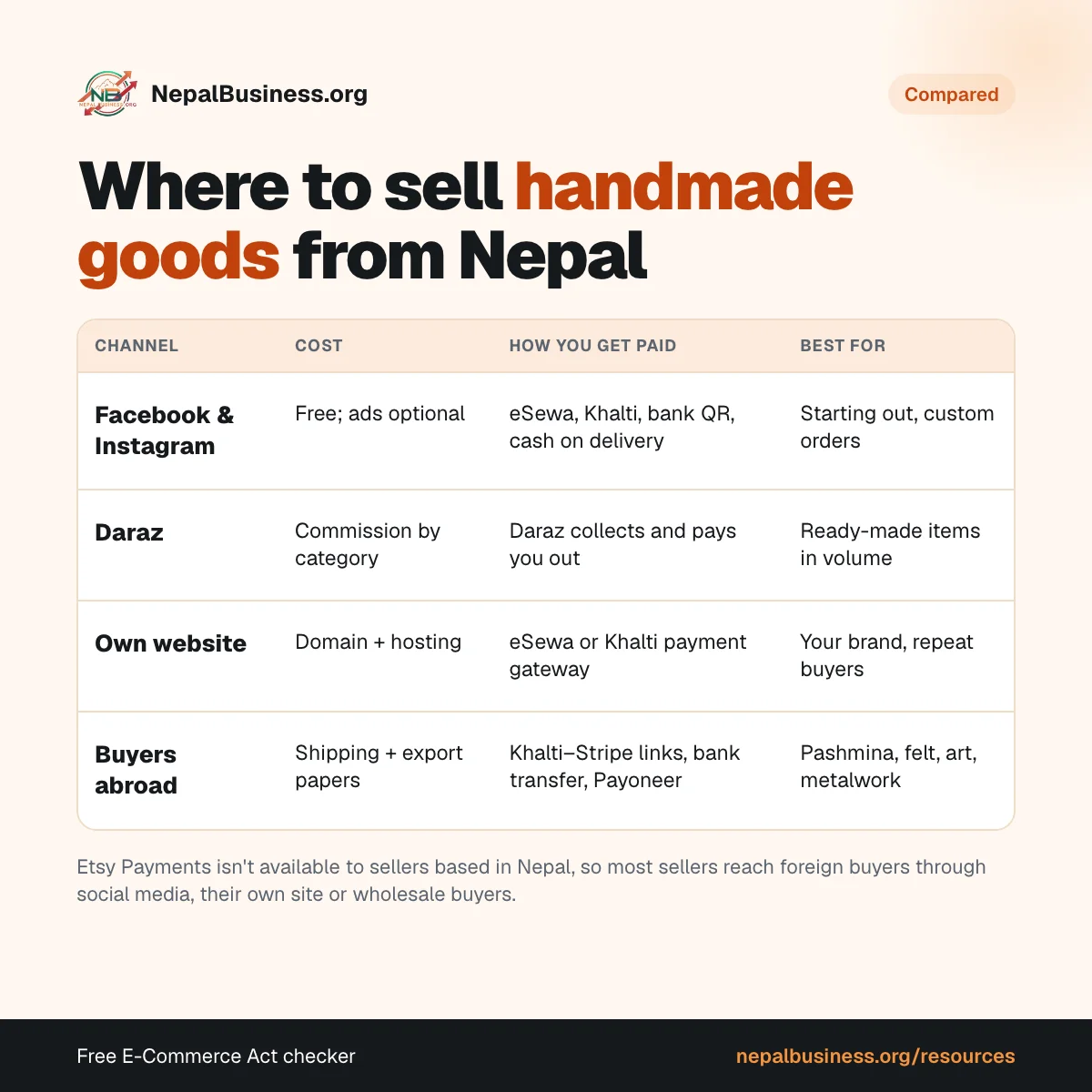
1. Facebook, Instagram and TikTok
Most handmade sellers in Nepal start here. It's free, buyers can message you directly, and it suits custom orders such as a dhaka shawl in a particular colour or a name engraved on a gift.
What works
- Real photos in daylight. Show the texture, the size against a hand, and the product in use.
- Show how it's made. Short videos of weaving, felting or carving build trust and explain your price.
- Put the price in every post, including delivery. Buyers trust clear prices, and the E-Commerce Act requires them.
- Pin a post with your policies: delivery areas and charges, payment methods and returns.
Getting paid and delivering
Most buyers pay by eSewa, Khalti, a bank QR code or cash on delivery. Courier and delivery companies across Nepal can collect cash on delivery for you. If you offer it, budget for some returns and failed deliveries.
The risk
You don't own your followers. In September 2025 the government briefly blocked Facebook, Instagram and other platforms, and sellers who sold only there lost their sales for days. Keep a list of your customers' phone numbers, and build a simple website as a backup.
2. Daraz
Daraz is Nepal's largest online marketplace. It brings buyers from across the country, collects payment and handles a lot of the delivery.
- How to join: register at sellercenter.daraz.com.np. Daraz asks for your business's PAN or VAT registration and a bank account.
- Cost: Daraz says there is no sign-up or monthly fee. It charges a commission on each sale, which depends on the product category and changes with campaigns. Check the current rate card in Seller Center before you set prices.
- Best for: handmade items you can stock in quantity, such as bags, home decor, felt products and jewellery. It's less suited to one-off or made-to-order pieces.
- Tips: use the words buyers search for ("handmade", "dhaka", "felt", "pashmina") in product titles, set your price after the commission, and keep stock levels accurate so orders don't get cancelled.
3. Your own website
A website is the only channel you fully control. You keep every customer, pay no commission and can be found on Google by buyers searching for exactly what you make.
- Domain: a .com.np domain is free for Nepali businesses and individuals.
- Payments: eSewa and Khalti offer payment gateways for registered businesses, and you'll need your registration and PAN to set them up.
- Get found: set up a Google Business Profile and follow our local SEO guide. Our free Local Business Schema Generator and Meta Tag & Share Preview tool help your pages show up properly on Google and when shared on Facebook and WhatsApp.
- Cost: see what agencies charge in our digital marketing cost guide.
4. Selling to buyers abroad
Handmade goods from Nepal sell well abroad, but the usual global marketplaces are hard to use from here. Etsy Payments isn't available for shops in Nepal, and PayPal works only for sending money from Nepal, not receiving it.
Ways that work
- Your own audience: tourists who bought from you in Thamel or Pokhara, Nepali families abroad, and followers on Instagram. Your website and Instagram are your shop window.
- Wholesale and fair-trade buyers: shops and importers abroad often buy in bulk. Trade fairs and the Federation of Handicraft Associations of Nepal (FHAN) can help you find them.
Getting paid from abroad
- Khalti–Stripe payment links: the buyer pays by card, Apple Pay or Google Pay, and you receive rupees in Khalti after completing its international payment KYC.
- Bank transfer (SWIFT): best for larger wholesale orders.
- Payoneer: useful if you sell through a platform that pays out to Payoneer.
Our guide to receiving international payments in Nepal explains each option, with limits and fees.
Shipping
- Nepal Post EMS takes parcels up to 20 kg per item. International couriers are faster but cost more.
- Every parcel containing goods goes through customs before dispatch, at the post office's customs counter or through your courier.
- Commercial exports normally need an EXIM code from the Department of Customs, applied for through the Nepal National Single Window, and VAT registration. Ask your courier or the customs counter what your shipment needs before you promise a delivery date.
- Items that look old, such as metal statues, thangka or old coins, may need a certificate from the Department of Archaeology showing they aren't antiques.
- Never sell products from protected animals, such as shahtoosh. Check the buyer's country's import rules for wood, bone and leather.
The legal checklist: E-Commerce Act 2081
The Electronic Commerce Act, 2081 applies to anyone selling online in Nepal, including Facebook and Instagram shops.
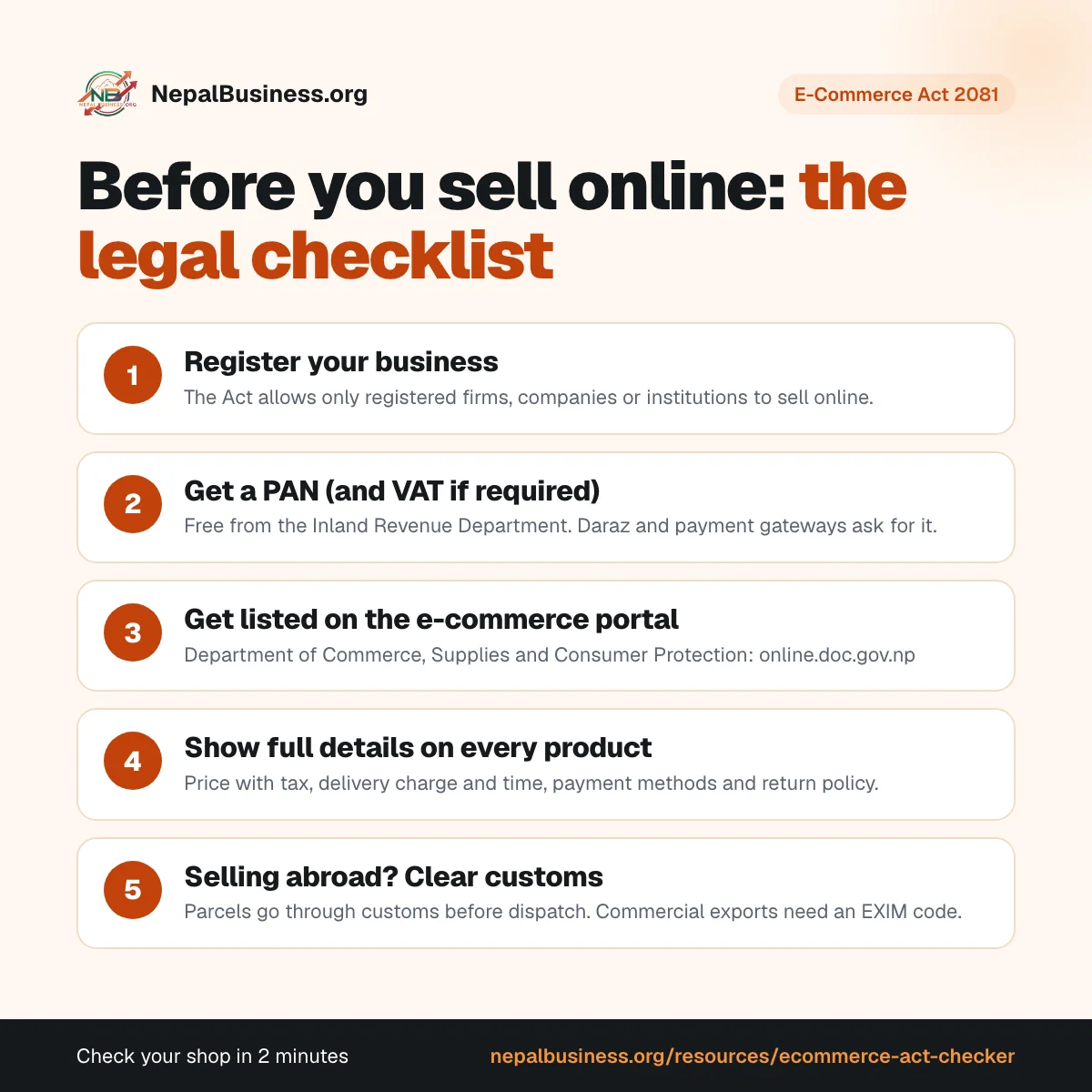
- Register your business. The Act allows only registered firms, companies or institutions to sell online. A sole proprietorship is the simplest option for a single maker. See how to start a small business in Nepal.
- Get a PAN. It's free from the Inland Revenue Department, online or at a tax office. Register for VAT once your turnover passes the VAT threshold, or if you import or export.
- Get listed on the e-commerce portal. Apply on the Department of Commerce, Supplies and Consumer Protection's portal (online.doc.gov.np). The Department sends a listing number.
- Show full details on every product: the final price including tax, delivery charges and time, payment methods and your return policy.
- Accept fair returns. Buyers can return items that don't match the description, are defective or arrive late, and get a refund including tax.
- Keep records of every sale, payment and return.
Read the full rules in E-Commerce Act 2081 explained, or check your shop in two minutes with our free E-Commerce Act Checker.
How to price handmade products
Many makers underprice because they forget their own time. Add up:
- Materials
- Your hours multiplied by a fair hourly wage
- Packaging
- Platform commission or payment fees
- Delivery, if you include it in the price
- Tax
- Your profit margin
Example (made-up numbers): a felt bag uses Rs 400 of materials and 3 hours of work at Rs 150 an hour (Rs 450). With Rs 50 of packaging, the cost is Rs 900 before fees. Add a 10% platform fee and a 30% margin, and the price comes to roughly Rs 1,300.
Need money to grow?
Women entrepreneurs can borrow up to Rs 25 lakh at a government-subsidised rate. See business loans for startups in Nepal.
Frequently asked questions
Can I sell on Etsy from Nepal?
Etsy Payments isn't available for shops based in Nepal, so most Nepali makers sell abroad through their own website, social media and wholesale buyers instead.
Do I need a registered business to sell on Facebook in Nepal?
Yes. The E-Commerce Act 2081 allows only registered firms, companies or institutions to sell online, and that includes social media shops.
Do I need a PAN to sell on Daraz?
Yes. Daraz asks for your business's PAN or VAT registration and a bank account.
How do I get paid by foreign buyers?
Through Khalti–Stripe payment links, a bank transfer (SWIFT) or Payoneer. PayPal can't receive money in Nepal.
Can I send handmade products abroad by post?
Yes. Nepal Post EMS accepts parcels up to 20 kg per item. Parcels go through customs before dispatch, and commercial exports normally need an EXIM code.
Sources
- Daraz: seller requirements
- Etsy Help: countries eligible for Etsy Payments
- Law Alpine: EXIM code registration in Nepal
- NepalBusiness.org: E-Commerce Act 2081 explained
This article is general information, not legal advice. Rules for export and online selling change; confirm with the relevant department before you rely on them.
Join the Discussion
Share your thoughts and engage with our community.
Loading comments...
Log in to join the discussion
Register on the platform, verify your email, then comment on this article.