
Foreign Investment in Nepal (2026): How to Set Up a Foreign-Owned Company
The Rs 2 crore minimum, the automatic route, closed sectors, approvals, tax, visas and every step to registration.


Last updated: 24 October 2026 (7 Kartik 2083). Investment rules in Nepal changed several times in 2025 and 2026. Confirm current requirements with the Department of Industry or a Nepali law firm before you invest.
Nepal allows foreign companies and individuals to own businesses here, in most sectors up to 100%. The rules come mainly from the Foreign Investment and Technology Transfer Act, 2019 (FITTA), and 2026 brought two big changes: the cap on the fast-track "automatic route" was removed, and Nepal Rastra Bank made it easier to bring money in and send profits home. This guide covers the legal requirements and every step to set up a foreign-owned company in Nepal.
Quick answer
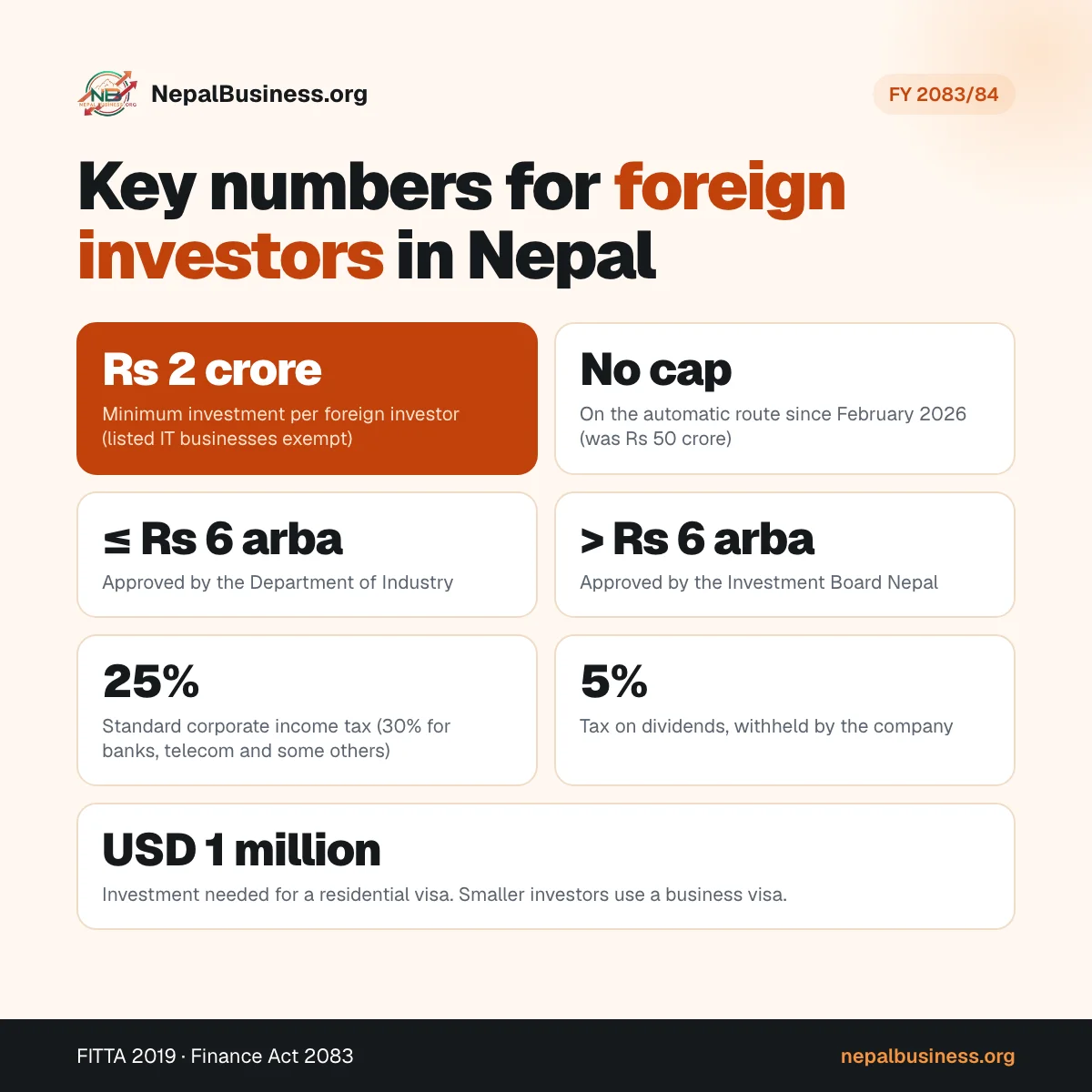
- Minimum investment: Rs 2 crore (Rs 20 million) per foreign investor. Listed IT businesses are exempt.
- Ownership: up to 100% in most open sectors. A few sectors have caps, and some are closed to foreign investment.
- Approval: the Department of Industry approves investments up to Rs 6 arba (Rs 6 billion). The Investment Board Nepal handles larger projects and energy projects above 200 MW. Listed sectors can use the automatic route without prior approval.
- Setup: investment approval, company registration, PAN/VAT, bank accounts, industry registration, then bringing in the money and recording it with Nepal Rastra Bank.
- Tax: 25% corporate income tax for most companies, and 5% tax on dividends.
The laws that apply
- Foreign Investment and Technology Transfer Act, 2019 (FITTA), amended in 2025: who can invest, where, and how approval works.
- Companies Act, 2063 (2006): registering the company.
- Industrial Enterprises Act, 2076 (2020): registering the industry.
- Public-Private Partnership and Investment Act, 2075 (2019): large projects through the Investment Board Nepal.
- Nepal Rastra Bank's foreign investment bylaws: bringing money in and sending it out. These were relaxed in December 2025.
How much you need to invest
The minimum is Rs 2 crore per foreign investor. It was cut from Rs 5 crore in 2022 and kept at Rs 2 crore in the January 2026 reforms. IT businesses listed in the Ministry of Industry's October 2023 notice are exempt and can invest any amount.
There is no maximum. In February 2026 the government also removed the Rs 50 crore ceiling that used to limit the automatic route.
Ways to invest
FITTA recognises several forms of foreign investment, including:
- Buying shares in a new or existing Nepali company
- Setting up or expanding an industry
- Reinvesting dividends earned in Nepal
- Leasing equipment and assets
- Investing through venture capital funds
- Technology transfer: patents, trademarks, know-how, franchising, and technical or management services
Sectors closed or capped for foreign investors
FITTA has a "negative list" of sectors closed to foreign investment. It changes from time to time, so check the current schedule before you plan. Broadly:
Closed to everyone
- Arms, ammunition and explosives, nuclear energy and radioactive materials, and security printing and currency
Reserved for Nepali investors
- Cottage and small industries
- Primary agriculture, unless more than 75% of output is exported
- Personal services such as hairdressing, tailoring and driving training
- Real estate, retail, local courier, money exchange and remittance services
- Travel agencies, trekking guiding, and rural tourism and homestays
- Mass media in national languages, and films in national languages
- Management, accounting, engineering and legal consultancy, and language, music and computer training
Open with an ownership cap
- Telecommunications: up to about 80% foreign ownership
- Domestic airlines: up to 49%
- Consultancy services, where open: up to 51%
Automatic route or approval route?
| Automatic route | Approval route | |
|---|---|---|
| Which sectors | Sectors listed by the government, including IT, manufacturing, tourism, agriculture, infrastructure, energy and services | All other open sectors |
| Prior approval | Not needed. You verify eligibility and register. | Needed, from the Department of Industry or the Investment Board Nepal |
| Size limit | None since February 2026 (was Rs 50 crore) | Up to Rs 6 arba at the Department of Industry; above that, the Investment Board Nepal |
| Speed | Usually faster | Slower, especially with environmental review |
Step by step: setting up a foreign-owned company
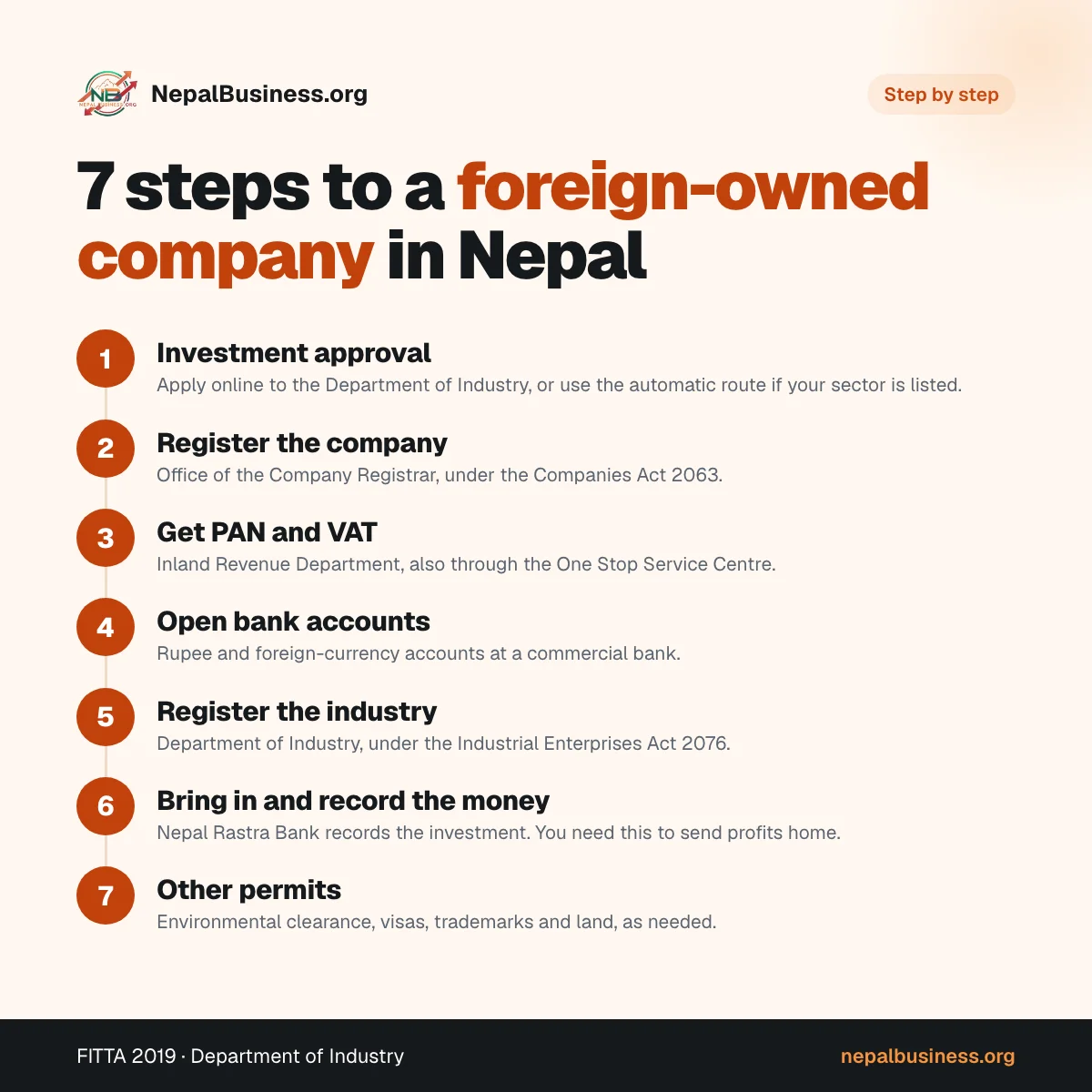
- Get investment approval. Apply online through the Department of Industry's portal (imis.doind.gov.np), or complete the automatic-route eligibility check if your sector is listed. Large projects go to the Investment Board Nepal.
- Register the company with the Office of the Company Registrar under the Companies Act. See our guide to company registration in Nepal.
- Get PAN and VAT registration from the Inland Revenue Department, also available through the One Stop Service Centre.
- Open bank accounts: a rupee account and a foreign-currency account at a commercial bank.
- Register the industry with the Department of Industry under the Industrial Enterprises Act.
- Bring in the money and record it. Transfer the investment through the banking system and get it recorded with Nepal Rastra Bank. This record is what lets you send profits and capital home later.
- Get any other permits your business needs: environmental clearance, visas, trademark registration and land.
Documents you'll need
For a new company or joint venture, the Department of Industry usually asks for:
- A signed project proposal
- The joint venture agreement, if you have a Nepali partner
- Notarised passports of the foreign investors, or the foreign company's incorporation documents
- A notarised board resolution, if the investor is a company
- A financial credibility certificate from the investor's bank at home
- CVs or company profiles of the investors
- An authorisation letter for the person handling the application
Buying shares in an existing Nepali company also needs the share transfer agreement, the current shareholder list, audit reports and a tax clearance certificate.
Sending profits home (repatriation)
Foreign investors can take home their original investment, dividends, royalties and money from selling their shares or assets. Nepal Rastra Bank gives permission on the recommendation of the body that approved the investment, after all taxes are paid. This only works if your investment was properly recorded with Nepal Rastra Bank when it came in.
Taxes
- Corporate income tax: 25% for most companies; 30% for banks, insurance, telecom, tobacco and alcohol. The Budget 2083/84 left these rates unchanged.
- Dividend tax: 5%, withheld by the company as a final tax.
- VAT: 13%.
- IT exports: part of IT export income is tax-exempt, but the exemption was cut from 75% to 50% in Budget 2083/84.
- Tax treaties: Nepal has double-taxation agreements with 11 countries: Austria, Bangladesh, China, India, Mauritius, Norway, Pakistan, Qatar, South Korea, Sri Lanka and Thailand.
For local taxes in more detail, see our guide to Nepal's tax system.
Visas for investors
- Business visa: for foreign investors and their representatives, valid for the investment period and renewed before it expires. You'll need your investment approval and company registration documents.
- Residential visa: for investments of USD 1 million or more. It covers the investor and family members.
- Visas for foreign staff: foreign employees need a non-tourist visa and a work permit, and you must show the job couldn't be filled locally.
Tips before you start
- Check your sector first. Confirm it's open, and whether it's on the automatic route, before you spend money on anything else.
- Use a local law firm for the paperwork. Missing documents are the most common cause of delay.
- Plan your bank transfers so every rupee of investment is recorded with Nepal Rastra Bank.
- Budget time. Approval times vary with the sector, the size of the project and how complete your documents are.
Frequently asked questions
Can a foreigner own 100% of a company in Nepal?
Yes, in most open sectors. Some sectors have ownership caps, such as domestic airlines at 49%, and some are closed to foreign investment.
What is the minimum foreign investment in Nepal?
Rs 2 crore (Rs 20 million) per foreign investor. Listed IT businesses are exempt.
Can foreigners open a retail shop, travel agency or real estate business in Nepal?
No. Retail, real estate, travel agencies, trekking guiding and homestays are reserved for Nepali investors.
What is the automatic route?
A faster path for listed sectors. You verify that your sector qualifies and register, without waiting for case-by-case approval. Since February 2026 there is no upper investment limit on it.
Can I send my profits back home?
Yes. Dividends, royalties and capital can be repatriated with Nepal Rastra Bank's permission after tax, as long as the investment was recorded when it came in.
Do I need a Nepali partner?
Not in most open sectors. You need one only where foreign ownership is capped.
Sources
- Medha Corporate Law: FDI in Nepal, 2026 legal guide
- NEPSE Trading: Nepal lifts cap on automatic-route FDI (2026)
- Niti Partners: minimum investment requirement in Nepal, 2026
- Niti Partners: income tax changes in Budget 2083/84
- UNCTAD Investment Policy Monitor: Nepal
This article is general information, not legal or tax advice. Foreign investment rules in Nepal change often; confirm your case with the Department of Industry or a qualified Nepali lawyer.
Related tools
Free calculators that match this topic
Join the Discussion
Share your thoughts and engage with our community.
Loading comments...
Log in to join the discussion
Register on the platform, verify your email, then comment on this article.