
Fish Farming in Nepal: Cost, Profit and How to Start (2026)
Real 2026 Kalimati fish prices, official pond and stocking figures, what nine studies say ponds earn, and the squeeze from feed and imports

Last updated: 10 November 2026. Fish prices, feed prices and grants change, so check with your buyers, feed supplier and local fisheries office before you invest. This is general information, not financial advice.
Quick answer
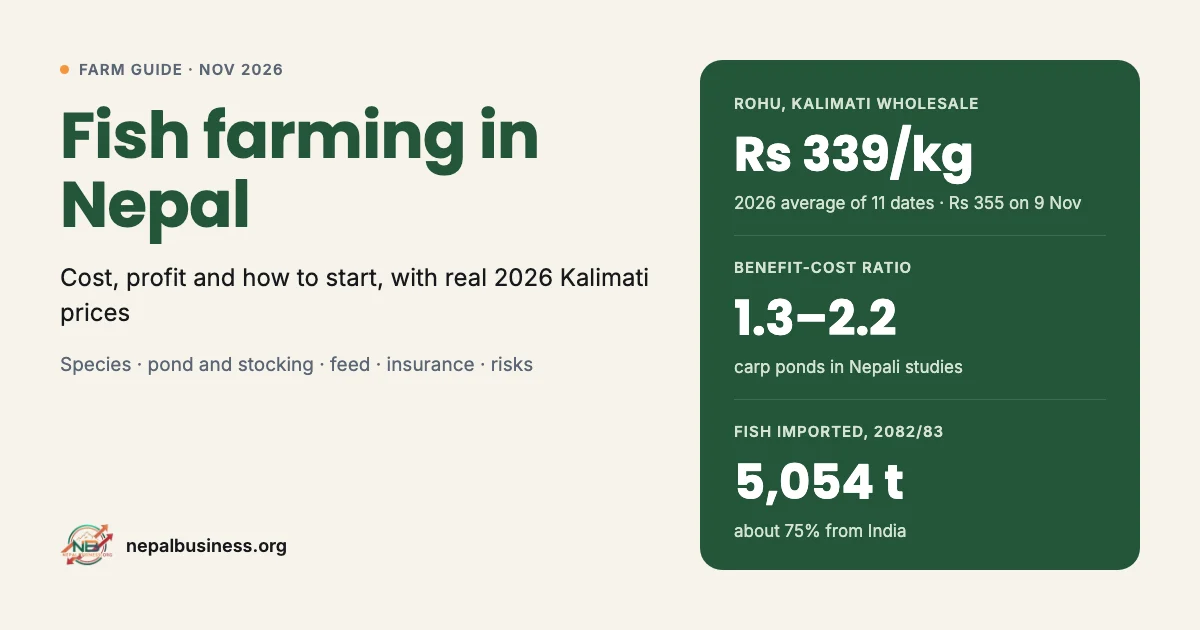
Fish farming (माछा पालन) in Nepal can pay. Nine Nepali farm studies report a benefit-cost ratio of about 1.3 to 2.2 for carp ponds, and Kalimati's wholesale price for rohu averaged Rs 339 a kg across 2026.
The margin is squeezed from two sides. Feed is 40 to 60% of production cost, and in Sarlahi its price has doubled in seven years while farmers still sell at Rs 200 to 400 a kg. Meanwhile Nepal imported 5,054 tonnes of fish in 2082/83, three-quarters of it from India, mostly frozen whole fish at a customs value of about Rs 212 a kg. The ponds that do well keep feed costs down, keep more fingerlings alive, and sell fresh fish locally.
Is fish farming profitable in Nepal in 2026?
Yes, for a well-run pond, but expect a modest margin on rented land. Here is what the studies found:
| Study (data year) | B:C | How it was counted |
|---|---|---|
| Koshi, 470 farms (2022/23) | 1.8 | Basis not stated |
| Chitwan (2016) | 1.63 | Full cost incl. land rent |
| Siraha (2023) | 1.28 | Full cost incl. land rent |
| Kanchanpur (2022) | 1.40 | No depreciation |
| Bara, Pachrauta (2021) | 2.20 | No land rent |
| Dang (2018) | 1.82 | Running costs only |
B:C is the benefit-cost ratio: 1.5 means Rs 1.50 back for every Rs 1 spent. Sources: Koshi Province fisheries survey 2079/80 and studies in Nepali journals; full list at the end.
Three things to know before you read too much into these numbers:
- The ratios are counted differently. When land rent and all costs are included, most studies land between 1.3 and 1.6. The higher figures leave out land rent or count only running costs.
- Bad years happen. In the Chitwan study, some farms lost up to Rs 4.96 lakh per hectare, and in a Dhanusha study some lost up to Rs 15.2 lakh, while others made good profits.
- Feed decides the result. It was the largest or second-largest cost in nearly every study. A Sunsari farmer with 30 ponds says he uses about 2 kg of feed for every kg of fish. At Rs 50 a kg, feed then costs about Rs 100 per kg of fish; at Rs 160 a kg, it costs over Rs 300 (our calculation), close to the whole wholesale price.
Fish prices in Nepal: Kalimati 2026
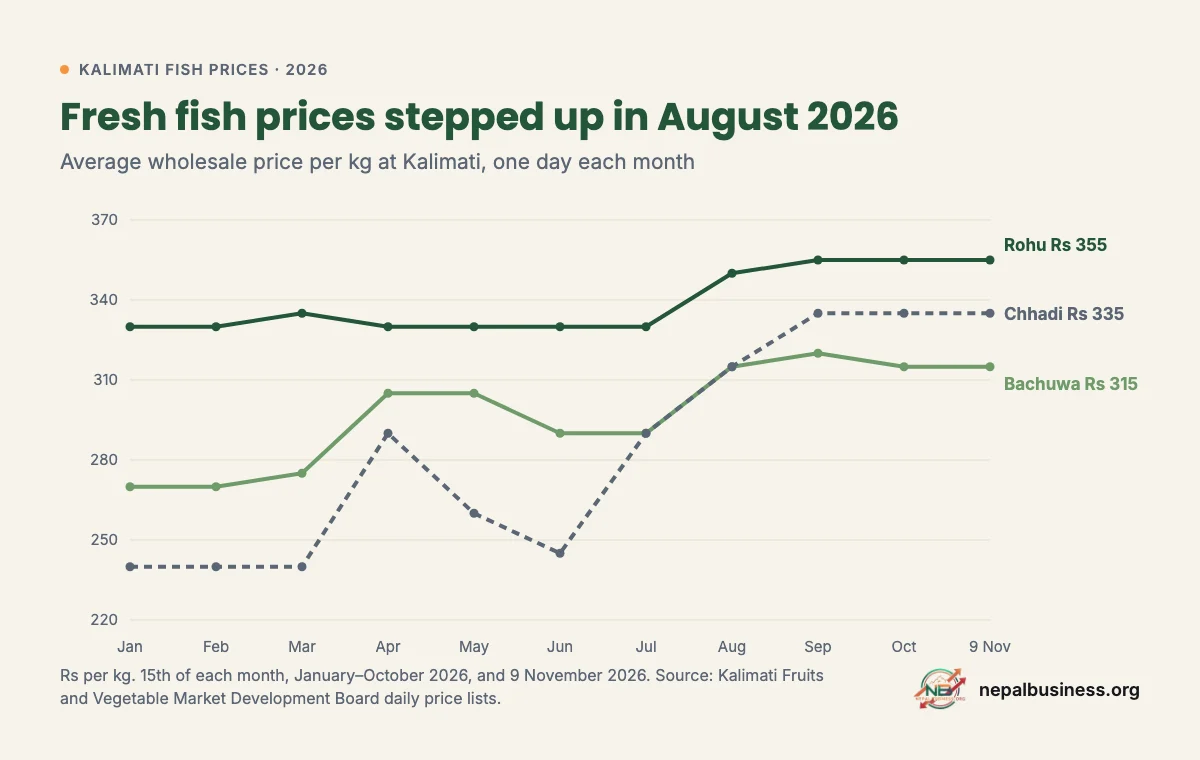
We pulled Kalimati market's official wholesale price list for one day in every month of 2026:
| Date | Rohu | Bachuwa | Chhadi |
|---|---|---|---|
| 15 Jan | Rs 330 | Rs 270 | Rs 240 |
| 15 Feb | Rs 330 | Rs 270 | Rs 240 |
| 15 Mar | Rs 335 | Rs 275 | Rs 240 |
| 15 Apr | Rs 330 | Rs 305 | Rs 290 |
| 15 May | Rs 330 | Rs 305 | Rs 260 |
| 15 Jun | Rs 330 | Rs 290 | Rs 245 |
| 15 Jul | Rs 330 | Rs 290 | Rs 290 |
| 15 Aug | Rs 350 | Rs 315 | Rs 315 |
| 15 Sep | Rs 355 | Rs 320 | Rs 335 |
| 15 Oct | Rs 355 | Rs 315 | Rs 335 |
| 9 Nov | Rs 355 | Rs 315 | Rs 335 |
Average wholesale price per kg on each date, from the Kalimati Fruits and Vegetable Market Development Board's daily price lists. Kalimati also lists dried fish at Rs 900 a kg. See today's prices on our daily prices page.
- Prices move in steps, not every day. All three fresh fish stepped up in mid-August 2026, and bachuwa and chhadi also rose in April.
- Compared with a year ago (9 November 2025), rohu is up 7.6%, bachuwa up 16.7% and chhadi up 39.6%.
- No festival spike showed up on the dates we checked, and we found no 2025–26 report of fish prices jumping at Dashain, Tihar or Chhath.
- Kalimati does not say which species it sells as bachuwa and chhadi, so we have left the names as they are.
From the pond to the plate
- Farm gate: Sarlahi farmers sell at Rs 200 to 400 a kg, the same as seven years ago (Gorkhapatra, May 2026). In Kailali, local fish sells wholesale at Rs 250 against Rs 220 for fish from across the border (eKantipur, August 2025).
- Retail: the Department of Commerce's monthly reports show local fish at about Rs 300 to 525 a kg across six cities in 2026, and Rs 450 to 500 in the Kathmandu Valley from Falgun to Asar 2083.
- Hills pay more: a Khotang farmer sells carp at Rs 800 a kg at his pond (Onlinekhabar, August 2026).
How big is fish farming in Nepal?
- Nepal produced 131,112 tonnes of fish in fiscal year 2081/82, 6.2% more than the year before. Pond carp gave 88,254 tonnes from 54,685 ponds, and 75,639 households farm fish (Ministry of Agriculture statistics).
- Recorded imports rose from 3,918 tonnes in 2081/82 to 5,054 tonnes in 2082/83, worth Rs 120.7 crore. India supplied about 75%, almost all of it frozen whole fish (Department of Customs).
- Frozen carp imports more than doubled, to 1,785 tonnes. That is still only about 2% of what Nepali ponds produce (our calculation), but at a customs value near Rs 212 a kg it pulls prices down.
- Imports are not always cheaper in shops. In Shrawan and Bhadra 2083, the average retail price of "outside" fish in five cities was higher than local fish.
Which fish should you farm in Nepal?
Beginners should start with carp polyculture: several carp species in one pond, each feeding at a different depth. More than 90% of fish farmers in Koshi Province farm this way. The government recommends seven species:
| Species | Nepali name | Share of fish |
|---|---|---|
| Silver carp | सिल्भर कार्प | 35% |
| Common carp | कमन कार्प | 25% |
| Naini (mrigal) | नैनी | 15% |
| Rohu | रहु | 10% |
| Bighead carp | बिगहेड | 5% |
| Grass carp | ग्रास कार्प | 5% |
| Bhakur (catla) | भाकुर | 5% |
Ratio for a pond with all seven species, from the government fish farming FAQ published by Suryabinayak Municipality. The Koshi Province handbook changes the mix by pond: more silver carp in green, fertile water, more grass carp in weedy ponds, and more rohu and naini where you feed pellets heavily.
- Carp need warm water. They grow best at 22 to 32 °C. The government FAQ says carp farming is "not very profitable" where water stays that warm for less than six months a year, which rules out many higher hill sites.
- Check that a species is allowed. In November 2026, Chitwan's district administration ordered three farms to destroy banned Maur fish (माउर). Ask your local fisheries office before you stock anything unusual.
Pangasius: high yield, but not for beginners
Pangasius (पंगास) can produce 30 to 70 tonnes per hectare in 7 to 9 months, according to the government FAQ, and Nepal produced 10,427 tonnes in 2081/82. But Koshi Province's survey found farmers switching from pangasius back to carp: seed came from India, feed was imported, summer water exchange made electricity expensive, and the fish was hard to sell. Nepal also imported about 2,900 tonnes of frozen catfish and catfish fillets in 2082/83. In a 2024 Kailali survey, 60% of pangasius farmers said illegal Indian imports hurt their sales. We found no Nepali study of pangasius costs and profit, so treat it as an option for experienced Terai farmers with reliable power.
Rainbow trout: for cold, flowing water only
Trout (ट्राउट) is a different business, grown in concrete raceways on cold, flowing water. NARC's trout manual says the water must stay below 21 °C all year, and even a small farm needs a steady 10 litres per second. Prices are high: Rs 1,300 to 1,800 a kg in Jumla in April 2026. But the start is hard. One Jumla farmer lost his first 15,000 fingerlings and, after two years, had invested Rs 17.75 lakh against Rs 7.32 lakh of sales (Kathmandu Post and eKantipur, April 2026). Koshi's survey recorded a trout B:C of only 1.3. Fingerlings come mainly from NARC's trout research station at Dhunche, Rasuwa.
How to prepare a fish pond: official figures
| Item | Official figure |
|---|---|
| Pond depth | 1.5–2 m (Terai pond 5–8 kattha) |
| Fingerlings | 350–500 per kattha, 3–4 inch |
| Lime before filling | 15–20 kg per kattha |
| Cow dung before stocking | 70–100 kg per kattha |
| Weekly fertiliser | 0.8 kg DAP + 1.2 kg urea + 60 kg dung per kattha |
| Water temperature | 20–32 °C |
| Dissolved oxygen | above 5 ppm |
| Water pH | 7–9 |
| Time to sell | about 6 months, at 0.5–1 kg |
From the government fish farming FAQ (Suryabinayak Municipality) and the Koshi Province fish farming handbook. The handbook gives a higher basal manure dose (200–300 kg per kattha), so ask your local fisheries technician which suits your pond. One hectare is about 29.5 kattha.
- Lime by soil pH. The handbook gives lime per hectare per year by soil pH: 2,000 kg at pH 4–5, 1,000 kg at 5–6.5, 500 kg at 6.5–7.5, 200 kg at 7.5–8, and none above 8. Lime first, then add manure.
- Check water colour. The handbook uses a Secchi disc: if you can see it 25 to 40 cm down, the water is good. Under 25 cm means too much plankton and a risk of low oxygen, so replace some water. Over 60 cm, add manure.
- Realistic yield: Koshi carp ponds produced 2.8 to 6 tonnes per hectare, and the national pond-carp average was 5.62 tonnes in 2081/82. Expect the lower end in your first years.
- What a pond costs to dig: there is no official rate per kattha or hectare. Costs depend on soil, water source, dikes and the machine, so get two or three local excavator quotes before you budget.
Fingerlings and feed: where your money goes
Fingerlings
- Government fisheries development centres are the cheapest. In November 2024, the Bhandara centre in Chitwan sold one-month fry at 25 paisa and 2 to 3-month fingerlings at 75 paisa each, and hatchlings at Rs 2,000 per lakh for naini and rohu. Janakpurdham's centre sold 43.8 million hatchlings in 2082/83. Call your nearest centre for this year's price.
- Private hatcheries cost more. A Sunsari farmer paid Rs 500 to 550 per kg of fingerlings in August 2026.
- Fingerlings come by season. The handbook's calendar: common carp in Baisakh–Jestha, grass carp in Jestha–Asar, silver and bighead in Asar–Bhadra, and rohu, naini and bhakur from Shrawan to Kartik–Mangsir. If you are starting now, build and prepare the pond over the winter and stock as each species comes on sale.
- Plan for losses. In Agriculture and Forestry University research ponds in Chitwan, only 59% of carp survived overall. The government FAQ says nursery ponds normally lose 40 to 50% of fry.
Feed
Feed fish 5 to 10% of their body weight a day when small, falling to 1 to 3% as they grow, at the same place and time each day. Skip feeding one day a week, on cloudy days, when oxygen is low, and 24 hours before harvest (Koshi handbook). A half-and-half mix of rice bran (ढुटो) and oilcake (पिना) gives about 20% protein, which suits table carp; fry need about 30%. Feed prices vary by product, so compare like with like:
| Feed price | What it was |
|---|---|
| Rs 50/kg | Pina and feed, Sarlahi, May 2026 |
| Rs 60/kg | Pellet, government cost model, 2023 |
| Rs 90/kg | Fish feed, Bardiya farmers, Nov 2025 |
| Rs 160–170/kg | Fish feed, one Sunsari farmer, Aug 2026 |
Sources: Gorkhapatra (May 2026 and November 2025), Koshi handbook, Nawalpur Today (August 2026). The government's guidance is that feed should not cost more than 20% of the price you get for the fish.
Real fish farmers in Nepal: what the news reports
These are success stories, so they show what is possible, not what is typical:
- Pipla Bhandari, Madi, Chitwan: grew from 31 kattha to 12 ponds on 11 bigha, and reports about Rs 20 lakh a year on Rs 50 lakh of sales, with a Rs 50 lakh loan from a microfinance company. She times her harvest for winter (Kathmandu Post, January 2025).
- Tejindra Ghimire, Khotang: sells carp at Rs 800 a kg at his hill ponds and reports Rs 6 to 7 lakh a year from fish and fingerlings. He received a Rs 3.5 lakh provincial grant to repair his ponds (Onlinekhabar, August 2026).
- Hariram Chaudhary, Kanchanpur: runs 22 ponds with pangasius and common carp, producing about 800 quintal a year, and reports over Rs 30 lakh of income. Monsoon rain burst some of his ponds and cost him "lakhs" (eKantipur, December 2024).
- Sarlahi's fish village (माछागाउँ): sends about 30 quintal a day to Kathmandu and Biratnagar, but farmers say their price has not moved in seven years while feed doubled (Gorkhapatra, May 2026).
The farmers earning lakhs usually have at least one advantage: they own their land, sell in the hills at higher prices, sell fingerlings as well as fish, or time their harvest well.
How to start a fish farm in Nepal: 8 steps
- Check your water and land. You need a year-round water source, soil that holds water (clay loam is best), and a site away from flood channels. Test groundwater for iron.
- Get trained. Ask your municipality's agriculture or livestock section, or the nearest government fisheries development centre, about training before you dig.
- Get listed and registered. Make sure your family is in the government's farmer listing programme (किसान सूचीकरण) at your local level; 26.45 lakh farm families were listed by Asar 2083. Register the farm with your municipality, and ask whether you need permission to dig a pond on your land.
- Find buyers first. Talk to local fish sellers, hotels and markets. Selling live or same-day fresh fish locally is your advantage over frozen imports.
- Build in the dry season. The Koshi handbook advises building in winter or the dry months, with a separate inlet and outlet and a screen on each.
- Prepare the pond. Dry it, remove weeds, add lime, fill it to about 1 m, add manure, and stock fingerlings 5 to 6 days later. Float the fingerling bag in the pond for 10 to 15 minutes before releasing them.
- Insure the fish. Since 1 Bhadau 2083 the government pays 80% of the premium (details below).
- Keep records. Note fingerlings stocked, feed bought, deaths and every sale, so you know your real cost per kg.
Electricity: check your meter category
Many fish farms pump water and run aerators, so the electricity rate matters. Nepal Electricity Authority's tariff list has no category for fish farming. For low-voltage connections, it lists:
| Category | Rate per unit |
|---|---|
| Irrigation (सिंचाई) | Rs 2.25 |
| Rural and cottage industry | Rs 7.80 |
| Small industry | Rs 9.60 |
| Commercial | Rs 11.20 |
| Non-commercial | Rs 12.00 |
Energy charge from NEA's published consumer tariff, checked 9 November 2026. Industry, commercial and non-commercial meters also pay a monthly demand charge; irrigation does not.
This is a real issue for farmers. Sarlahi fish farmers say their ponds were moved from about Rs 2.30 a unit to Rs 12 (Gorkhapatra, May 2026), and in March 2024 they blocked the East-West Highway, saying NEA had given them industrial meters. Before you connect power, ask your local NEA office which category your pond will be billed under.
Do fish farmers pay VAT?
No VAT applies when you sell live fish or fresh and chilled fish. Both are listed as exempt in Schedule 1 of the VAT Act 2052 (Group 3), as amended up to the Finance Act 2083, unless a hotel, restaurant or similar business sells them. Frozen fish and fish fillets are not on that exempt list. For PAN and income tax, ask your local Inland Revenue Office.
What government support is there for fish farmers?
Insurance: the government pays 80% of the premium
Under the Ministry of Agriculture's premium subsidy procedure, in force from 1 Bhadau 2083 (about 17 August 2026), the government pays 80% of the premium on a policy's sum insured up to Rs 1 crore, and 50% on any amount above that. Fish insurance (माछा बीमालेख) is on the list of covered policies. You pay only your share when the insurer issues the policy. Ask the insurer what the premium rate is and exactly which losses are covered, such as floods, disease or lack of oxygen, because we could not find these in an official source.
Concessional loans: ask your bank if they are lending
Under the 2082 procedure, the government pays 3 percentage points of the interest on concessional agriculture and livestock loans of up to Rs 5 crore, and banks can charge at most their base rate plus 1.5%. Banks had stopped new concessional lending for about two and a half years because the government owed them subsidy. In September 2025 the Finance Ministry paid Rs 9.8 billion of that money, and eKantipur reported that banks were likely to restart. In Saun 2083 the procedure was amended so that a borrower who repays on time can renew and keep the subsidy for up to five years. We found no figure showing how many new loans banks are giving now, so ask your bank, for example the Agricultural Development Bank, before you plan around one. See our guide to business loans for startups in Nepal.
Fish zones and local grants
- Fish zones continue under the renamed national agriculture modernisation programme. Madi Municipality in Chitwan is one (eKantipur, November 2026).
- Typical help includes grants for fingerlings, feed-making machines, aerators and pond digging, though farmers told Onlinekhabar in November 2025 it was not enough. In 2081/82, Kailali's fish zone offered fish-farming equipment at a 50% grant.
- Ask early. Grants are set each fiscal year, which starts on 1 Shrawan (mid-July), and you usually have to apply. We could not confirm this year's grant rates, so ask your municipality and the provincial fisheries office.
What are the biggest risks in fish farming?
- Floods. The Asoj 2081 floods damaged 458 hectares of fish ponds in Madhesh and nearby districts, with about Rs 1.13 billion of fish lost (Onlinekhabar). In August 2026, the Bhotekoshi-Trishuli flood washed away the government fish farm at Trishuli. Build strong dikes and a spillway, and keep ponds away from flood channels.
- Cheap imports. Indian frozen fish enters at about Rs 212 a kg by customs value. In November 2024, Chitwan's fish entrepreneurs said 300 tonnes of local fish sat unsold.
- Feed and other costs. Feed has doubled for Sarlahi farmers in seven years, and Jhapa farmers report rising electricity, medicine and labour costs.
- Low oxygen. The government handbook warns that too much manure and dense plankton can starve fish of oxygen, especially on cloudy days. Watch water colour and stop feeding when oxygen is low.
- Disease and survival. Bara farmers most often report red spot disease, lernaea and argulus. Losing a large share of fingerlings is normal, so plan for it.
- Pollution. Pesticide runoff has slowed fish growth in Kulekhani's cage farms (eKantipur, October 2025).
Tips from the numbers
- Watch your feed cost per kg of fish. It decides your profit more than anything else.
- Use government fingerlings and stock to the pond's capacity. Koshi's survey found many farmers get low yields simply because they cannot stock enough fingerlings.
- Sell fresh and local. Live or same-day fish is the one thing frozen imports cannot offer.
- Do not judge by Kalimati alone. It is a Kathmandu wholesale price; your farm-gate price will be lower in the Terai and can be higher in the hills.
- Keep records. Our AI prompts for businesses include prompts that turn notebook records into a clean sheet.
Frequently asked questions
Is fish farming profitable in Nepal?
It can be. Nepali studies report a benefit-cost ratio of about 1.3 to 2.2 for carp ponds, and around 1.3 to 1.6 when land rent and all costs are counted. Feed cost, fingerling survival and where you sell decide whether your pond makes money.
What is the price of fish in Nepal today?
On 9 November 2026, Kalimati's average wholesale price was Rs 355 a kg for rohu, Rs 315 for bachuwa and Rs 335 for chhadi. Retail prices for local fish ranged from about Rs 300 to 525 a kg across cities in 2026. Check today's Kalimati prices on our prices page.
Which fish is best for beginners in Nepal?
Carp polyculture: silver, common, naini, rohu, bighead, grass carp and bhakur together in one pond. Pangasius and trout can earn more but need more experience, money and the right water.
How many fish can I keep in one kattha?
The government recommends 350 to 500 fingerlings of 3 to 4 inches per kattha for a semi-intensive carp pond.
How long do carp take to grow?
About six months to reach 0.5 to 1 kg, according to the government fish farming FAQ, if the water stays between 22 and 32 °C.
Where can I buy fingerlings in Nepal?
From government fisheries development centres, such as Bhandara in Chitwan and Janakpurdham, which are the cheapest, and from private hatcheries. Call your nearest centre for this season's price and stock.
Is there insurance for fish farming in Nepal?
Yes. Fish policies are covered by the government's premium subsidy: since 1 Bhadau 2083, it pays 80% of the premium for a sum insured up to Rs 1 crore and 50% above that.
Do I pay VAT when I sell fish?
No, not on live or fresh fish. Both are VAT-exempt under Schedule 1 of the VAT Act, unless sold by a hotel or restaurant. Frozen fish is not on the exempt list.
Related guides
- Goat farming in Nepal: cost, profit and how to start
- Poultry farming in Nepal: cost, profit and how to start
- Mushroom farming in Nepal: cost, profit and how to start
- 270 business ideas for Nepal
- Business loans for startups in Nepal
Sources
- Kalimati Fruits and Vegetable Market Development Board, daily wholesale price lists (dates in the table, collected 9 November 2026)
- Suryabinayak Municipality, fish farming FAQ
- Directorate of Livestock and Fisheries Development, Koshi Province, fish farming handbook and fisheries survey 2079/80
- Bagmati Province fisheries, fish feed guidance
- Ministry of Agriculture, Statistical Information on Nepalese Agriculture 2081/82
- Department of Customs, foreign trade statistics 2081/82 and 2082/83
- Department of Commerce, Supplies and Consumer Protection, monthly price reports, for example Baisakh 2083 and Shrawan–Bhadra 2083
- Chitwan study, economics of fish production, Journal of Agriculture and Natural Resources, 2018
- Siraha study, fish farming economics, Journal of Agriculture and Natural Resources, 2024
- Kanchanpur study, carp farming, 2025
- Pachrauta, Bara study, fish production in a super zone, Heliyon, 2024
- Dhanusha study, fish farming, Archives of Agriculture and Environmental Science, 2024
- Dang study, fish farming economics, Journal of Agriculture and Natural Resources, 2022
- Agriculture and Forestry University, carp polyculture trial in Chitwan, 2022
- NARC, Rainbow Trout Fish Farming Technology and Practice
- Nepal Electricity Authority, consumer tariff rates (checked 9 November 2026)
- Nepal Law Commission, मूल्य अभिवृद्धि कर ऐन, २०५२ (VAT Act 2052), Schedule 1, Group 3 (as amended up to the Finance Act 2083)
- Ministry of Agriculture, Forest and Environment, कृषि, पशुपन्छी तथा जडीबुटी बीमाको प्रिमियममा अनुदान उपलब्ध गराउने कार्यविधि, २०८३ (premium subsidy procedure; in force from 1 Bhadau 2083)
- eKantipur, concessional loan procedure 2082 (29 August 2025) and Rs 9.8 billion interest subsidy released (21 September 2025)
- Onlinekhabar, concessional loans can be renewed for up to five years (7 Saun 2083)
- Onlinekhabar, farmer listing programme (21 Asar 2083)
- Gorkhapatra, Sarlahi fish village (31 May 2026) and Bardiya fish farmers (November 2025)
- PrabhabOnline, Bhandara fisheries centre fingerling prices (22 November 2024)
- Onlinekhabar English, 43.8 million hatchlings in Janakpur (7 August 2026)
- Nawalpur Today, Sunsari fish farmer (28 August 2026)
- eKantipur, Kailali farmers and imported fish (10 August 2025)
- The Kathmandu Post, success stories from the field and the farm (1 January 2025) and trout farming in Jumla (15 April 2026)
- Onlinekhabar, Khotang fish farmer (August 2026)
- eKantipur, Kanchanpur fish farmer (7 December 2024)
- Onlinekhabar, flood damage to fish ponds (Asoj 2081)
- eKantipur, Chitwan orders banned Maur fish destroyed (2 November 2026)
- Onlinekhabar, fish farmers on government support (22 November 2025) and Kailali fish zone (Asoj 2081)
- PrabhabOnline, Chitwan fish unsold (November 2024)
- The Kathmandu Post, fish farmers block the East-West Highway (22 March 2024)
- eKantipur, pesticide runoff in Kulekhani (28 October 2025)
Join the Discussion
Share your thoughts and engage with our community.
Loading comments...
Log in to join the discussion
Register on the platform, verify your email, then comment on this article.