
Poultry Farming in Nepal: Cost, Profit and How to Start (2026)
What 500 broilers cost, what one batch really earns, and the risks most guides skip

Last updated: 3 November 2026. Prices change every week, so check them with your hatchery, feed dealer and buyer before you invest. This is general information, not financial advice.
Poultry is the biggest commercial farm business in Nepal. According to the National Statistics Office's commercial poultry survey, 22,928 farms keep about 33.5 million birds, and broiler meat alone brings in more than Rs 57 billion a year. It is also one of the easiest farm businesses to start: chicks are ready to sell in about six weeks, and a small shed can hold 500 birds. Most guides stop there. This one also covers the parts that decide whether you make money: what a batch really costs per kilo, how far prices can fall in a month, and what bird flu did to farms in 2026.
Quick answer
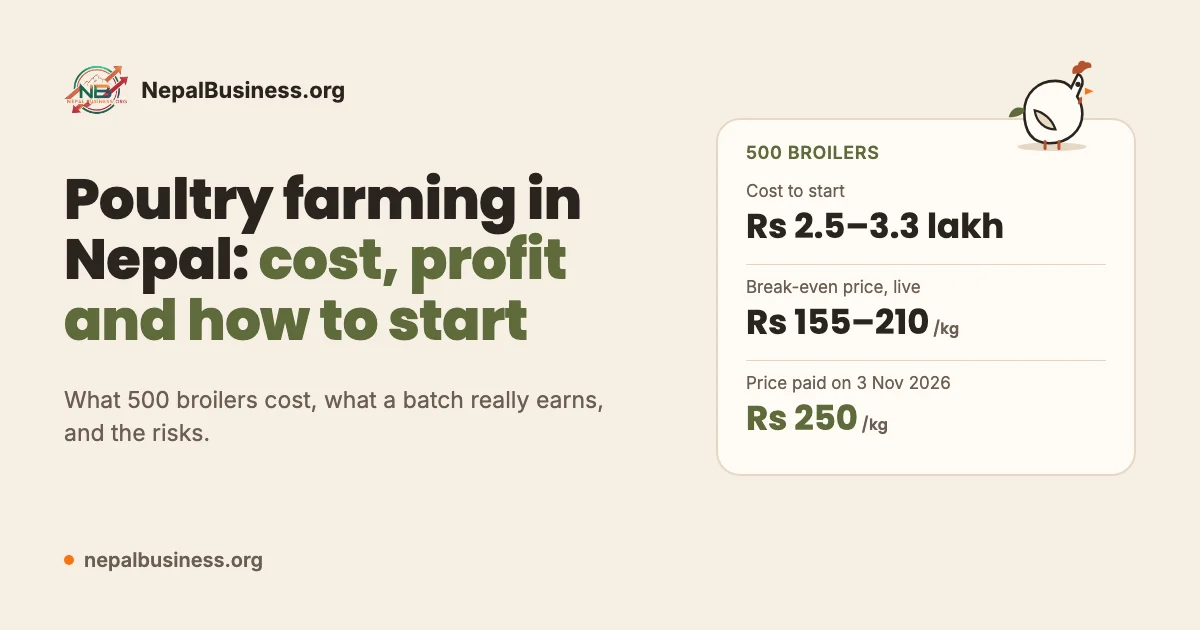
- Starting cost: about Rs 2.5 to 3.3 lakh for a 500-bird broiler farm. That covers a simple shed, equipment and the first batch of chicks and feed.
- Profit per batch: from about Rs 8,000 to Rs 1.3 lakh in our model. It depends mostly on the live chicken price on the day you sell, how many birds die and how well they convert feed into weight.
- Today's price (3 Nov 2026): buyers in Kathmandu Valley pay Rs 250 per kg live, down from Rs 290 a month earlier.
- Biggest cost: feed, at about 70% of everything you spend.
- Biggest risks: price crashes, disease (half of all farms reported losses) and bird flu, which led to more than 835,000 birds being culled in 2026.
- Help available: the government pays 80% of the insurance premium and part of the interest on qualifying agriculture loans.
Is poultry farming profitable in Nepal in 2026?
It can be, but the profit is thin and unpredictable. Demand is real: the average Nepali eats about 5.7 kg of chicken and 3.66 kg of eggs (about 61 eggs) a year, against world averages of 14.1 kg and 8.9 kg. That is less than half, so there is room to grow. But the supply side is crowded and most inputs are imported. Nepal imports about 99% of the soybean and close to half of the maize used in poultry feed, and feed makes up about 70% of production costs. When feed prices rise or the chicken price falls, small farms feel it first.
The industry has been through hard years. Broiler hatcheries fell from 340 before Covid to 109 by early 2026. For two years hatcheries sold broiler chicks below their Rs 65 cost, sometimes for as little as Rs 25. Prices only recovered in March 2026. The farms that last are the ones that budget for bad batches, not just good ones.
| Nepal's poultry sector | Figure |
|---|---|
| Commercial poultry farms | 22,928 |
| Farms raising meat birds | 92% |
| Farms producing eggs | 7.5% |
| Broilers on farms | 24.5 million |
| Layers on farms | 6.6 million |
| Broiler meat a year | 258,626 tonnes |
| Spent on feed a year | Rs 54 billion |
| Farms with disease losses | 51.2% |
| Farms with insurance | 4.1% |
Source: National Statistics Office commercial poultry survey (calendar year 2024), reported by the Kathmandu Post, 20 March 2026.
Broiler or layer: which should a beginner choose?
Most beginners should start with broilers. Broilers are meat chickens sold at about six weeks, so you get your money back quickly and learn from each batch. Layers lay eggs from about week 19 to week 80. They need far more capital, and in late 2025 eggs were selling below their cost of production.
| Broiler | Layer | |
|---|---|---|
| What you sell | Meat birds | Eggs |
| Chick price (Mar 2026) | Rs 90 | Rs 160 |
| Time to first sale | About 6 weeks | About 5 months |
| Start cost, 500 birds | Rs 2.5 to 3.3 lakh | Rs 5 to 7 lakh |
| Best for | Beginners | Experienced farmers |
Why layers are risky right now: a December 2025 study by Agriculture and Forestry University put the cost of producing one egg at Rs 19.12. That is about Rs 574 for a crate of 30. Farmgate prices at the time were Rs 490 to 520 a crate, so many layer farms were selling at a loss. Layers can pay well when egg prices rise, but they are a second step, not a first one.
Local and Giriraja chickens are a third option. The survey counted about 407,000 Giriraja birds on commercial farms. They grow more slowly but sell at a premium to buyers who want "local" chicken. Start small and line up buyers first, because this market is much smaller than the broiler market.
How much does it cost to start a poultry farm in Nepal?
For 500 broilers, plan on about Rs 2.5 to 3.3 lakh in total. About half goes on the shed and equipment, which you buy once. The rest is working capital for the first batch, which comes back when you sell.
| Item (500 broilers) | Low | High |
|---|---|---|
| Shed, about 500 sq ft | Rs 80,000 | Rs 1,20,000 |
| Feeders, drinkers, brooder, scale | Rs 13,000 | Rs 18,000 |
| First batch (chicks, feed, medicine) | Rs 1,60,600 | Rs 1,90,100 |
| Total | Rs 2.5 lakh | Rs 3.3 lakh |
Shed and equipment ranges are estimates from a Nepali farm guide (Thulo Bazaar, 2025). First-batch costs come from our model below. A common rule of thumb is about 1 square foot of floor per broiler. A brick shed costs more, roughly Rs 1.5 to 2.5 lakh.
If you already have land and a sound outbuilding, you can start for well under Rs 2 lakh. Don't spend all your money on the shed. Keep enough cash for at least two batches of chicks and feed, because the first batch is where most beginners make costly mistakes.
How much profit does one batch of 500 broilers make?
We built a simple model for one batch of 500 chicks, with a good case and a tough case. Every input is shown so you can change it to match your own quotes.
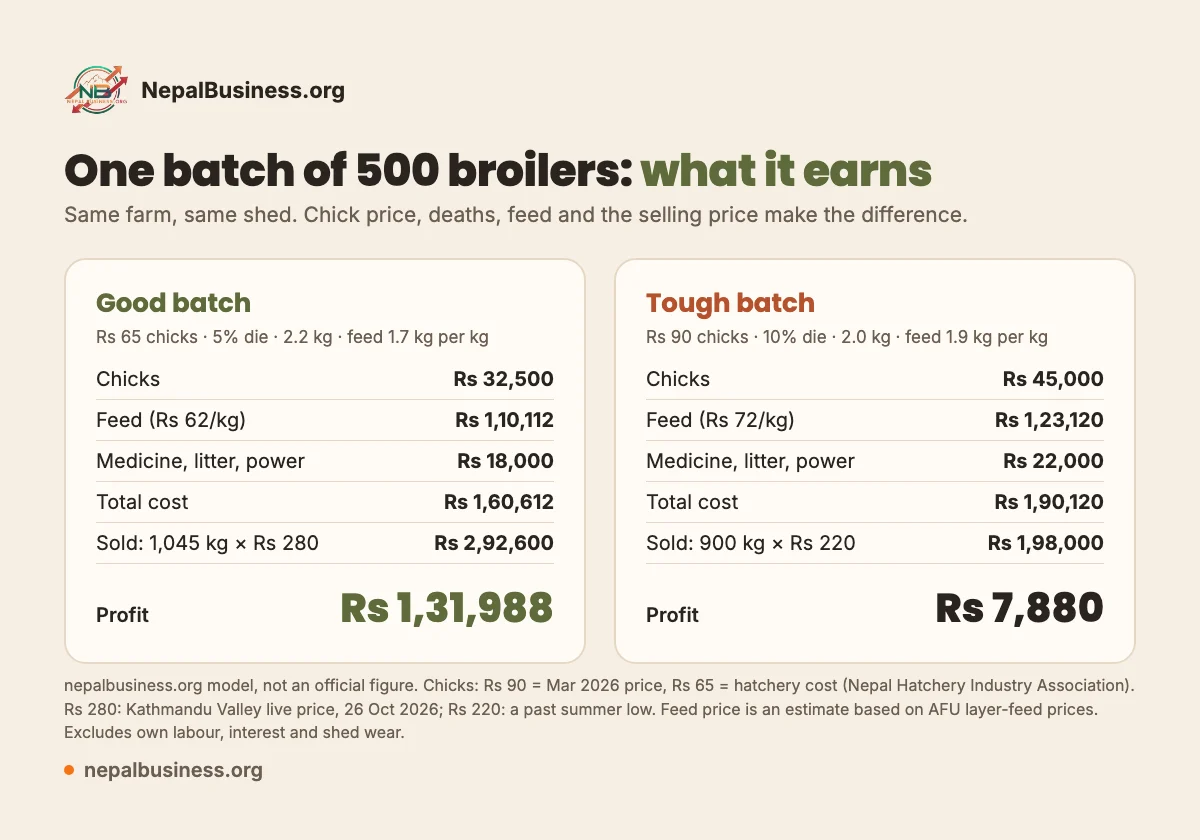
| One batch, 500 chicks | Good | Tough |
|---|---|---|
| Chick price | Rs 65 | Rs 90 |
| Birds that die | 5% | 10% |
| Weight at sale | 2.2 kg | 2.0 kg |
| Feed per kg of bird | 1.7 kg | 1.9 kg |
| Feed price per kg | Rs 62 | Rs 72 |
| Chicks | Rs 32,500 | Rs 45,000 |
| Feed | Rs 1,10,112 | Rs 1,23,120 |
| Vaccines, medicine | Rs 6,000 | Rs 8,000 |
| Litter, power, transport | Rs 12,000 | Rs 14,000 |
| Total cost | Rs 1,60,612 | Rs 1,90,120 |
| Cost per kg live | Rs 154 | Rs 211 |
| Live weight sold | 1,045 kg | 900 kg |
| Sale price per kg | Rs 280 | Rs 220 |
| Sales | Rs 2,92,600 | Rs 1,98,000 |
| Profit | Rs 1,31,988 | Rs 7,880 |
Our model, not an official figure. Chick prices come from the Nepal Hatchery Industry Association: Rs 90 is the March 2026 selling price, and Rs 65 is what it costs a hatchery to produce a chick. Hatcheries sold at or below Rs 65 for two years before March 2026, so the good case reflects a weak chick market. The Rs 280 sale price is the Kathmandu Valley rate on 26 October 2026. Rs 220 is a summer low: traders have cut the Valley live price to Rs 220 in past slow seasons. We found no published 2026 broiler feed price, so the feed price is our estimate. It is based on the Rs 60.50 to 68 per kg layer feed prices in the AFU study and on earlier broiler feed rates of Rs 63 to 66 per kg reported by New Business Age. The model leaves out your own labour, loan interest and shed wear (about Rs 4,000 a batch if a Rs 1 lakh shed lasts five years).
What the model shows:
- Your break-even price is roughly Rs 155 to 210 per kg live. At today's Rs 250, both cases make money: about Rs 1 lakh in the good case and Rs 35,000 in the tough case.
- Feed conversion matters most. Every extra 0.1 kg of feed per kg of bird costs you about Rs 6,500 a batch. Good chicks, clean water, the right temperature and no feed waste keep it down.
- Selling day matters too. The live price fell by Rs 40 per kg between 2 October and 3 November 2026. On 1,000 kg of birds, that is Rs 40,000 lost just from the timing.
- A realistic year has five or six batches (about 6 weeks of growing plus 1 to 2 weeks of cleaning). Some will be good and some will be tough, so plan your budget around the tough case.
How to start a poultry farm in Nepal: 8 steps
1. Learn first, ideally on a working farm
Spend a few weeks on a nearby farm, or take a short livestock training course through your municipality or district veterinary office. You will learn brooding, vaccination and how to spot sick birds, which no budget can teach you.
2. Pick the site carefully
Choose dry land with road access, clean water and electricity, away from houses. After the 2026 bird flu outbreaks, officials said high-risk farms were often near tall trees with wild birds, near wetlands, or open to vehicles and visitors. Your municipality may also check the location and how you handle manure, so ask before you build.
3. Register the farm
Register with your local level (municipality or rural municipality). Most have an agriculture or livestock section that registers farms. Only 63.7% of commercial poultry farms are registered with any government agency, but you will need registration for loans, insurance, subsidies and bird flu compensation. If you plan to run it as a business, read our guide to business registration in Nepal and get a PAN.
Fees and exact requirements differ by municipality, but these documents are commonly asked for:
- Citizenship certificate of the owner (or of each director, for a company)
- Land ownership certificate (lalpurja) and this year's land tax receipt, or a written lease agreement if you rent the land
- A map of the plot showing where the sheds will stand
- A recommendation letter from your ward office, which may first ask whether neighbours object
- A simple farm plan: shed size, number of birds, drainage and manure handling
Larger farms may also need an environmental study and an inspection by the district veterinary office. Ask at your ward office before you build, because getting approval for a shed that already exists is harder.
4. Find your buyer before you buy chicks
This is the step most new farmers skip. Talk to local traders, cold stores, meat shops, hotels and restaurants. Agree roughly on when they will collect and how the price will be set. In Kathmandu Valley the National Chicken Sales Entrepreneurs Association announces the buying price, and it can change several times a month. If you plan to sell dressed chicken or packed eggs straight to customers, that can also need a food licence. See our guide to food licences in Nepal.
5. Build the shed and buy equipment
For broilers, an open-sided shed with good airflow, a raised floor or deep litter, curtains for cold nights, and a brooder for the first two weeks is enough. Put a footbath and a gate at the entrance, and keep one pair of boots just for the shed.
6. Buy chicks and feed from known suppliers
Buy day-old chicks from a registered hatchery and ask for its vaccination record. Compare feed prices from two or three agrovets, because feed is 70% of your cost. Write down every bag you use. Feed per kg of bird is the number that tells you whether a batch went well.
7. Vaccinate, keep records and insure
Follow a vaccination schedule from your veterinarian or the district Veterinary Hospital and Livestock Service Expert Centre. Record deaths, feed and weight every day. Then insure the flock: since mid-July 2026 the government pays 80% of the premium on livestock and poultry policies up to Rs 1 crore insured value. Only 4.1% of farms are insured, so the rest carry the full loss themselves when disease hits.
8. Sell, clean and rest the shed
Sell at about 35 to 42 days, when the birds reach around 2 kg or more. Then remove all litter, wash and disinfect the shed and equipment, and leave it empty for 1 to 2 weeks before the next batch. Skipping this break is how disease carries over from one batch to the next.
What are the biggest risks in poultry farming?
Bird flu
Bird flu (H5N1) hit Nepal hard in 2026. By July, outbreaks had reached 162 farms in 12 districts, led by Bhaktapur, Kathmandu and Kavrepalanchok. The government culled 835,563 birds and destroyed more than 1.2 million eggs and 264 tonnes of feed. It paid Rs 507 million in compensation to 104 farms.
Know the compensation rules before an outbreak. Under the Bird Flu Control Regulation, farmers can get up to 75% of the assessed value, but only for birds the government culls. Birds that die before culling are not covered. So report sick birds to your veterinary office early, and keep your farm registration and records up to date.
Price crashes
Chicken prices follow demand. They rise before festivals and fall afterwards and in the hot months. Prices fell again after Dashain 2026 because people ate goat meat during the festival and many residents had not yet returned to the Valley. Spread your batches so you are not selling all your birds in the weakest weeks.
Disease and heat
More than half of farms (51.2%) reported birds lost to disease and other causes in the survey year. In the Tarai, summer heat cuts growth sharply. Good ventilation, shade, clean water and biosecurity cost little compared with losing a batch.
Feed and imports
Feed prices depend on imported soybean and maize, and cheap chicken and eggs brought in from India without permission push prices down. You cannot control either. You can control feed waste, and you can keep a cash buffer.
What government support is there for poultry farmers?
| Support | What you get |
|---|---|
| Livestock insurance | Govt pays 80% of premium (up to Rs 1 crore cover) |
| Concessional loan | Govt pays 3 points of interest; collateral needed |
| Bird flu compensation | Up to 75% of value of culled birds |
| Local programmes | Varies; ask your municipality |
Under the 2025 concessional loan procedure, the government pays 3 percentage points of the interest on qualifying commercial agriculture loans, up to Rs 5 crore. Unlike most other categories, agriculture and livestock loans need collateral. Banks also have to lend part of their money to agriculture, so a registered farm with a clear plan is a welcome borrower. Our guide to business loans for startups in Nepal explains how to apply.
Don't count on grants, though. Only 5.6% of poultry farms received any subsidy in three years. Build your budget without one, and treat any subsidy as a bonus.
Tips from the numbers
- Start with 300 to 500 broilers. It is big enough to learn the business and small enough to survive a bad batch.
- Track feed per kg of bird every batch. If it is above 1.8, find out why before the next batch.
- Keep cash for two batches. The second batch pays for the mistakes of the first.
- Insure every flock. At an 80% premium subsidy, it is the cheapest protection you can buy.
- Sell to more than one buyer. A single trader can set your price.
- Compare with other farm businesses. See our dairy business guide and our list of business ideas in Nepal.
Frequently asked questions
How much does it cost to start poultry farming in Nepal?
About Rs 2.5 to 3.3 lakh for 500 broilers, including a simple shed, equipment and the first batch. A 500-bird layer farm costs about Rs 5 to 7 lakh, because the hens must be raised for about 20 weeks before they lay.
How much profit can I make from 500 broilers?
In our model, one batch makes from about Rs 8,000 in a tough batch to about Rs 1.3 lakh in a good one, before your own labour. At the 3 November 2026 price of Rs 250 per kg, the range is about Rs 35,000 to Rs 1 lakh.
What is the chicken price in Nepal today?
From 3 November 2026, buyers in Kathmandu Valley pay Rs 250 per kg for live broilers, and the retail price for dressed chicken is Rs 350 per kg. The National Chicken Sales Entrepreneurs Association sets these rates and changes them often.
How many days does a broiler take to grow?
About 35 to 42 days to reach around 2 kg or more. With cleaning and a rest period between batches, a farm can raise five or six batches a year.
Do I need to register a poultry farm in Nepal?
Register with your local level. You need it for bank loans, insurance, subsidies and bird flu compensation. Most offices ask for your citizenship certificate, land ownership papers or a lease, a plot map and a ward recommendation. Fees differ by municipality, so ask your ward office or the municipality's agriculture or livestock section.
Is there insurance for poultry in Nepal?
Yes. Livestock insurance covers poultry, and since mid-July 2026 the government pays 80% of the premium for policies up to Rs 1 crore insured value and 50% above that. Insurance agents sell the policies.
Is layer farming better than broiler farming?
Not for beginners. Layers need about twice the capital and take months before they earn anything. In December 2025, eggs cost more to produce (about Rs 574 a crate) than farmers were paid (Rs 490 to 520). Start with broilers, then add layers once you know the business.
Sources
- Kathmandu Post: Poultry sector adds over Rs60.96 billion to Nepal's economy annually (20 March 2026), on the National Statistics Office commercial poultry survey
- OnlineKhabar: Chicken prices fall in Kathmandu Valley (3 November 2026)
- OnlineKhabar: Chicken prices fall in Kathmandu after Dashain (26 October 2026)
- Ratopati: Chick prices cover costs after two years of losses (20 March 2026)
- Ceotab: Cost of egg production rises to Rs 19.12 per egg (14 December 2025), on the Agriculture and Forestry University study
- Kathmandu Post: Bird flu hits 162 poultry farms, Rs507 million paid in compensation (23 July 2026)
- Kathmandu Post: More farmers are getting insurance (19 August 2026)
- Republica: Govt cuts concessional loan interest subsidy to 3% (28 August 2025)
- The Star / Asia News Network: Nepal's poultry sector faces challenges (2 January 2026)
- Republica: Declining meat demand pushes live chicken price down to Rs 220 per kg, for a past summer low
- New Business Age: Prices of poultry feed rise due to increase in price of raw materials, for earlier broiler feed rates
- Value chain analysis of broiler poultry in Sindhuli District, Nepal (NepJOL)
- Thulo Bazaar: Poultry farming in Nepal, setup cost and returns (2025), for shed and equipment estimates
Join the Discussion
Share your thoughts and engage with our community.
Loading comments...
Log in to join the discussion
Register on the platform, verify your email, then comment on this article.