
Nepali Food Products: A Complete Guide (2026)
What Nepal makes, what it exports, which products have official standards, and how to read a label

Last updated: 3 November 2026. Export figures come from Nepal's customs data as reported in the press, and quality standards from Nepal Gazette notices. Figures are for Nepali fiscal years, which run from mid-July to mid-July.
Nepal produces far more than dal bhat. Its hills grow some of the world's most prized large cardamom and orthodox tea, its mountains make the hard chhurpi cheese that ends up as dog chews in the United States, and its villages have fermented gundruk and sun-dried masyaura for generations. This guide covers the main Nepali food products, what Nepal actually exports, which products now have official quality standards, and how to tell a properly labelled product from a risky one.
Quick answer
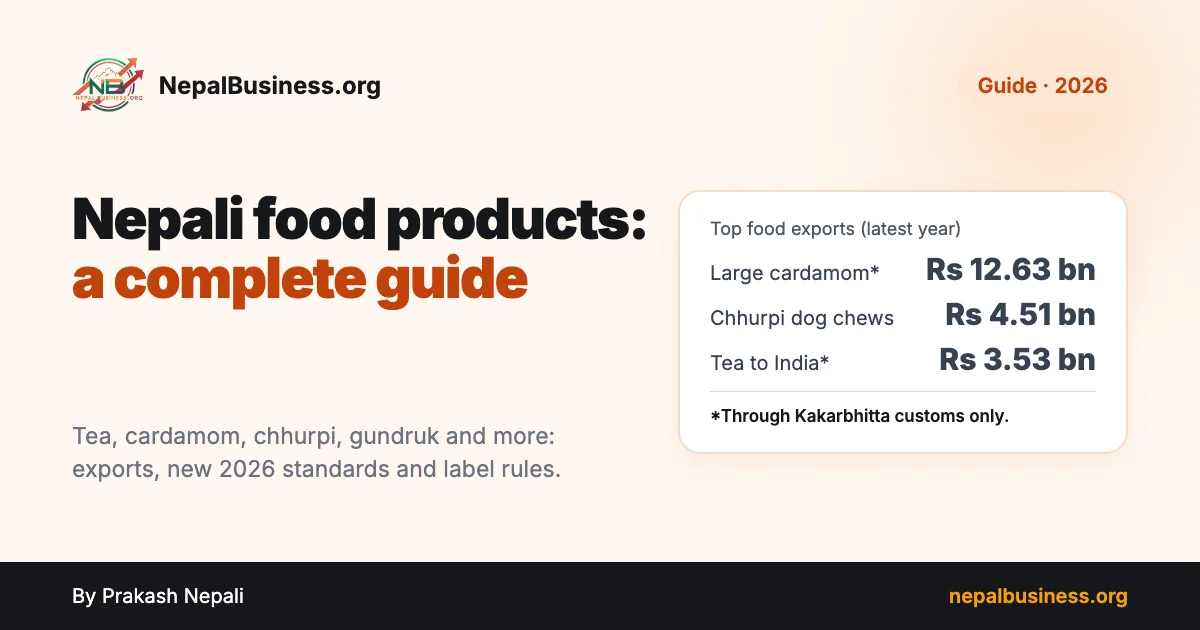
- Nepal's biggest food exports are large cardamom, chhurpi and tea. Cardamom alone earned about Rs 12.6 billion through one customs office in FY 2082/83.
- Traditional foods now have legal standards. In 2026 the government set the first official quality standards for masyaura, chhurpi, gundruk, rolled oats and soya chunks.
- Every packaged food must carry a label with the product name, maker, ingredients, weight, price, batch number and production date. Selling without one can bring a fine of up to Rs 1 lakh.
- Nepal has no registered "GI" products yet, so names like "Ilam tea" or "Jumla Marshi rice" are not legally protected the way Darjeeling tea is in India.
- Buying from abroad? Tea, spices and dried vegetables usually travel well, but meat and dairy (including chhurpi and ghee) are banned or restricted in many countries' customs rules, including the UK's.
What are the main Nepali food products?
The table lists the best-known Nepali food products, where they mainly come from, and how they are used.
| Product | Main areas | Used as |
|---|---|---|
| Orthodox and CTC tea | Ilam, Jhapa, Dhankuta | Drink, export |
| Large cardamom | Eastern hills | Spice, export |
| Coffee (arabica) | Gulmi, mid-hills | Specialty coffee |
| Timur (Nepali pepper) | Mid-hills | Spice, achar |
| Chhurpi (hard cheese) | Mountain districts | Snack, dog chew |
| Gundruk and sinki | Hills, nationwide | Fermented greens |
| Masyaura | Hills, nationwide | Dried lentil balls |
| Jumla Marshi rice | Jumla | Red rice |
| Honey and ghee | Nationwide | Food, gifts |
| Achar, lapsi, titaura | Nationwide | Pickles, sweets |
| Instant noodles | Factories | Snack, export |
Tea and coffee
Nepal is self-sufficient in tea. It produced about 26.1 million kg in FY 2081/82, according to figures reported by Spotlight Nepal. The flat Jhapa estates make mostly CTC tea (the strong, granular tea used for milk tea), while the hills of Ilam and Dhankuta make orthodox leaf tea, which sells for more abroad.
Coffee is the opposite story. Nepal grew about 501 tonnes of green coffee in FY 2080/81, but it imported more than it exported: 443 tonnes worth Rs 419.8 million came in, while 89 tonnes worth Rs 149.2 million went out, according to National Tea and Coffee Development Board figures. Nepali coffee is small-batch and earns about three times the price per kilo of the cheap coffee Nepal imports.
Spices
Large cardamom is Nepal's star food export. It grows under forest shade in the eastern hills and is sold mostly to India and onward markets. Timur, a relative of Sichuan pepper with a tingling, citrus taste, is a mid-hill crop used in pickles and spice mixes. Dried ginger and turmeric are smaller exports.
Traditional fermented and dried foods
Gundruk (fermented and dried mustard, radish or cauliflower leaves) and sinki (fermented radish root) are made in almost every hill household. Masyaura are sun-dried balls of black lentil mixed with yam or taro. These foods keep for months without a fridge, which is why they travel well and why small producers increasingly sell them packaged.
Dairy: chhurpi and ghee
Chhurpi is a cheese made from cow, yak or buffalo milk. Nepali families eat a softer kind, but the very hard kind has become a major export: it is shaped into long-lasting dog chews, mostly for the US market. Ghee from the hills is also a popular gift for relatives abroad.
Rice, grains and packaged foods
Jumla Marshi is a red rice grown in the high valleys of Karnali, among the highest-altitude rice fields in the world. Buckwheat, millet and beaten rice (chiura) are other traditional staples. Among factory foods, instant noodles such as Wai Wai are the best-known Nepali brands abroad.
Which Nepali food products earn the most from exports?
Customs data shows a clear top three. Cardamom is by far the largest, and chhurpi has quietly grown into a multi-billion-rupee export.
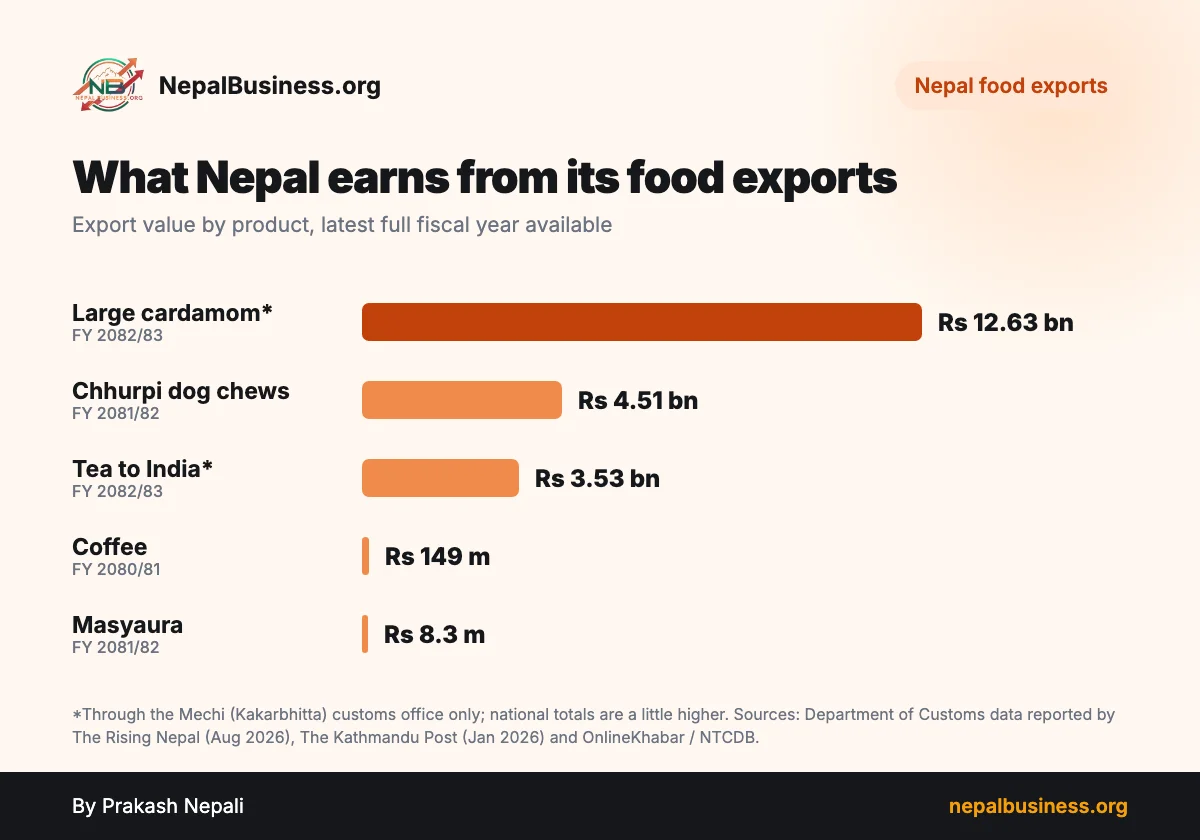
| Product | Year | Export value |
|---|---|---|
| Large cardamom* | 2082/83 | Rs 12.63 bn |
| Chhurpi dog chews | 2081/82 | Rs 4.51 bn |
| Tea to India* | 2082/83 | Rs 3.53 bn |
| Coffee | 2080/81 | Rs 149 m |
| Masyaura | 2081/82 | Rs 8.3 m |
*Through the Mechi (Kakarbhitta) customs office only, the main exit point for cardamom and tea; national totals are a little higher. Each row uses the latest full year we could find. Sources: The Rising Nepal (cardamom), The Rising Nepal (tea), The Kathmandu Post (chhurpi, masyaura), OnlineKhabar (coffee).
Two trends stand out. Cardamom is booming: exports through Kakarbhitta rose from about 4.29 million kg (Rs 7.67 billion) to 6.38 million kg (Rs 12.63 billion) in one year. Tea is under pressure: tea sent to India through Kakarbhitta fell from 15,311 tonnes (Rs 4.17 billion) to 13,045 tonnes (Rs 3.53 billion). From May 2026, India also began requiring a lab test for every truckload of imported tea, at about Rs 18,000 per sample and at least 14 days' wait. Exporters told Spotlight Nepal that shipments stopped completely for a time after the rule began.
Which Nepali foods now have official quality standards?
Nepal's Food Hygiene and Quality Act, 2081 lets the government set quality standards for any food by a notice in the Nepal Gazette (Section 3). In 2026 it used that power for several traditional and popular foods for the first time:
| Food | Set in | Key rule |
|---|---|---|
| Masyaura | Jan 2026 | Moisture up to 11% |
| Chhurpi | Jan 2026 | Moisture up to 14% |
| Rolled oats | Feb 2026 | Clean, no mould |
| Soya chunks | Feb 2026 | No added colour |
| Gundruk | 2026 | No metal vessels |
- Masyaura must be clean, dry and free of insects and decay, with moisture up to 11% and protein not over 15% of dry weight.
- Chhurpi may have no more than 14% moisture and must have at least 60% milk protein (dry weight). It is graded high-fat (5% milk fat or more) or low-fat, and must be free of fungus, stones, glass, plastic, hair and other debris (Kathmandu Post).
- Gundruk may be made from mustard, rapeseed or radish leaves and stems. Iron, aluminium, copper and brass vessels are banned in production, the product must have no mould or insects, and it must be packed in clean, dry, food-grade material (Ratopati).
- Soya chunks may contain no more than 3% of other added food by weight, and artificial colours and fragrances are banned (Ratopati; Kathmandu Post).
These standards matter for sellers. Food that falls below a published standard counts as "substandard" under the Act, which can bring up to 6 months in jail, a fine of up to Rs 3 lakh, or both (Section 42). The Department of Food Technology and Quality Control (DFTQC) publishes the full list of mandatory standards.
How do you check a Nepali packaged food label?
Section 19 of the Act bans selling packaged food without a label and lists what every label must show. Use it as a checklist before you buy, or before you print your own labels:
- The name of the food, and the maker's name and address
- The ingredients
- Net weight or volume, selling price, batch number and production date
- The use-by period, if the food must be eaten within a set time
- Warning messages or symbols, if the food could harm people with certain conditions
- Nutrition information, for foods where the government requires it
The label must be in Nepali or English, and makers should prefer Nepali for products made and sold in Nepal. Loose fruit and vegetables don't need labels, but imported packaged produce does. Labels must not be false or misleading, for example by calling a lower-grade product a higher grade (Section 17).
Red flags: no batch number or date, a handwritten price over a printed one, a "pure" or "organic" claim with no maker's address, or a past use-by date. Under Section 24, shops must not sell food that should be labelled but isn't, or food past its use-by date.
The NS mark is a separate certificate from the Nepal Bureau of Standards and Metrology. Many good food products don't carry it, so its absence alone is not a warning sign.
Are Nepali food names like "Ilam tea" legally protected?
Not yet. A geographical indication (GI) is a legal tag that stops other producers from using a place name, the way only tea from the Darjeeling region may be sold as "Darjeeling tea". As of late 2026, Nepal has no registered GI products. A draft Industrial Property Bill would create a GI register, but it has not been passed (Nepal Economic Forum; Kathmandu Post).
In practice, a pack labelled "Ilam tea", "Jumla Marshi" or "Himalayan honey" is only as trustworthy as its maker. Buy from known brands, cooperatives or estates that print a full address, and be wary of very cheap "premium" products.
Can you take or order Nepali food abroad?
Many Nepalis abroad ask relatives to bring food, or order it online. The rules depend on the country you are entering, not on Nepal:
- Usually allowed if declared: tea, coffee, dry spices, sealed packaged snacks and noodles, and dried vegetables like gundruk. Check your country's list first.
- Often banned: meat (including sukuti) and dairy (including chhurpi and ghee). The UK does not allow meat or milk-based products from outside the EU in personal luggage, apart from infant milk and special medical food (GOV.UK). US Customs requires travellers to declare all food and restricts many meat and animal products (CBP).
- Commercial imports (for a shop or online store abroad) need the destination country's import approvals. Nepali exporters can ask DFTQC for a quality certificate showing the food meets the buyer country's standards (Section 14 of the Act).
Sending money home to buy these goods? See our guides to sending money from the USA and from the UK.
Which Nepali food products make good small businesses?
Products that keep without a fridge, are hard to make in a city kitchen and have a story behind them sell best online and to Nepalis abroad. Good starting points include:
- Packaged gundruk, masyaura and sinki, now that official standards make quality easier to prove
- Achar and timur spice mixes, which need little equipment
- Single-estate orthodox tea and Nepali coffee, where buyers pay for origin
- Honey and ghee from your own cooperative or farm, with a lab test to back up purity claims
- Dairy products, which have steady local demand; see our dairy business guide
Before you sell, you'll need the right registration and food licence. Our step-by-step guide on how to sell food online in Nepal explains the licences, labels and costs. For more ideas, browse our 270 business ideas for Nepal.
Frequently asked questions
What is Nepal's most exported food product?
Large cardamom. About 6.38 million kg worth Rs 12.63 billion left through the Kakarbhitta customs office alone in FY 2082/83, more than chhurpi and tea exports combined.
Why does Nepal export so much chhurpi?
Hard chhurpi lasts for months and is very chewy, so US pet companies sell it as a natural dog chew. Nepal exported about 2,610 tonnes of dog chews worth Rs 4.51 billion in FY 2081/82.
What is the difference between gundruk and sinki?
Both are fermented and sun-dried. Gundruk is made from leaves (mustard, radish, cauliflower), while sinki is made from radish roots. Gundruk now has an official quality standard.
Does every Nepali food pack need a licence number?
The Act requires every food business to hold a licence (Section 9) and every packaged food to carry a label (Section 19). The label list in Section 19 does not include a licence number, but many makers print their DFTQC licence number anyway, which helps buyers check them.
Where can I check Nepal's official food standards?
The Department of Food Technology and Quality Control publishes mandatory standards and notices on dftqc.gov.np. New standards also appear in the Nepal Gazette.
Sources
- Food Hygiene and Quality Act, 2081 (Nepal Law Commission), Sections 3, 14, 17, 19, 24 and 42
- Department of Food Technology and Quality Control
- The Rising Nepal: cardamom exports through Kakarbhitta
- The Rising Nepal: tea exports to India
- Spotlight Nepal: India's tea testing rule
- The Kathmandu Post: masyaura and chhurpi standards
- The Kathmandu Post: rolled oats and soya chunks standards
- Ratopati: gundruk standards
- OnlineKhabar: Nepal's coffee trade
- Nepal Economic Forum: missing GI tags
- GOV.UK: bringing meat and dairy into Great Britain
Join the Discussion
Share your thoughts and engage with our community.
Loading comments...
Log in to join the discussion
Register on the platform, verify your email, then comment on this article.