
How to Sell Food Online in Nepal: Licences and Steps (2026)
Which food licence you need, who issues it, what your label and online store must show, and what it costs

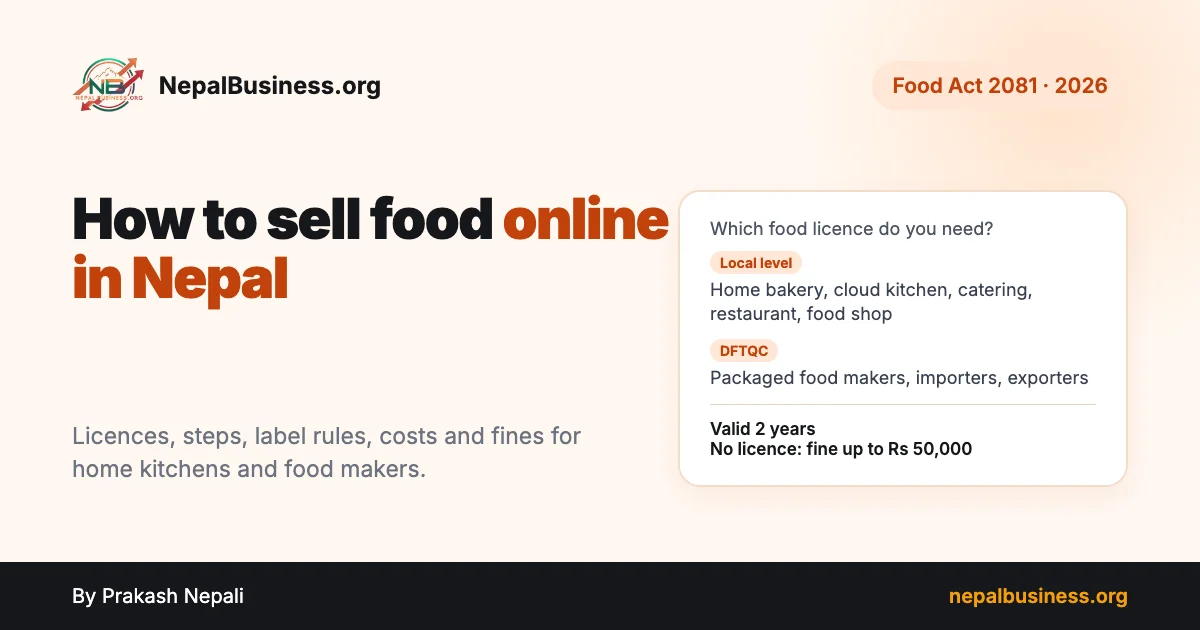
Last updated: 3 November 2026. This guide is based on the Food Hygiene and Quality Act, 2081 and the Electronic Commerce Act, 2081. It is general information, not legal advice. Fees and some exemptions are set in rules and by each local government, so confirm with your municipality or the Department of Food Technology and Quality Control before you start.
Thousands of Nepalis now sell food online: cakes from a home kitchen, achar and gundruk through Instagram, momo through delivery apps, honey and tea on Daraz. Many assume a Facebook page needs no paperwork. It does. Nepal's 2081 food law defines a food business to include selling food online through an electronic system, and every food business needs a licence before it starts. This guide explains which licence you need, the steps in order, what your labels and online store must show, and what happens if you skip them.
Quick answer
- Yes, you need a licence to sell food online. The Food Hygiene and Quality Act, 2081 counts online food sales as a food business (Section 2) and requires a licence before you operate (Section 9).
- Cooked food, bakeries, catering and food shops get their licence from the local level (your municipality or rural municipality).
- Food manufacturers, packers, importers and exporters get theirs from the Department of Food Technology and Quality Control (DFTQC), often online through NeFFILS.
- You also need a registered business, a PAN, and a listing on the government's e-commerce portal.
- A licence lasts two years. Running a food business without one can bring a fine of up to Rs 50,000.
Does Nepal's food law apply to online sellers?
Yes. Section 2 of the Food Hygiene and Quality Act, 2081 defines a "food business" as producing, processing, preparing, packaging, storing, selling, exporting or importing food for commercial or public use. It then adds that this includes selling food from a fixed place, while moving on the street, or online using an electronic system.
So the law treats an Instagram cake shop the same way it treats a bakery on the high street. The same is true of the Electronic Commerce Act, 2081, which covers sales through a website, an app or a social media marketplace.
Which food licence do you need?
Section 9 splits food licences between two authorities. Which one you need depends on what you do, not on whether you sell online.
| What you sell | Licence from |
|---|---|
| Home bakery, cakes | Local level |
| Cloud kitchen, tiffin | Local level |
| Catering, events | Local level |
| Restaurant, cafe | Local level |
| Reselling packaged food | Local level |
| Making packaged food | DFTQC |
| Importing or exporting | DFTQC |
Local level licences (Section 9(2)(a)) cover wholesale and retail food trade, street vending, hotels, motels, restaurants, food courts, food parks, canteens, catering, eateries, homestays and other food businesses that must register with the local level. You apply to the chief of your municipality, or the officer they appoint. If you run food outlets in more than one municipality, you need a separate licence for each (Section 9(4)).
DFTQC licences (Section 9(2)(b)) cover import, export and every other food business, which in practice means makers and packers of food products: achar, packaged gundruk, spice mixes, juices, noodles, packed honey and so on. You apply to the Director General of the Department of Food Technology and Quality Control or the head of one of its offices.
Possible exemptions: Section 9 says some types of food business may be exempt "as prescribed", meaning the government can list exemptions in the rules under the Act. Don't assume you are exempt. Ask your ward or municipality, or DFTQC, in writing.
Step by step: how to start selling food online legally
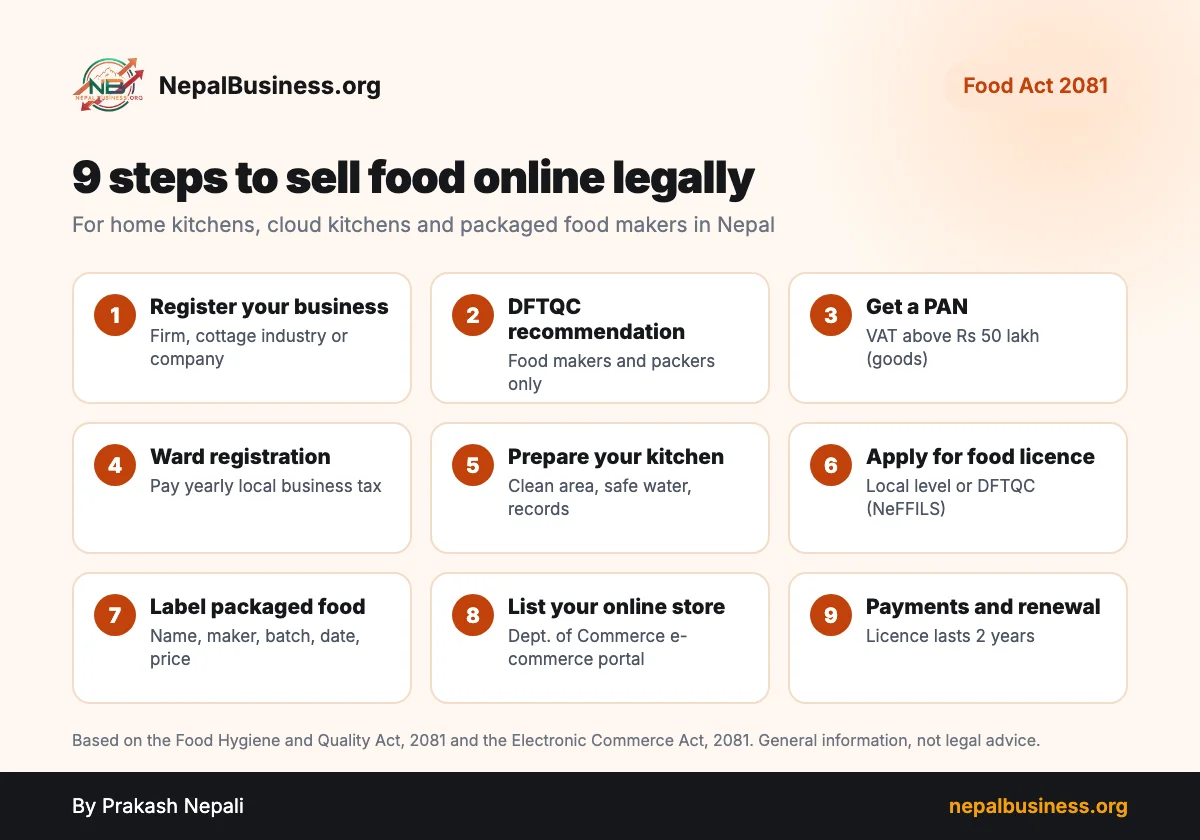
Step 1: Choose and register your business
The E-Commerce Act lets only a registered firm, company or institution sell online (Section 3), so you can't stay an unregistered individual. Most small food sellers register as a sole proprietorship (private firm) or a cottage industry with their local government or province office, or as a private company with the Office of Company Registrar. Our guides to company registration and the cost to start a business compare the options and fees.
If you will make or pack food, do Step 2 first. Section 8 says anyone setting up an industry that produces, processes, packages or stores food must get a recommendation from DFTQC (or the province's food office) before registering the industry.
Step 2: Get a DFTQC recommendation (makers and packers only)
Apply to DFTQC with the request letter from the industry registration office, the industry's capital, type and capacity, and a technical proposal explaining how you will keep the food hygienic and up to quality, including who will do that work (Section 8(4)). If DFTQC is satisfied, it issues the recommendation for a fee.
Step 3: Get your PAN (and VAT if needed)
Register for a Permanent Account Number with the Inland Revenue Department. Your PAN must be shown on your online store. VAT registration becomes compulsory once yearly turnover passes Rs 50 lakh for goods, or Rs 30 lakh for services or a mix. Restaurants and catering often fall in the mixed category, so check with your tax office. See our Nepal tax guide.
Step 4: Register with your ward and pay local business tax
Register the business with your ward office and pay the yearly business tax your municipality sets. If you rent a kitchen or shop, the landlord should register the rental agreement with the ward too.
Step 5: Prepare your kitchen and paperwork
The licensing officer will inspect your premises and can send samples for lab testing before issuing a licence (Section 9(5)). Get ready for that by keeping:
- A clean, separate food preparation area with safe water, drainage and pest control
- Food-grade containers and packaging
- A list of your products and how much you expect to make each year
- A simple written process for keeping each product hygienic
- Records of where you buy ingredients and which batch went to which customer (the Act calls this traceability, Sections 20 and 24)
Staff with an infectious or contagious disease must not handle food until they have recovered (Section 20).
Step 6: Apply for the food licence
Apply to the local level or DFTQC (see the table above) with these documents (Section 9(3)):
- A copy of your business registration certificate
- Details of the food you will produce, process, pack or store, and the yearly quantity
- A detailed description of the methods you will use to keep it hygienic and up to quality
- Your business address, phone number and details of the main people running it
DFTQC licences can be applied for, renewed and tracked online through NeFFILS. Local levels have their own forms; ask at your ward or municipal office. If your application passes inspection and any lab tests, the officer must issue the licence, with the conditions you must follow, within 30 days (Section 9(5)).
Step 7: Design a legal label (packaged food)
If your food goes out in a sealed pack, it needs a label. See the label checklist below. Unlabelled packaged food can't legally be made or sold (Section 19).
Step 8: List your online store with the Department of Commerce
After setting up your website, app, Daraz shop or social media page, apply to be listed on the e-commerce portal of the Department of Commerce, Supplies and Consumer Protection. The Department sends a listing number within 7 days (E-Commerce Act, Section 5). Our free E-Commerce Act Checker shows what is still missing from your store.
Step 9: Set up payments and delivery, then renew on time
Payment wallets such as eSewa and Khalti usually ask for your registration certificate and PAN before opening a merchant account. For delivery, use a courier that can keep the food cool and on time, because you are responsible if it arrives spoiled. Put your licence renewal date in your calendar: a licence lasts two years (Section 10).
What must a food label show in Nepal?
Section 19 lists what every packaged food label must include:
| Item | Example |
|---|---|
| Food name | Mustard gundruk |
| Maker name, address | Your firm, ward no. |
| Ingredients | Mustard leaves |
| Weight or volume | 200 g |
| Selling price | Rs 250 |
| Batch number | GD-2611-01 |
| Production date | 2083-07-15 |
| Use-by period | If it has one |
| Warnings | If needed |
| Nutrition facts | Where required |
Write the label in Nepali or English (you may add other languages), and prefer Nepali for food made and sold in Nepal. Don't make false or misleading claims in words, pictures or design (Section 17). Words like "pure", "organic", "sugar-free" or "cures" are risky unless you can prove them. Some foods also have official quality standards that your product must meet; see our guide to Nepali food products for the 2026 standards for gundruk, masyaura and chhurpi.
What must your online food store show?
The Electronic Commerce Act, 2081 (Section 4) requires every online store to show:
- Your business name, address and registration details
- Your PAN or VAT number and your e-commerce listing number
- Phone, email and social media contacts, and who handles complaints
- Any special licence your business needs, which for a food seller means your food licence
Update these details within 48 hours of any change. If an order doesn't match the description, you must take it back, and you must give a full refund for defective goods or late delivery (Sections 10 and 15–16). With fresh food, this makes clear photos, honest descriptions and realistic delivery times essential. Full details are in our E-Commerce Act guide.
How much does it cost to start selling food online?
Government costs for a small home food business are modest. The Act lets each authority charge a fee for the recommendation, licence and renewal, but doesn't fix the amounts. Ask your municipality or DFTQC for the current schedule. For local business tax, Kathmandu Metropolitan City's rates for FY 2083/84 give a guide:
| Business (Kathmandu) | Tax per year |
|---|---|
| Home bakery | Rs 2,000 |
| Small cafe or fast food | Rs 3,000 |
| E-commerce platform | Rs 3,000 |
| Pickle, gundruk maker | Rs 5,000 |
| Outdoor catering | Rs 5,000 |
Source: Kathmandu Metropolitan City Finance Act 2083. "Small cafe" means up to 400 sq ft. Other municipalities set their own rates. In Kathmandu, owners who are women, Dalit, Janajati, disabled or under 35, with capital up to Rs 5 lakh, get 40% off if they pay by the end of Asoj.
On top of this, budget for business registration (see our cost guide), lab tests if the inspector asks for them, label printing, food-grade packaging and delivery.
What happens if you sell food without a licence?
Section 42 of the Food Hygiene and Quality Act sets these maximum penalties:
| Offence | Maximum penalty |
|---|---|
| No licence | Rs 50,000 fine |
| Missing or wrong label | Rs 1 lakh fine |
| Substandard or misleading | 6 months, Rs 3 lakh |
| Contaminated food | 5 years, Rs 5 lakh |
| Blocking an inspector | Rs 20,000 on the spot |
A repeat offence doubles the penalty. Jail and fine can be given together for the more serious offences. Officials can also stop sales, seize or destroy food, and order a recall. E-commerce breaches are separate: misleading ads or refusing valid refunds can bring a fine of Rs 50,000 to Rs 5 lakh, jail of 6 months to 3 years, or both (E-Commerce Act, Section 23).
Tips for selling food online in Nepal
- Start with foods that keep. Achar, gundruk, cookies, dry snacks and spice mixes survive delivery far better than cream cakes and are easier to label.
- Put your licence and PAN in your Instagram or Facebook bio. It builds trust and meets the E-Commerce Act's display rules.
- Batch-number everything. If one customer complains, you can trace and fix the batch instead of guessing.
- Get found locally. A complete Google Business Profile and good reviews bring orders; see our local SEO guide.
- Price for delivery and spoilage. Include packaging, rider costs and a few returned orders in your price.
- Need capital? See our guide to business loans for startups in Nepal, and our guide to selling handmade products online for marketplace tips.
Frequently asked questions
Do I need a licence to sell homemade food on Facebook or Instagram in Nepal?
Yes, in general. The Food Hygiene and Quality Act, 2081 counts online food sales as a food business and requires a licence before you start, unless your type of business is specifically exempted in the rules. The E-Commerce Act also requires you to be a registered business with a PAN.
Who issues a food licence for a home bakery or cloud kitchen?
Your local level (municipality or rural municipality), because these are food-service and retail businesses under Section 9(2)(a). If you also pack products such as cookies for sale through shops, ask whether you need a DFTQC licence as well.
What is NeFFILS?
NeFFILS is the Department of Food Technology and Quality Control's online system for food industry licences. It handles new applications, renewals and product additions at neffils.dftqc.gov.np.
How long is a food licence valid in Nepal?
Two years from the date it is issued. Apply to renew at least 35 days before it expires, with proof that you paid tax for the last fiscal year. You can still renew within six months after expiry, but you pay double the fee (Section 10).
Can I sell food online before my licence arrives?
No. Section 9 says you must get the licence before you operate. Once a complete application passes inspection, the officer must issue the licence within 30 days, so plan your launch around that.
Do I need a nutrition label?
Only for foods where the government requires one. Every packaged food needs the other label items listed in Section 19.
Sources
- Food Hygiene and Quality Act, 2081 (Nepal Law Commission), Sections 2, 8, 9, 10, 17, 19, 20, 24, 41 and 42
- Department of Food Technology and Quality Control and its NeFFILS licensing portal
- Department of Commerce, Supplies and Consumer Protection (e-commerce listing)
- Electronic Commerce Act, 2081 explained (Sections 3, 4, 5, 10, 15, 16 and 23)
- Kathmandu Metropolitan City Finance Act 2083 (business tax rates, FY 2083/84)
Join the Discussion
Share your thoughts and engage with our community.
Loading comments...
Log in to join the discussion
Register on the platform, verify your email, then comment on this article.