
Nepal Currency Guide 2026: Exchange Rates, ATMs, Cash and Cards
What the rupee is worth in pounds, dollars and euros, where to change money legally, and the cash rules at the border

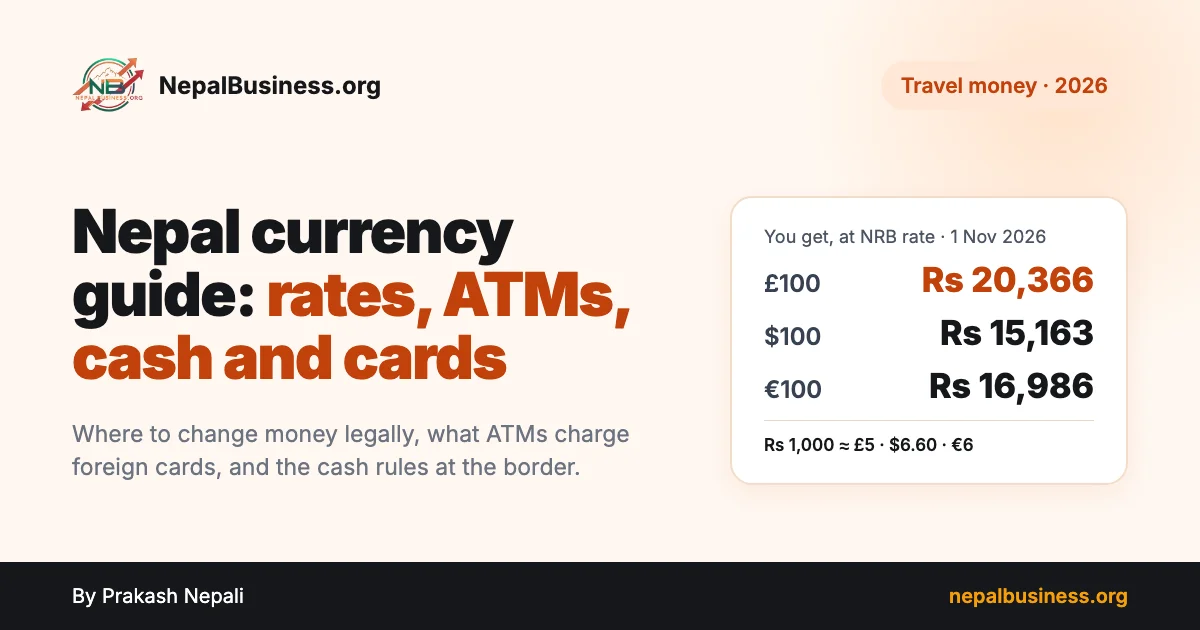
Last updated: 1 November 2026. Rates below are Nepal Rastra Bank's official rates for 1 November 2026. Check today's rate before you travel.
Nepal uses the Nepali rupee (NPR, written Rs), and most of the country still runs on cash. Visitors from the UK, Europe and the US need a plan for getting rupees at a fair rate and for paying in places where cards don't work. This guide covers what your money is worth, where to change it legally, what ATMs charge foreign cards, whether you can pay by QR code, and how much cash you can bring in.
Quick answer
- £100 ≈ Rs 20,370, $100 ≈ Rs 15,160 and €100 ≈ Rs 16,990 at Nepal Rastra Bank's buying rate on 1 November 2026.
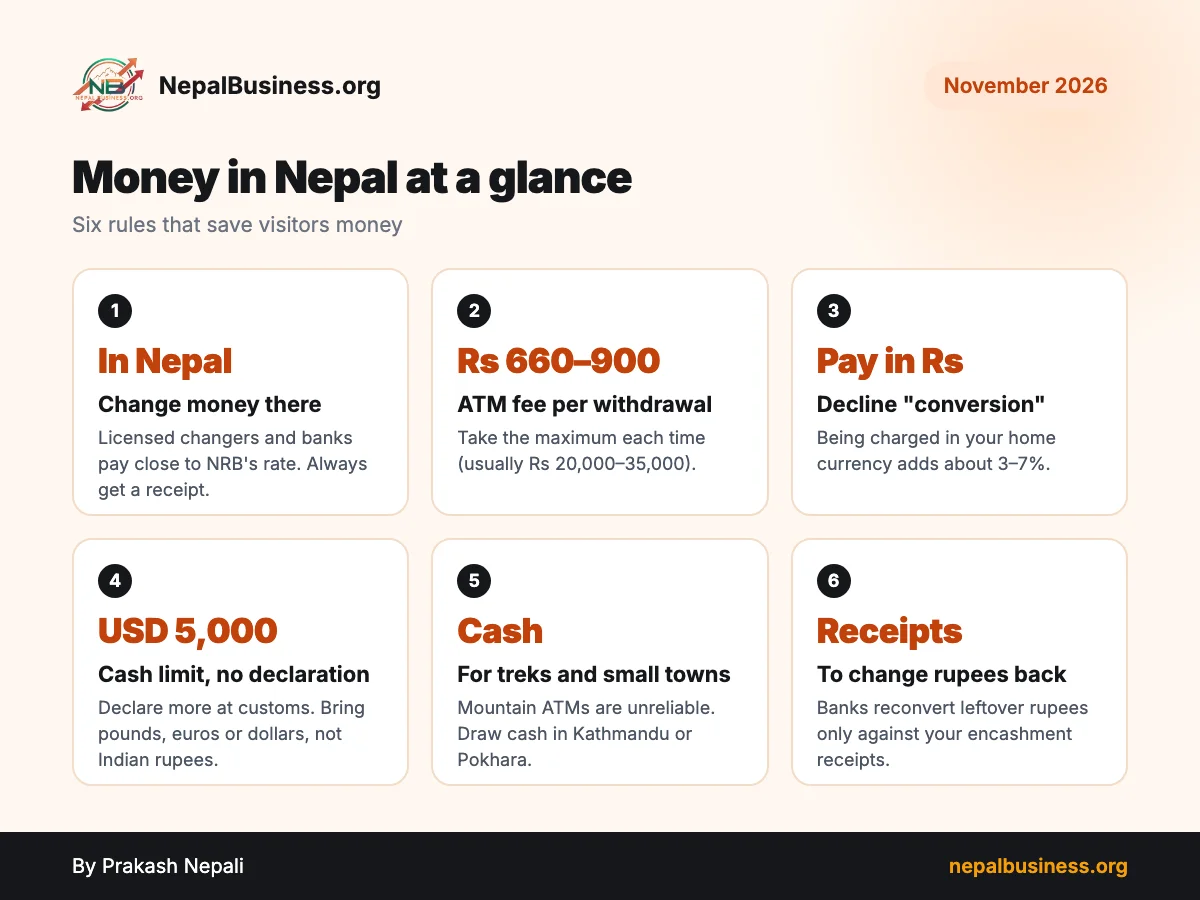
- Change money in Nepal, not at home. Licensed money changers and banks pay close to the official rate, while rupees are hard to buy abroad. Always ask for a receipt.
- ATMs work in cities but charge foreign cards about Rs 660–900 per withdrawal (roughly £3.25–£4.40), going by September 2026 bank tariffs. Take out the maximum each time.
- You can bring up to USD 5,000 in cash (or the same value in pounds or euros) without declaring it. Declare anything above that at customs.
- Carry cash for treks and small towns. Cards work mainly in upmarket hotels, larger agencies and supermarkets, and ATMs on trekking routes are rare and unreliable.
Nepal exchange rate today: pounds, dollars and euros
Nepal Rastra Bank (NRB), the central bank, publishes official buying and selling rates every day. For a visitor, the buying rate is what you get when you sell your pounds, euros or dollars for rupees. The selling rate is what you pay to turn rupees back into foreign currency.
| Currency | NRB buys | NRB sells | 100 gets you |
|---|---|---|---|
| British pound | 203.66 | 204.47 | Rs 20,366 |
| US dollar | 151.63 | 152.23 | Rs 15,163 |
| Euro | 169.86 | 170.54 | Rs 16,986 |
Rates published by Nepal Rastra Bank for 1 November 2026. For today's rate, use our currency converter, which uses NRB's official rates.
What things cost in your money
| Rupees | Pounds | Dollars | Euros |
|---|---|---|---|
| Rs 100 | £0.49 | $0.66 | €0.59 |
| Rs 500 | £2.46 | $3.30 | €2.94 |
| Rs 1,000 | £4.91 | $6.60 | €5.89 |
| Rs 5,000 | £24.55 | $32.98 | €29.44 |
| Rs 25,000 | £122.75 | $164.88 | €147.18 |
A simple rule of thumb: Rs 1,000 is about £5, $6.60 or €6.
Where to exchange money in Nepal
Changing money is legal only with an NRB-licensed business. As of April 2026, NRB's register listed 296 licensed money changers, most of them in Kathmandu and Pokhara, plus 20 commercial banks and many hotels, travel agencies and trekking agencies with exchange licences.
- Licensed money changers. Thamel in Kathmandu and Lakeside in Pokhara have many. By law they must display their licence and a board with their buying and selling rates, and must give you an encashment receipt for every exchange. Compare two or three boards against NRB's buying rate.
- Banks. Fair rates and reliable service, but shorter opening hours, and you'll need your passport.
- The airport. Fine for a small amount to pay for a taxi. Change the rest in town.
- At home before you fly. Usually the worst deal. Few UK, European or US bureaux stock rupees, and those that do give poor rates. Bring pounds, euros or dollars instead.
- On the street, unofficially. Don't. Dealing with an unlicensed person is illegal under Nepal's foreign exchange law, and you have no protection against fake notes.
Tip: bring clean, undamaged notes. Changers are liable for any fake notes they accept, so they often refuse or pay less for torn, marked or very old notes, especially US dollars.
Using ATMs in Nepal
ATMs are easy to find in Kathmandu, Pokhara and other cities, and most accept Visa and Mastercard. Every Nepali bank charges foreign cards a flat fee per withdrawal, and those fees have risen. Bank tariffs from September 2026, as reported in October 2026:
| Bank | Fee per withdrawal |
|---|---|
| NMB Bank | Rs 660 |
| Everest Bank | Rs 750 |
| NIC Asia (Visa) | Rs 750 |
| Siddhartha Bank | Rs 850 |
| NIC Asia (Mastercard) | Rs 900 |
Fees are taken from bank tariffs quoted by a travel publisher; banks don't publish all of them online, so the screen at the ATM is the final word. Many older guides still quote Rs 500, which is out of date.
- Withdrawal limits: no bank publishes a limit for foreign cards, but travellers usually report Rs 20,000–35,000 per withdrawal, with Nabil Bank most often named for Rs 35,000.
- Your own bank's charges come on top. Many UK, European and US cards add a foreign transaction fee, so a card with no foreign fees saves money here.
- Take the maximum each time. A Rs 750 fee is 3% of a Rs 25,000 withdrawal but 7.5% of a Rs 10,000 one.
- Always choose to be charged in rupees. If the ATM offers to "convert" the amount into pounds, dollars or euros, decline. This dynamic currency conversion typically costs an extra 3–7%.
ATMs on trekking routes
Don't count on them. Namche Bazaar has a couple of machines that work only some of the time and can run out of cash in peak season, and ATMs at Lukla, Jomsom and Manang are unreliable or missing. Withdraw all the cash you need for a trek in Kathmandu or Pokhara, and carry some US dollars or pounds as a backup.
Paying by card or QR code
Cards
Upmarket hotels, larger trekking agencies, supermarkets and some restaurants in Kathmandu and Pokhara take Visa and Mastercard. Buses, park checkposts, teahouses and small shops take cash only. Many merchants add 3–4% for card payments, even though Nepal Rastra Bank has said merchants may not charge customers extra for using a card machine. Ask before you pay, and pay in rupees, not your home currency.
QR payments
Nepal's QR codes (Fonepay, NepalPay) are everywhere, even at tea stalls, but the local wallets that scan them, such as eSewa and Khalti, need a Nepali phone number and identity checks, so most tourists can't use them. There are two newer options:
- MOCO Travel App: launched with Mastercard on 20 August 2026, it lets visitors link a foreign card and pay at Fonepay and NepalPay QR codes. MOCO says Visa cards also work. Its fees and exchange rate aren't published, so compare the rupee amount with a cash price.
- Alipay+ and UnionPay wallets: visitors from China and several other Asian countries can scan Fonepay QR codes with their home apps, and Indian visitors can use UPI.
How much cash can you bring into Nepal?
- Foreign currency: you can bring up to USD 5,000 in cash, or the same value in other currencies (about £3,700 on 1 November 2026), without declaring it. Above that, you must declare it to customs on arrival. Nepal Rastra Bank restated this rule in July 2026.
- Indian rupees: Nepal now allows ₹200 and ₹500 notes issued after 9 November 2016, up to ₹25,000 per person, but the permission is written for Nepali and Indian citizens. Old ₹500 and ₹1,000 notes are banned. If you're travelling from the UK, Europe or the US, bring pounds, euros or dollars instead.
- Nepali rupees: don't plan to carry them in or out. An older NRB circular limits it to Rs 5,000 per person, and rupees are hard to use or exchange outside Nepal.
Changing leftover rupees back
Keep every encashment receipt. NRB's rules say foreign visitors can convert leftover rupees back into foreign currency "on submission of encashment receipt or proof of source of Nepalese Rupees", and that receipts stamped "USED" aren't accepted. In practice, that means a bank counter, such as those at Tribhuvan International Airport on departure, because licensed money changers are only allowed to buy foreign currency, not sell it.
Some travel sites say you can only change back 10% or 15% of what you exchanged. We couldn't find that limit in NRB's published rules, which cap the amount at what your receipts show. Either way, the simplest plan is to change only what you need and spend the rest before you fly.
How much cash do you need?
That depends on your trip, but plan to pay cash for:
- teahouses, meals and snacks on trekking routes;
- taxis, local buses and tips;
- entry tickets at heritage sites, small shops and markets.
Carry it in small notes. Nepal's banknotes come in Rs 5, 10, 20, 50, 100, 500 and 1,000, and small shops and drivers often can't change a Rs 1,000 note.
Six tips for getting more rupees
- Change money in Nepal, not at home.
- Use licensed changers or banks only, compare their boards against NRB's buying rate, and get a receipt every time.
- Take the maximum from each ATM so the flat fee costs you less.
- Always pay and withdraw in rupees and decline currency conversion.
- Use a card with no foreign transaction fees.
- Draw your trekking cash in Kathmandu or Pokhara before you set off.
Sending money to family in Nepal rather than travelling? See our guides to sending money from the UK and sending money from the USA. Doing business with Nepal? Read how Nepali businesses receive international payments and our guide to foreign investment in Nepal.
Frequently asked questions
What currency is used in Nepal?
The Nepali rupee (NPR, written Rs). Pounds, euros and dollars aren't accepted in everyday shops, though some hotels and trekking agencies quote prices in dollars. Change your money into rupees for daily spending.
Is it better to exchange money before going to Nepal?
No. Nepali rupees are hard to find outside Nepal and India, and rates abroad are usually poor. Bring pounds, euros or dollars and change them at a licensed money changer or bank in Nepal, or use an ATM.
How much is £100 in Nepali rupees?
About Rs 20,370 at Nepal Rastra Bank's buying rate on 1 November 2026 (203.66). A licensed money changer will give you close to that. Check today's rate with our GBP to NPR converter.
How much do ATMs in Nepal charge foreign cards?
About Rs 660–900 per withdrawal, going by September 2026 bank tariffs, plus any foreign fee your own bank charges. Most ATMs let you take out Rs 20,000–35,000 at a time, so withdraw the maximum to keep the fee small.
Can tourists pay by QR code in Nepal?
Mostly not with eSewa or Khalti, which need a Nepali phone number and ID. The MOCO Travel App, launched in August 2026, lets visitors link a Mastercard (and, according to MOCO, a Visa card) to pay at Nepal's QR codes. Its fees aren't published.
How much cash can I take into Nepal?
Up to USD 5,000 or the same value in other currencies without declaring it. Declare anything above that at customs on arrival.
Can I change Nepali rupees back when I leave?
Yes, at a bank counter, such as those at Kathmandu airport, if you show your encashment receipts. The amount is limited to what your receipts show, so keep them and change only what you need.
Sources
- Nepal Rastra Bank: foreign exchange rates (rates for 1 November 2026)
- Nepal Rastra Bank: Money Changer Bylaw
- Nepal Rastra Bank: licensed foreign exchange businesses (April 2026)
- B360 Nepal: NRB rules on bringing cash into Nepal (July 2026)
- eKantipur: exchanging Indian rupees (July 2026)
- The Everest Holiday: ATM fees and limits for foreign cards (October 2026)
- ShareSansar: NRB says merchants can't charge extra for card payments
- Onlinekhabar: Mastercard and MOCO launch QR payments for tourists (August 2026)
- Kathmandu Post: Fonepay adds UnionPay for foreign travellers (May 2026)
Related tools
Free calculators that match this topic
Join the Discussion
Share your thoughts and engage with our community.
Loading comments...
Log in to join the discussion
Register on the platform, verify your email, then comment on this article.