
EXIM Code in Nepal (2026): Who Needs It, How to Apply on NNSW and Renew
The new Customs Act 2082 and Customs Regulation 2083 changed the rules. Here is who is exempt, what the Department of Customs asks for, and what late renewal costs.

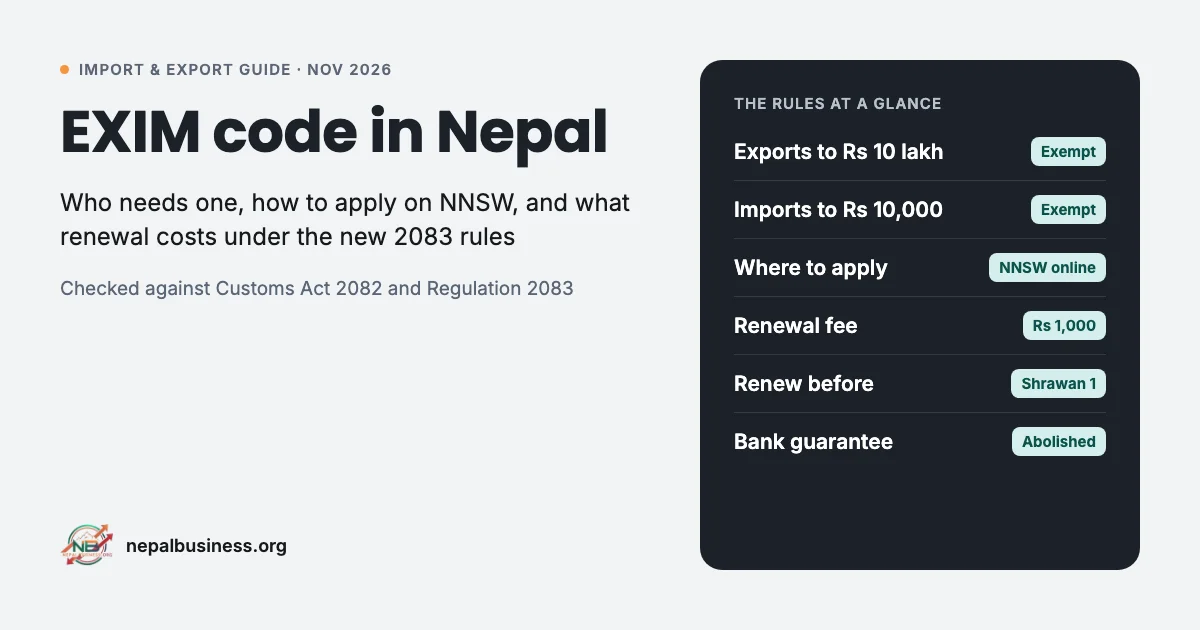
Last updated: 23 November 2026 (7 Mangsir 2083). Checked against the Customs Act 2082 (as amended by the Finance Act 2083), the Customs Regulation 2083 and the Department of Customs' EXIM procedure.
An EXIM code (निकासी वा पैठारी सङ्केत नम्बर) is the number Nepal's customs uses to identify businesses that import or export goods. The rules behind it changed in 2025 and 2026: a new Customs Act, a new Customs Regulation, no more bank guarantee, and approval by your nearest customs office instead of the Department in Kathmandu. Many guides online still quote the old 2064 rules. This one uses the current law.
Quick answer
- Who needs one: anyone who imports or exports goods, except for small shipments. You don't need a code to export goods worth up to Rs 10 lakh or import goods worth up to Rs 10,000 in one shipment.
- Where to apply: online on the Nepal National Single Window (NNSW). A customs office checks and approves it.
- How long: the Department of Customs' procedure says a complete application gets its certificate within 7 working days.
- Renewal: every fiscal year, before Shrawan 1. The fee is Rs 1,000 plus a tax clearance certificate. Late renewal costs 50% more until Asoj end, then 100% more until Asar end.
- Bank guarantee: no longer needed. The old Rs 3 lakh guarantee was abolished in 2025.
What is an EXIM code?
It is a customs identification number for traders. Section 114 of the Customs Act 2082 says no one may import or export goods without one, and that it must be renewed. You can't trade using a code that hasn't been renewed.
Under the Department of Customs' EXIM procedure, a regular code has 13 digits followed by the letters "NP":
- Digits 1 to 9 are your business's PAN.
- Digits 10 and 11 number each firm registered under the same PAN (01, 02 and so on).
- Digits 12 and 13 are added by the system.
So the code is tied to your PAN. If you don't have one yet, see how PAN registration fits into starting a small business in Nepal.
Do you need an EXIM code? The Rs 10 lakh and Rs 10,000 rule
Rule 110 of the Customs Regulation 2083 says you don't need a code for:
- personal goods that travellers may bring in or take out under the Department's passenger notice,
- imports worth up to Rs 10,000 at one time,
- exports worth up to Rs 10 lakh at one time.
There is no separate rule for handmade goods, samples or e-commerce parcels. The same value test applies to all of them.
| Your situation | Need a code? |
|---|---|
| Export shipment up to Rs 10 lakh | No |
| Export shipment over Rs 10 lakh | Yes |
| Import shipment up to Rs 10,000 | No |
| Import shipment over Rs 10,000 | Yes |
| You already have a code | Quote it every time |
That last row matters. Rule 110 also says anyone who already holds a code must use it on every shipment, whatever the value.
For handmade sellers: if you post felt bags, dhaka or lokta paper to buyers abroad and each shipment is under Rs 10 lakh, the Regulation doesn't require an EXIM code. Our guide to selling handmade products online covers payments and shipping.
For shops importing stock: the import limit is only Rs 10,000, so almost any commercial import needs a code.
Don't confuse this with courier duty limits. Rules 67 and 68 of the same Regulation exempt small courier and postal parcels from customs duty (for example, exports by courier up to Rs 5,000). Those are different limits. They decide whether you pay duty, not whether you need an EXIM code.
Special EXIM codes
Rule 112 allows a "special" code, with no renewal needed, for some cases:
- micro, cottage and small industries importing their own raw materials, machinery or parts,
- a one-time machinery import to set up an industry,
- one-time donation, gift or relief shipments,
- government bodies, projects, diplomatic missions and non-governmental organisations, for non-commercial goods.
Who can get a regular code, and what documents you need
The Department of Customs' EXIM procedure (as amended in September 2025) lists these conditions:
- Registration: your business is registered with the Department of Commerce, Supplies and Consumer Protection, the Office of the Company Registrar or the Department of Industry, or holds a recommendation from the relevant body. See company registration in Nepal.
- Paid-up capital of at least Rs 10 lakh. This does not apply if you take a code for exports only.
- A PAN certificate.
- VAT registration, unless you deal only in goods that are exempt from VAT (Schedule 1 of the VAT Act). Our Nepal tax guide explains VAT registration.
Documents to upload, under the same procedure:
- your registration certificate or recommendation,
- proof of paid-up capital of at least Rs 10 lakh (not needed for export-only codes),
- your PAN certificate,
- a self-declaration that you owe no government dues,
- a tax clearance certificate from your Inland Revenue office,
- a passport-size photo of the owner or head of the business, taken in the last six months,
- the memorandum of association (MOA), for private and public limited companies.
The capital and VAT conditions come from the Department's procedure, not from the Customs Act or Regulation. The procedure was written under the old 2064 Act, so ask your customs office if you're unsure whether a condition applies to you.
You don't need a bank guarantee any more. Until 2025, importers had to give a Rs 3 lakh guarantee from a class "A" bank. It was removed from the rules in May 2025, and on 3 July 2025 (2082/03/19) the Department wrote to banks asking them to release existing guarantees.
How to apply for an EXIM code on NNSW
Since 15 April 2025 (2082 Baisakh 2), codes are issued only by customs offices, not by the Department of Customs itself. You apply online and choose the office.
- Go to the NNSW trade portal at nnsw.gov.np/trade and click Apply for New EXIM.
- Enter your business PAN, your personal PAN and your email address.
- Enter the one-time code sent to your email.
- Fill in the form: business information (including the Verifying Office, the customs office that will check your application), IRD information and business registration details.
- Upload your documents. The portal accepts files under 2 MB each.
- Submit. The application goes to the customs office you chose.
In Kathmandu Valley, NNSW directs applicants to the Tribhuvan International Airport Customs Office or the Chobhar Dry Port Customs Office.
Under the Department's procedure, the office issues the certificate within 7 working days of a complete application. If it needs more documents, you have 7 days to send them. If it refuses, it must tell you why within 7 days. You can print the certificate yourself from the system once it's approved. One person gets only one regular code for the same business.
The NNSW help desk numbers are 01-5917010 and toll-free 16600160016.
How much does an EXIM code cost?
The Customs Regulation sets the renewal fee at Rs 1,000 a year. We found no separate fee for a first-time code in the Regulation or the Department's procedure. Any fee due is paid through NNSW when you apply.
Your real costs are the things around it: registering your business, keeping your tax filings clean so you can get a tax clearance certificate, and, if you import, VAT registration.
EXIM code renewal: deadline and late fees
Rule 111 of the Customs Regulation 2083 says you must renew your code for each fiscal year before that fiscal year starts, which means before Shrawan 1 (mid-July). Send a tax clearance certificate and pay the Rs 1,000 fee.
| When you renew | What you pay |
|---|---|
| Before Shrawan 1 | Rs 1,000 |
| By Asoj end | Fee + 50% |
| By Asar end | Fee + 100% |
| Later | Fee + Rs 10,000 per year |
On a Rs 1,000 fee, that works out to Rs 1,500 by Asoj end and Rs 2,000 by Asar end (our arithmetic from the percentages in the rule).
Where that leaves you in Mangsir 2083: fiscal year 2083/84 began on Shrawan 1, 2083 (about 17 July 2026), and the 50% window closed at the end of Asoj. If you missed the deadline, you can still renew this fiscal year at the 100% rate until Asar end 2084 (about mid-July 2027).
NNSW doesn't accept a renewal earlier than one month before your code expires, so in practice you renew in Asar. To renew, log in to NNSW and use Renew EXIM.
Rule 111 also lets an industry renew for five fiscal years at once by paying the five-year fee together.
Freezes and cancellation
- Unpaid dues: under the Department's procedure, a customs office can freeze your code for up to six months if you owe revenue or other dues. It is unfrozen when you pay.
- Cancelling your own code: the Customs Act 2082, as amended by the Finance Act 2083, says you can apply to the Department to cancel your code after paying the renewal fee.
- Not renewing: you can't import or export with an unrenewed code, and late renewal costs more every season. Renew on time or cancel properly.
How many businesses have EXIM codes?
| Fiscal year | New | Renewed | Cancelled |
|---|---|---|---|
| 2081/82 | 2,491 | 33,827 | 875 |
| 2082/83 | 4,748 | 52,030 | 29,715 |
The 2081/82 figures come from the Department of Customs' annual progress report. Of the 33,827 renewals that year, 17,213 were early renewals for 2082/83. The 2082/83 figures were reported by Onlinekhabar on 26 Asoj 2083, citing Department data. New codes nearly doubled, but cancellations rose far faster. The Department hasn't published a reason.
Frequently asked questions
Do I need an EXIM code to export handmade products from Nepal?
Not if each shipment is worth Rs 10 lakh or less. Rule 110 of the Customs Regulation 2083 exempts exports up to Rs 10 lakh at one time. If you already have a code, you must still quote it on every shipment.
How much is the EXIM code renewal fee?
Rs 1,000 a year if you renew before Shrawan 1. It's 50% more until Asoj end, 100% more until Asar end, and an extra Rs 10,000 for each fiscal year after that.
Is a bank guarantee still required for an EXIM code?
No. The Rs 3 lakh bank guarantee was abolished in 2025, and the Department of Customs asked banks to release existing guarantees.
Where do I apply for an EXIM code in Kathmandu?
Online on NNSW (nnsw.gov.np/trade). Choose the Tribhuvan International Airport Customs Office or the Chobhar Dry Port Customs Office as your verifying office.
How long does it take to get an EXIM code?
The Department of Customs' procedure says 7 working days after a complete application.
Is the EXIM code the same as PAN?
No, but it's built on it. The first nine digits of the code are your PAN, followed by four more digits and "NP".
Sources
- Law Commission: Customs Act 2082 (as amended by the Finance Act 2083), section 114
- Law Commission: Customs Regulation 2083, rules 67–68 and 109–112
- Department of Customs: EXIM Code Issuance Procedure 2079, 4th amendment (2082/05/30)
- Department of Customs: EXIM notice, 2081/12/19
- Department of Customs: release of EXIM bank guarantees, 2082/03/19
- Department of Customs: Annual Progress Statement 2081/82
- Nepal National Single Window: trade portal, FAQ and notices
- Onlinekhabar: एक्जिम कोड : नयाँ दर्ताभन्दा खारेजी धेरै (26 Asoj 2083)
This article is general information, not legal advice. Customs rules change; confirm with your customs office before you ship.
Join the Discussion
Share your thoughts and engage with our community.
Loading comments...
Log in to join the discussion
Register on the platform, verify your email, then comment on this article.