
Mutual Funds in Nepal 2026: Open-Ended vs Closed-Ended, All 47 Listed Funds Compared
How Nepal's 61 mutual fund schemes work, why 43 of 45 listed funds trade below their NAV, and what matured funds actually paid

Last updated: 8 November 2026. Fund prices are from 30 October to 6 November 2026; NAVs are each fund's latest weekly figure (11 September to 23 October 2026). Both change every week.
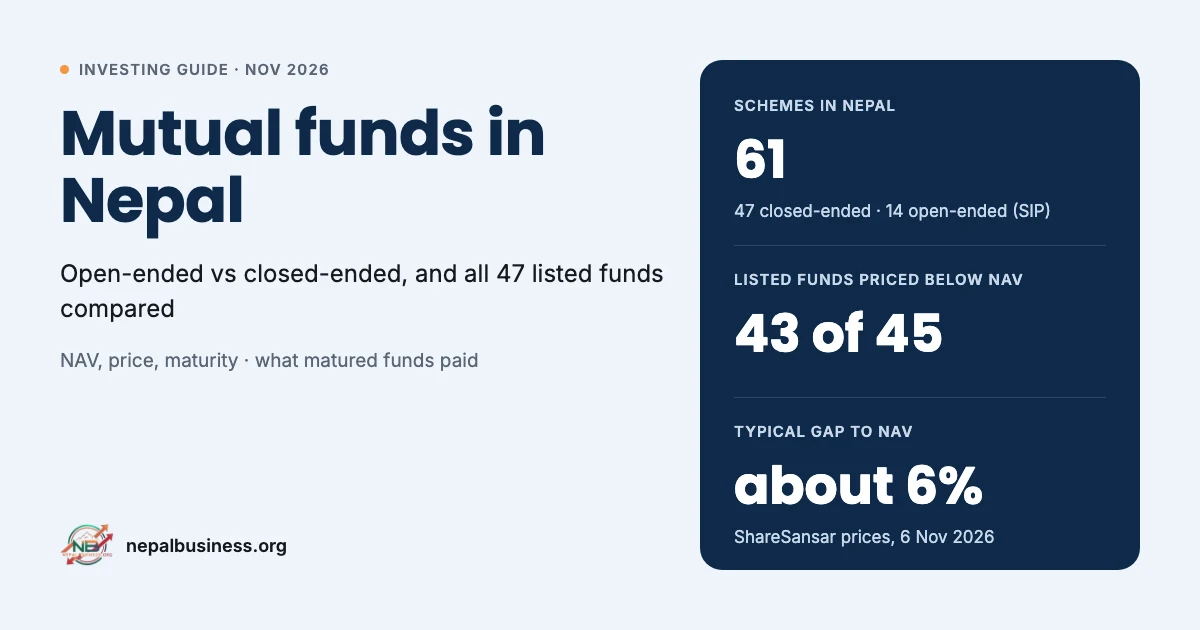
Nepal has 61 mutual fund schemes right now: 47 closed-ended funds that trade on NEPSE like shares, and 14 open-ended funds that you buy from the fund manager, which most people know as SIP schemes.
Our SIP guide already compares all 14 open-ended funds. This guide covers the other side: how mutual funds work in Nepal, every closed-ended fund in one table, why almost all of them trade below their real value, and what the 14 funds that have already matured actually paid their investors.
This is general information, not financial advice. Mutual fund returns aren't guaranteed. Read a scheme's offer document, or talk to a licensed advisor, before you invest.
Quick answer
- Two kinds of mutual fund. Open-ended funds (SIP schemes) let you buy and sell at NAV any time through the fund manager. Closed-ended funds have a fixed number of units, trade on NEPSE through a broker and end on a fixed maturity date.
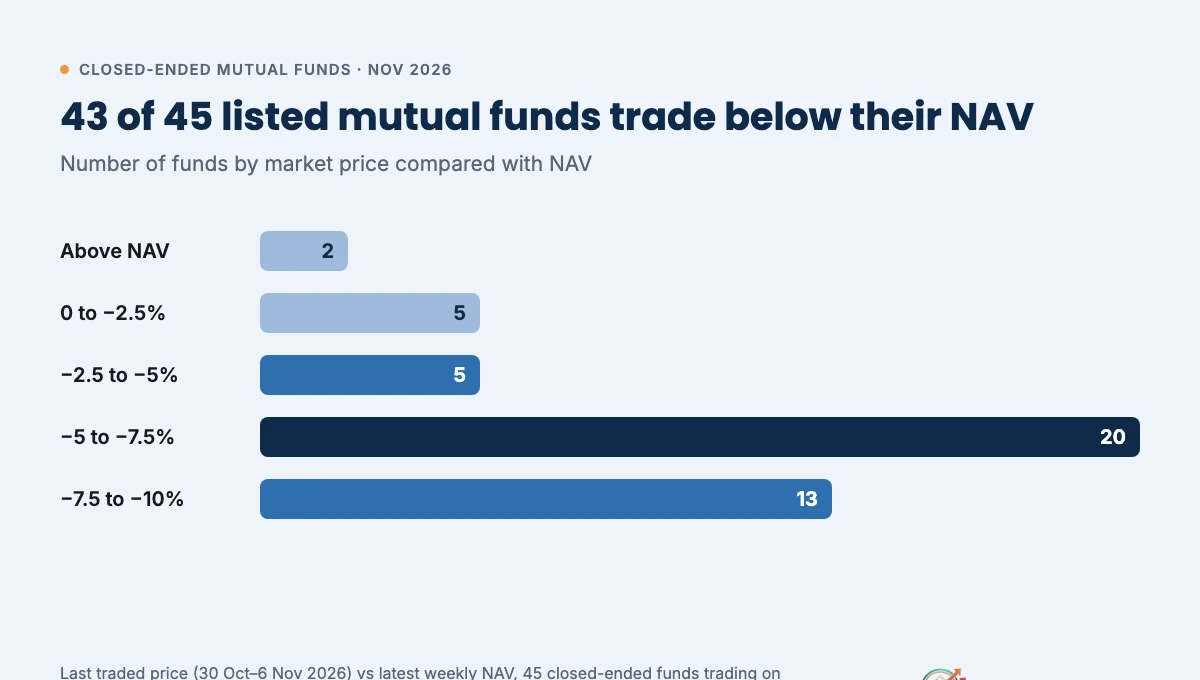
- Most closed-ended funds trade below their value. On 6 November 2026, 43 of the 45 trading closed-ended funds were priced below their NAV. The typical gap was about 6%.
- At maturity you get NAV, not market price. The fund sells its holdings and pays unit holders out at NAV, so the discount closes at the end. The NAV itself can still rise or fall before then.
- Matured funds paid an average of about 17% a year in dividends, but 5-year funds launched before a bull market did far better than 7-year funds that lived through two bear markets.
- Minimum investment is small: 100 units (Rs 1,000) in a closed-ended IPO. For SIPs, see the SIP guide.
- There is no single "best mutual fund". Pick by when you need the money back, then compare price vs NAV, fund manager track record and size.
Open-ended vs closed-ended: what's the difference?
Both pool money from many investors, are run by a SEBON-licensed fund manager (usually a bank's capital company) and invest mostly in NEPSE shares. The difference is how you get in and out.
| Open-ended (SIP schemes) | Closed-ended | |
|---|---|---|
| How many in Nepal | 14 | 47 |
| Where you buy | From the fund manager (online, app or office) | IPO through MeroShare, then on NEPSE through a broker |
| Price you pay | NAV | Market price (usually below NAV) |
| How you get out | Redeem with the fund manager at NAV | Sell on NEPSE, or hold to maturity |
| Number of units | Grows and shrinks | Fixed |
| End date | None | Fixed: 7 to 12 years |
| Monthly SIP | Yes | No |
NAV (net asset value) is what one unit is really worth: everything the fund owns, minus what it owes, divided by the number of units. Units start at Rs 10.
For a closed-ended fund, NAV and market price are two different numbers. That gap is the most important thing to understand before you buy one.
How many mutual funds are there in Nepal, and where does the money go?
- 47 closed-ended schemes on ShareSansar's list as of 8 November 2026. 45 were trading on NEPSE; the other two (NIC Asia Equity Opportunity Fund and Muktinath Mutual Fund 2) were issued in October 2026 and had no trading price yet. Together the 47 were issued for about Rs 57.5 billion.
- 14 open-ended schemes (the SIP funds).
- 15 schemes have matured so far: 14 by May 2026, plus NMB 50, which matured in late August 2026.
The Himalayan Times put the whole industry at nearly Rs 73 billion in assets in 2026, up from about Rs 13.6 billion in 2019. That's still small: about 1.2% of GDP.
Where the money goes, at the end of Bhadra 2083 (mid-September 2026):
| Where mutual funds invest | Amount |
|---|---|
| Listed and unlisted shares | Rs 67.3 billion |
| – of which commercial banks | 21.2% |
| – of which hydropower | 17.0% |
| – of which microfinance | 11.0% |
| Cash in banks | Rs 14.7 billion |
| Debentures and bonds | Rs 4.6 billion |
So a Nepali mutual fund is mostly a basket of NEPSE shares, led by banks and hydropower. When NEPSE falls, almost every fund falls with it.
All 47 closed-ended mutual funds compared
Sorted by maturity date, soonest first. "Price vs NAV" is the market price compared with the latest weekly NAV: −6% means you could buy Rs 10 of assets for about Rs 9.40.
| Fund (symbol) | Size (Rs cr) | Matures | NAV (Rs) | Price (Rs) | Price vs NAV |
|---|---|---|---|---|---|
| Siddhartha Equity Fund (SEF) | 150 | Nov 2027 | 10.59 | 10.00 | −5.6% |
| Sanima Large Cap Fund (SLCF) | 120 | Feb 2028 | 9.96 | 9.15 | −8.1% |
| Prabhu Select Fund (PSF) | 125 | Jun 2028 | 12.02 | 11.80 | −1.8% |
| NIC Asia Select-30 (NICSF) | 125 | Jul 2028 | 9.50 | 8.91 | −6.2% |
| RBB Mutual Fund 1 (RMF1) | 125 | Jul 2028 | 9.83 | 9.10 | −7.4% |
| Nabil Balanced Fund - 2 (NBF2) | 112 | May 2029 | 9.65 | 9.12 | −5.5% |
| NIC Asia Flexi Cap Fund (NICFC) | 102 | Jun 2029 | 10.16 | 9.35 | −8.0% |
| Siddhartha Investment Growth Scheme-2 (SIGS2) | 120 | Aug 2029 | 10.43 | 9.70 | −7.0% |
| NIC ASIA Balanced Fund (NICBF) | 75.5 | Aug 2029 | 9.99 | 9.21 | −7.8% |
| Sunrise First Mutual Fund (SFMF) | 86 | Nov 2029 | 10.17 | 9.90 | −2.6% |
| Laxmi Unnati Kosh (LUK) | 65.3 | Aug 2030 | 10.10 | 9.60 | −5.0% |
| NIC Asia Growth Fund 2 (NICGF2) | 90.5 | Nov 2030 | 9.75 | 9.00 | −7.7% |
| Kumari Equity Fund (KEF) | 100 | Mar 2031 | 10.39 | 9.80 | −5.7% |
| Sunrise Bluechip Fund (SBCF) | 125 | Mar 2031 | 9.42 | 9.40 | −0.2% |
| NIBL Samriddhi Fund - 2 (NIBSF2) | 150 | May 2031 | 9.67 | 8.83 | −8.7% |
| Mega Mutual Fund - 1 (MMF1) | 125 | Sep 2031 | 9.52 | 8.99 | −5.6% |
| Nabil Balanced Fund III (NBF3) | 125 | Sep 2031 | 9.79 | 9.08 | −7.2% |
| Sunrise Focused Equity Fund (SFEF) | 100 | Feb 2032 | 9.94 | 9.12 | −8.2% |
| Prabhu Smart Fund (PRSF) | 100 | Mar 2032 | 13.03 | 12.80 | −1.8% |
| Kumari Dhanabriddhi Yojana (KDBY) | 122.5 | Jul 2032 | 11.18 | 10.40 | −7.0% |
| Global IME Balanced Fund-I (GIBF1) | 102.6 | Jul 2032 | 10.51 | 10.15 | −3.4% |
| NMB Sulav Investment Fund - II (NSIF2) | 120 | Sep 2032 | 10.49 | 10.13 | −3.4% |
| NIBL Growth Fund (NIBLGF) | 132 | Jan 2033 | 9.79 | 9.18 | −6.2% |
| Siddhartha Investment Growth Scheme 3 (SIGS3) | 80.6 | Apr 2033 | 10.77 | 10.69 | −0.7% |
| Citizens Super 30 Mutual Fund (C30MF) | 75.1 | May 2033 | 9.94 | 9.10 | −8.4% |
| RBB Mutual Fund 2 (RMF2) | 84.6 | May 2033 | 10.12 | 9.60 | −5.1% |
| Laxmi Value Fund-II (LVF2) | 80 | Sep 2033 | 9.61 | 9.40 | −2.2% |
| Himalayan 80-20 (H8020) | 100 | Oct 2033 | 10.98 | 11.45 | +4.3% |
| Sanima Growth Fund (SAGF) | 67.3 | Nov 2033 | 9.97 | 9.47 | −5.0% |
| Kumari Sabal Yojana (KSY) | 74.5 | Mar 2034 | 10.08 | 9.16 | −9.1% |
| Muktinath Mutual Fund 1 (MNMF1) | 125 | Dec 2034 | 9.93 | 9.24 | −7.0% |
| Garima Samriddhi Yojana (GSY) | 125 | Jan 2035 | 10.04 | 9.25 | −7.9% |
| NMB Hybrid Fund L-II (NMBHF2) | 136.5 | Feb 2035 | 9.93 | 9.20 | −7.3% |
| Reliable Samriddhi Yojana (RSY) | 120 | May 2035 | 10.32 | 9.61 | −6.9% |
| Global IME Samunnat Yojana -II (GBIMESY2) | 150 | Jul 2035 | 9.98 | 9.45 | −5.3% |
| HLI Large Cap Fund (HLICF) | 500 | Sep 2035 | 8.46 | 8.60 | +1.6% |
| Citizens Santulit Yojana (CSY) | 125 | Jan 2036 | 9.58 | 8.86 | −7.5% |
| Nepal Life Samriddhi Lagani Yojana (NSY) | 200 | Feb 2036 | 9.70 | 9.10 | −6.2% |
| NIBL Stable Fund (NIBLSTF) | 113 | Feb 2036 | 9.58 | 8.63 | −9.9% |
| Sanima Equity Fund-2 (SAEF2) | 125 | Jun 2036 | 10.01 | 9.30 | −7.1% |
| Reliable Samriddhi Yojana-2 (RSY2) | 125 | Jun 2036 | 9.94 | 9.12 | −8.2% |
| NIC ASIA Equity Opportunity Fund (NICEOF) | 100 | Oct 2036 | 10.04* | not trading yet | — |
| Muktinath Mutual Fund 2 (MNMF2) | 125 | Oct 2036 | 9.95* | not trading yet | — |
| MBL Equity Fund (MBLEF) | 121.6 | Mar 2037 | 10.05 | 9.26 | −7.9% |
| RBB Focus 40 (RBBF40) | 125 | Nov 2037 | 9.90 | 9.37 | −5.3% |
| Siddhartha Equity Fund 2 (SEF2) | 125 | Jun 2038 | 10.20 | 9.80 | −3.9% |
| LS Horizon 12 (LSH12) | 150 | Jun 2038 | 9.98 | 9.25 | −7.3% |
Source: ShareSansar, Mutual Fund & NAVs, read 8 November 2026. NAV = latest weekly NAV (dated 11 September to 23 October 2026). *Monthly NAV for Ashwin 2083 (no weekly NAV yet). Price = last traded price, 30 October to 6 November 2026. Price vs NAV as calculated by ShareSansar. Size is the issued size (units × Rs 10), not current assets.
What stands out:
- Only 2 of 45 trade above NAV: Himalayan 80-20 (+4.3%) and HLI Large Cap Fund (+1.6%). 33 trade at a discount of 5% or more.
- 25 of 45 have a NAV below Rs 10. That doesn't always mean they lost money, because funds pay profits out as dividends, which pulls NAV back down. Our SIP guide explains this.
- Terms are getting longer. 35 funds run for 10 years, only 6 for 7 years, and 5 recent funds run for 12 years, including NIBL Stable Fund, MBL Equity Fund and LS Horizon 12.
- The next to mature: Siddhartha Equity Fund (November 2027), Sanima Large Cap Fund (February 2028), Prabhu Select Fund (June 2028).
Why do closed-ended funds trade below NAV?
An open-ended fund always deals at NAV, because the fund itself buys and sells the units. A closed-ended fund doesn't. Once its IPO is over, you can only buy from another investor on NEPSE, and the price is whatever buyers will pay.
In Nepal, that price has mostly been below NAV. In our table, only 2 of the 45 trading funds were priced above it.
The discount matters most at maturity. Under the Mutual Fund Regulation, 2067, a closed-ended fund is wound up when its term ends. It is delisted from NEPSE at least a month before maturity, sells what it owns, and pays unit holders the final NAV. At that point, the market price stops mattering.
A worked example, using the fund closest to maturity:
- Siddhartha Equity Fund (SEF) matures in November 2027.
- On 6 November 2026 it traded at Rs 10.00. Its last weekly NAV was Rs 10.59.
- If the NAV were still Rs 10.59 at maturity, a unit bought at Rs 10.00 would pay back Rs 10.59, plus any dividends along the way.
- But the NAV won't stay still. It moves with NEPSE every week until the fund closes. When NIBL Pragati Fund matured, its final NAV was Rs 9.58, below the Rs 10 its investors started with.
The same gap also raises the dividend you earn on what you paid. Himalayan 80-20 declared a 15% cash dividend for FY 2082/83. That's Rs 1.50 per Rs 10 unit, and a buyer paying the market price gets the same Rs 1.50.
What did Nepal's matured mutual funds actually pay?
This is the best real-world evidence we have, because these funds have finished. ShareSansar studied all 14 that had matured by May 2026:
| Fund (symbol) | Size (Rs cr) | Term | Total paid* | Per year |
|---|---|---|---|---|
| Siddhartha Investment Growth Scheme-1 (SIGS1) | 50 | 5 yrs | 242.2% | 48.4% |
| Nabil Balanced Fund-1 (NBF1) | 75 | 5 yrs | 166.5% | 33.3% |
| NIBL Samriddhi Fund 1 (NIBSF1) | 100 | 7 yrs | 125.9% | 18.0% |
| Sanima Equity Fund (SAEF) | 130 | 7 yrs | 122.7% | 17.5% |
| NMB Sulav Investment Fund-1 (NMBSF1) | 75 | 5 yrs | 84.1% | 16.8% |
| Global IME Samunnat Scheme 1 (GIMES1) | 100 | 7 yrs | 105.6% | 15.1% |
| NIC Asia Growth Fund (NICGF) | 83.5 | 7 yrs | 99.3% | 14.2% |
| Laxmi Value Fund-1 (LVF1) | 50 | 5 yrs | 70.2% | 14.0% |
| Siddhartha Equity Oriented Scheme (SEOS) | 100 | 5 yrs | 68.0% | 13.6% |
| Citizens Mutual Fund-1 (CMF1) | 82 | 7 yrs | 84.0% | 12.0% |
| NMB Hybrid Fund L-1 (NMBHF1) | 100 | 7 yrs | 78.5% | 11.2% |
| Laxmi Equity Fund (LEMF) | 125 | 7 yrs | 63.7% | 9.1% |
| Nabil Equity Fund (NEF) | 125 | 7 yrs | 58.7% | 8.4% |
| NIBL Pragati Fund (NIBLPF) | 75 | 7 yrs | 61.0% | 8.1% |
*Total dividends as a % of the Rs 10 face value. For SIGS1, SEOS, SAEF and NEF, ShareSansar also counts the amount by which the final NAV was above Rs 10. For NIBLPF, the final NAV of Rs 9.58 cut the effective total to 56.8%. "Per year" is the total divided by the number of years, not a compounded return. Source: ShareSansar, 20 May 2026.
Three lessons from this table:
- Timing drove the results. The five 5-year funds averaged about 25% a year because they ran through a strong bull market. The nine 7-year funds averaged about 12.6% a year, after living through one bull and two bear markets.
- The same manager can have very different results. NIMB Ace Capital (formerly NIBL Ace Capital) ran both NIBL Samriddhi Fund 1 (18% a year) and NIBL Pragati Fund (8.1% a year).
- Even the weakest paid something, but one returned less than Rs 10 per unit at the end. Past returns don't promise future ones.
The Himalayan Times reported that 11 of these 14 funds beat the NEPSE index over their lives.
How to buy a closed-ended mutual fund in Nepal
You need the same setup as for shares: a Demat account, MeroShare and a bank CRN number. The SIP guide walks through opening these. Then there are two ways in:
1. In the IPO (at Rs 10 a unit). New closed-ended schemes are issued through MeroShare, like a share IPO. In a typical issue, such as Reliable Samriddhi Yojana-2 in May 2026, 15% of units go to the fund manager and sponsor and 85% to the public and institutions. You can apply for 100 units (Rs 1,000) up to 1 crore units. Watch ShareSansar or MeroShare for open issues.
2. On NEPSE (at market price). After listing, you buy units through any licensed broker's TMS, exactly like a share, and pay normal trading charges. This is where the discount to NAV applies.
Before you buy, check three things in the table above: when it matures (can you hold that long?), price vs NAV (are you paying close to full value?) and the latest NAV report on the fund manager's website (what does it actually own?).
Open-ended funds: lump sum or SIP?
Open-ended funds are the 14 SIP schemes. You don't have to invest monthly, though: you can also buy units with a lump sum at NAV, directly from the fund manager online, through its app or at its office, and redeem them the same way.
Everything else about them, including the fund table, which bank runs which fund, fees, how to start and tax when you redeem, is in our SIP guide. To see what a monthly amount could grow to, use the SIP calculator.
Which type is right for you?
| Your situation | What fits |
|---|---|
| You want to invest a fixed amount every month | Open-ended (SIP) |
| You might need the money back at any time | Open-ended. Closed-ended units have to be sold on NEPSE, often below NAV. |
| You have a lump sum and can wait until a fund matures | Either. A closed-ended fund bought below NAV and held to maturity gets paid at NAV. |
| You want to buy at a discount | Closed-ended, on NEPSE. Check the maturity date and the discount. |
| You need the money within 3 years | Neither. Use a fixed deposit or the one debt-oriented SIP fund. |
How to choose a mutual fund in Nepal
"Which is the best mutual fund in Nepal?" has no honest one-name answer. Instead, compare funds on these points, in this order:
- Your timeline. Rule out any closed-ended fund that matures after you need the money, unless you're happy to sell on NEPSE.
- Price vs NAV. Paying 8% below NAV is a better starting point than paying above it.
- The manager's track record. Look at how that manager's matured funds did (table above) and its current funds' NAV and dividend history.
- Dividend history. Fund managers publish NAV reports monthly, and ShareSansar tracks dividend declarations.
- What it holds. Check the fund manager's monthly NAV report to see what the fund invests in. Two funds full of the same bank shares don't diversify you.
Tax on mutual funds in Nepal
- The fund pays no tax on the dividends and interest it earns, so income isn't taxed twice.
- Dividends you receive: 5% is deducted at source for individuals (FY 2083/84 rates).
- Selling closed-ended units on NEPSE: capital gains tax is deducted automatically when the trade settles, as with shares. Since 22 September 2026, the rate for individuals on gains from SEBON-listed securities is 3.75% if you held them for more than 365 days and 5% if 365 days or less, cut from 7.5% and 10% under a Finance Ministry notice in the Nepal Gazette. Your broker's contract note shows the exact amount deducted.
- Redeeming open-ended units: see the tax section of our SIP guide.
For your wider tax picture, see Nepal Tax System Explained (2026).
What's changing for mutual funds in 2026?
- Easier rules for experienced fund managers (January 2026). SEBON cut the money managers must put into their own funds ("seed capital") from 15% to 10% or 5% for managers with a longer track record and larger funds. That frees capital for new schemes.
- Government capital market plan (September 2026). The Finance Ministry's action plan asks SEBON to make mutual funds more professional, diversified and transparent, and to bring in guidelines for exchange-traded funds (ETFs) and bonds, with a mid-December 2026 deadline.
- New draft policy (October 2026). SEBON's draft Collective Investment Fund Policy, 2083 gives priority to open-ended schemes and proposes new products: ETFs, real estate investment trusts (REITs), infrastructure funds and green funds. It was open for public comment until Kartik 15, 2083.
- Longer terms. The 7-year funds still running are expected to mature by 2030, and new launches are 10 to 12 years.
We'll update this guide when the final policy is published.
The risks
- Market risk. Funds hold mostly NEPSE shares, so they fall when NEPSE falls. SEBON regulates how funds are run, not what the market does.
- Concentration. About half of all fund share holdings are in just three sectors: banks, hydropower and microfinance.
- The discount can widen. If you need to sell a closed-ended fund early, you may get even less compared with NAV than you paid.
- NAV can end below Rs 10. NIBL Pragati Fund paid back Rs 9.58 per unit at maturity.
Frequently asked questions
How many mutual funds are there in Nepal?
61 schemes as of 8 November 2026: 47 closed-ended funds (45 trading on NEPSE and 2 newly issued) and 14 open-ended SIP funds. Another 15 have already matured.
Which is the best mutual fund in Nepal?
There isn't one best fund. Match the fund type and maturity date to when you need your money, then compare price vs NAV, the manager's track record and dividend history. The tables in this guide put those numbers side by side.
What is the minimum investment in a mutual fund in Nepal?
100 units (Rs 1,000) in a closed-ended IPO. Open-ended SIPs usually start from Rs 500 to Rs 1,000 a month; see the SIP guide.
Can I sell a closed-ended mutual fund before it matures?
Yes, on NEPSE through your broker, at the market price. That price is usually below NAV, and trading stops when the fund is delisted about a month before maturity.
What happens when a closed-ended fund matures?
It is delisted from NEPSE, sells its investments and pays unit holders the final NAV per unit. The fund manager publishes a notice explaining the payout process.
Is SIP a mutual fund?
No. A SIP is a way of paying, a fixed amount each month, into an open-ended mutual fund. The fund is the product.
Are mutual funds safe in Nepal?
They are regulated by SEBON, and your units are held in your own Demat account. But they are not risk-free: their value moves with NEPSE, and a fund can end below Rs 10 a unit.
The bottom line
If you want to invest monthly, or might need your money at short notice, an open-ended SIP fund is the simpler choice. If you have a lump sum and can wait until a fund's maturity date, closed-ended funds are worth a look, because most are on sale below what they own. Either way, check the maturity date, the price vs NAV and the manager's record before you buy.
Related guides
- Best SIP in Nepal 2026: all 14 open-ended funds compared
- SIP calculator: what a monthly SIP grows to
- 8 ways to invest in Nepal: NEPSE, SIP, FD, gold and more
- SIP vs mutual funds vs share market
Sources
- ShareSansar, Mutual Fund & NAVs, closed-end list (read 8 November 2026)
- ShareSansar, How did the mutual funds perform in Bhadra (2 October 2026): scheme count, investments by sector
- ShareSansar, How matured mutual funds performed in Nepal: a dividend trend study (20 May 2026)
- ShareSansar, Which mutual funds paid out the most (and least) (7 September 2026)
- ShareSansar, Citizens Mutual Fund 1 set for maturity and delisting: maturity rules under Mutual Fund Regulation, 2067
- ShareSansar, Reliable Samriddhi Yojana-2 public issue (27 April 2026): unit allocation and application limits
- The Himalayan Times, High returns, low scale: the Nepal paradox (22 April 2026): industry size, matured funds vs NEPSE
- NIC Asia Capital, Mutual fund Nepal: how open-ended and closed-ended units are bought and sold
- Pradhan & Associates, Income tax rates 2083-84 (2026-27): tax on mutual fund returns and listed securities
- ShareSansar, Capital gains tax rates reduced, decision published in Gazette (22 September 2026): 3.75% and 5% rates in force
- ShareSansar, SEBON revises seed capital policy (20 January 2026)
- Republica, Capital market action plan (15 September 2026)
- ShareSansar, SEBON unveils draft Collective Investment Fund Policy 2083 (16 October 2026)
- Securities Board of Nepal (SEBON): mutual fund regulator
This article is general information, not financial advice. Mutual fund investments carry market risk, and past performance doesn't guarantee future returns.
Related tools
Free calculators that match this topic
Join the Discussion
Share your thoughts and engage with our community.
Loading comments...
Log in to join the discussion
Register on the platform, verify your email, then comment on this article.