
SIP Return Rate in Nepal 2026: What SIP Funds Really Earned, vs India and the US
There is no fixed SIP interest rate. Here is what Nepal's SIP funds actually returned, how they are taxed, and how they compare with India and the US

Last updated: 13 November 2026. Fund returns use month-end NAVs for Ashwin (mid-October) 2023, 2025 and 2026. Every figure below shows its date, because these numbers change every month.
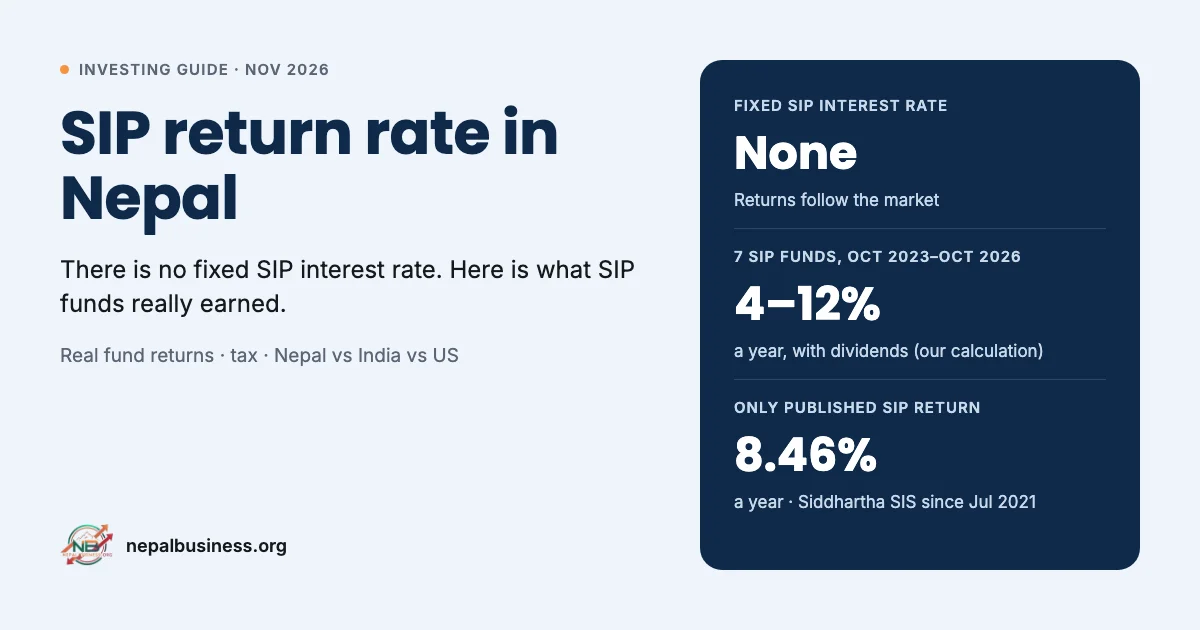
"What is the SIP interest rate in Nepal?" is one of the most searched SIP questions. The honest answer: there isn't one. A SIP is not a deposit. It is a plan to buy units of a mutual fund every month, and you earn whatever the fund earns, up or down.
So instead of a rate, this guide shows what Nepal's SIP funds actually earned, why the NAV hides most of that return, how SIP compares with a fixed deposit, how it is taxed, whether Nepalis working abroad can invest, and how all of it compares with India and the US.
This is general information, not financial advice. Past returns do not tell you future returns. Read a scheme's offer document, or talk to a licensed advisor, before you invest.
Quick answer
- No fixed SIP rate. SIP returns follow the share market. One fund's own 1-year SIP return moved from 7.79% to 11.18% in a single month (Siddhartha SIS, Bhadra to Ashwin 2083).
- The only published SIP return in Nepal: Rs 1,000 a month into Siddhartha Systematic Investment Scheme since July 2021 earned 8.46% a year, against 4.23% for the same SIP into NEPSE (fund factsheet, Ashwin 2083 / October 2026).
- Seven SIP funds with three years of data returned about 4% to 12% a year from October 2023 to October 2026, counting dividends (our calculation from published NAVs and dividends).
- Start date matters a lot. NEPSE grew about 8% a year over 12 years but lost about 2% a year over the last 5 (to mid-July 2026, price only, our calculation from NRB data).
- Tax is light: dividends from a mutual fund carry a 5% final tax. Gains when you redeem units are taxable too, but the law does not clearly say at what rate (more below).
- Working abroad? Nepali citizens with a PAN, demat (BOID) account and Nepali bank account can generally invest like anyone in Nepal. Rules for NRNs with a foreign passport are still being written.
- India's SIP market is huge: one month of Indian SIP money (October 2026) is about 16 times everything held in Nepal's SIP funds (our calculation).
What is the SIP interest rate in Nepal?
There is no SIP interest rate, and anyone quoting a fixed one is quoting something else.
A fixed deposit tells you the rate on day one. A SIP buys units of an open-ended mutual fund. SEBON's Mutual Fund Regulation requires these funds to buy and sell units at a price based on NAV, calculated daily. NAV rises and falls with the shares and bonds the fund holds, so your return is only known when you sell.
Siddhartha Capital's own factsheet says it plainly: SIP performance "can vary significantly from month to month".
Proof from the same fund:
| Siddhartha SIS factsheet | 1-year SIP return (a year) |
|---|---|
| Bhadra 2083 (September 2026) | 7.79% |
| Ashwin 2083 (October 2026) | 11.18% |
Same fund, same SIP, one month apart. And in Ashwin 2082 (October 2025), every open-ended fund's NAV fell within one month, by between 2.7% and 8.9% (ShareSansar).
How much have SIP funds in Nepal actually returned?
Nepal has 14 open-ended (SIP) funds and 47 closed-ended funds (ShareSansar, November 2026). Our SIP guide lists all 14. Seven of them have at least three years of NAV and dividend history, so we calculated their total return.
How we calculated it: total return = (NAV at the end + cash dividends paid during the period) ÷ NAV at the start − 1. NAVs are month-end Ashwin figures from ShareSansar. Dividends are from ShareHub. We assume a dividend of "10%" means Rs 1 per Rs 10 unit; ShareHub does not say this outright. Dividends are added as cash, not reinvested.
3 years: Ashwin 2080 (October 2023) to Ashwin 2083 (October 2026). All returns are our calculation.
| Fund | NAV Oct 2023 | NAV Oct 2026 | Dividends paid (Rs per unit) | Total, 3 years | Per year |
|---|---|---|---|---|---|
| Siddhartha SIS (SSIS) | 8.59 | 11.03 | 1.10 | +41.2% | 12.2% |
| Kumari Sunaulo Lagani (KSLY) | 10.08 | 11.38 | 2.41 | +36.8% | 11.0% |
| Shubha Laxmi Kosh (SLK) | 9.49 | 10.06 | 2.35 | +30.8% | 9.4% |
| NMB Saral Bachat-E (NMBSBF) | 8.81 | 10.33 | 0.95 | +28.1% | 8.6% |
| Nabil Flexi Cap (NFCF) | 9.41 | 10.34 | 1.40 | +24.8% | 7.7% |
| NIC Asia Dynamic Debt (NADDF) | 10.09 | 9.97 | 1.56 | +14.2% | 4.5% |
| NIBL Sahabhagita (NIBLSF) | 9.72 | 10.35 | 0.70 | +13.7% | 4.4% |
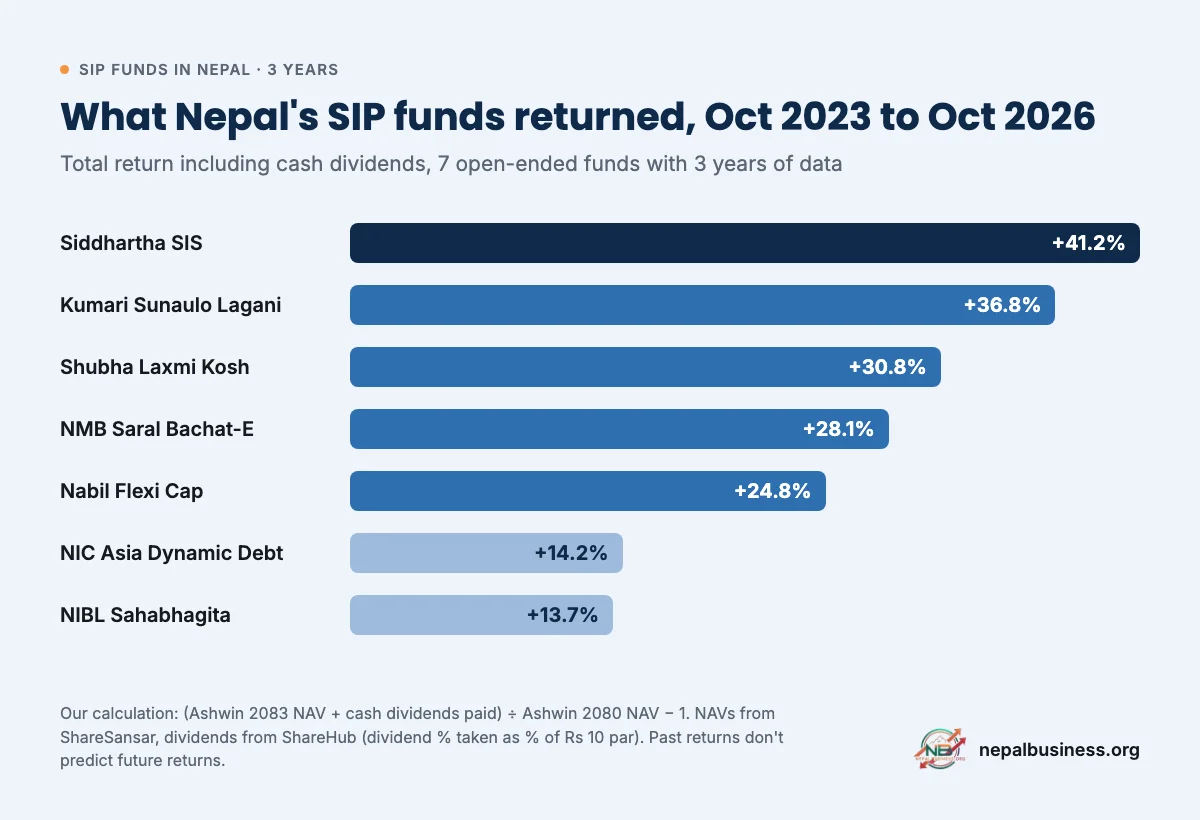
1 year, October 2025 to October 2026 (our calculation, same method): SSIS +14.7%, KSLY +13.6%, NIBLSF +10.0%, NMBSBF +9.6%, NADDF +5.7%, NFCF +5.3%, SLK +2.9%.
Three things stand out:
- The gap between funds is wide. Over the same three years, the best fund returned about three times as much as the weakest.
- Last year's leader isn't always the 3-year leader. SLK was third over 3 years but last over 1 year.
- A table like this is one window. Start it a year earlier or later and the order changes.
The younger SIP funds (Prabhu, Sanima, NI 31 and others) have no dividend history on ShareHub yet, so we left them out rather than show a misleading price-only number.
Nabil Flexi Cap's NAV changes daily: the table uses the month-end Ashwin NAV of 10.34. Nabil Invest showed a daily NAV of 10.35 on 12 November 2026.
Why does the NAV stay near Rs 10 if the fund is making money?
Because Nepali SIP funds pay out much of their profit as cash dividends. Each payout takes money out of the fund, so the NAV drops back toward the Rs 10 starting price.
Look at Shubha Laxmi Kosh in the table above: its NAV only went from 9.49 to 10.06 in three years (+6.0%). But it also paid Rs 2.35 per unit in dividends. Counting those, the return was +30.8%, five times what the NAV alone suggests.
So if you see "NAV 10.35" and think the fund earned 3.5% since it started, you are reading it wrong. Always ask: what did it pay out along the way?
Be careful with "return since inception" numbers on aggregator sites too. NepseAlpha shows NIBL Sahabhagita at 96.61% since inception while its NAV is about Rs 10. That figure must include payouts (the fund once paid a 50% dividend), but the site does not say how it is calculated or whether it is per year. Don't read it as "the fund nearly doubled every year".
Does it matter when you start a SIP?
Yes, more than anything else. Here is NEPSE (the index most SIP funds follow) measured from different starting years to mid-July 2026. These are price-only figures and leave out the dividends companies paid, so they understate what a shareholder earned.
| Period to mid-July 2026 | NEPSE at start | Growth per year (our calculation) |
|---|---|---|
| 12 years | 1,036.1 (2014) | 7.96% |
| 10 years | 1,718.2 (2016) | 4.22% |
| 5 years | 2,883.4 (2021) | −2.06% |
| 3 years | 2,097.1 (2023) | 7.40% |
| 1 year | 2,794.8 (2025) | −7.0% |
NEPSE mid-July closing levels from Nepal Rastra Bank. Mid-July 2026 close: 2,597.8.
NEPSE hit its all-time high of 3,198.60 on 18 August 2021. By mid-July 2026 the index was still about 19% below that peak, and below its mid-July 2021 level too.
This is exactly where a SIP helps. Because you buy every month, you also buy when prices are low, and your average cost comes down. Siddhartha's factsheet shows it: a Rs 1,000 monthly SIP into NEPSE since July 2021 still earned 4.23% a year, even though the index itself ended lower than where it started. A SIP does not remove risk. It spreads your buying over good months and bad.
Is a SIP better than a fixed deposit in Nepal?
They do different jobs.
| Fixed deposit | SIP (equity fund) | |
|---|---|---|
| Return known in advance? | Yes | No |
| Recent figure | 4.95% average fixed-deposit rate at commercial banks (NRB, mid-July 2026) | About 4–12% a year over 3 years, depending on the fund (our calculation, Oct 2023–Oct 2026) |
| Can it lose money? | No | Yes, especially over 1–3 years |
| Best for | Money you need within 1–3 years | Money you can leave for 5+ years |
One more number to keep in mind: inflation in Nepal was 5.14% in mid-July 2026 (NRB), slightly above that average FD rate, and 6.34% by mid-September 2026. Money sitting in an average FD was barely keeping its value.
Note the windows are different: the FD rate is one date, the fund returns are three years. So treat this as a rough guide, not a contest.
What are the SIP rules in Nepal?
From SEBON's Mutual Fund Regulation:
- Units are bought and sold at a price based on daily NAV.
- No entry fee is allowed when you buy.
- An exit fee of up to 1.5% can be charged when you redeem. It goes back into the fund, not to the fund manager.
- Yearly fee caps: 1.5% of NAV for the fund manager, 0.2% for the supervisor, 0.2% for the depository.
- The regulation does not set a minimum SIP amount or a lock-in. Each fund sets its own.
What three funds say on their own pages:
| Fund | Minimum | Lock-in | Exit fee |
|---|---|---|---|
| Siddhartha SIS | Rs 1,000 a month | None | 1.5% if sold within 1 year, then nil |
| NIBL Sahabhagita | Rs 1,000 monthly or quarterly | 3 months, only for units from the original offer | 1.5% (under 6 months) stepping down to 0.75% (18–24 months), nil after 2 years |
| NIC Asia Capital SIP | Rs 1,000 | Check with the fund | Check with the fund |
Siddhartha's SIP form adds two conditions worth knowing: you can cancel the SIP registration only after one year, and the fund manager can end your SIP if you miss an instalment. For the other funds, check the offer document or ask the fund manager.
Want to see what a monthly amount could grow to at different return rates? Try our SIP calculator. Remember the rate you type in is a guess, not a promise.
How are SIP returns taxed in Nepal?
- The fund itself pays no tax on income it earns in line with its objectives (Income Tax Act, Section 10).
- Dividends to you: 5% final tax. The fund deducts 5% when it pays an individual, and that is the end of it. You owe nothing more on that income (Income Tax Act, Sections 88 and 92). The Finance Act 2083 did not change this.
- Gains when you redeem units: taxable, but the rate is unclear. Redeeming units counts as selling them, so the gain is taxed. But the law's capital gains rule was written for shares traded on NEPSE, and open-ended units never trade there. Fund managers' own pages quote different things. Ask your fund manager what rate it deducts on redemption before you sell.
- For context: gains on listed shares for individuals were cut to 3.75% (held over a year) and 5% (a year or less) from 22 September 2026, as reported from the Nepal Gazette. Whether open-ended units follow these rates is not settled.
- Bonus units: we could not find any clear rule on how they are taxed.
Because most of a Nepali SIP fund's return comes as dividends, that light 5% dividend tax matters more than the unclear redemption rate.
Can Nepalis working abroad or NRNs invest in a Nepali SIP?
It depends on which passport you hold.
Nepali citizens working abroad (Korea, Japan, the Gulf, Malaysia and elsewhere): the documents we read treat you like any other investor.
- Siddhartha's SIP form asks for a PAN, a BOID (demat) number, a Nepali address and a Nepali bank account. There is no question about where you live.
- The same form lets family members pay the monthly instalment, by online payment or bank debit.
- Siddhartha's FAQ names Nepalis living abroad with a valid BOID as eligible investors.
- Nabil Bank added SIP sign-up and payment to its nBank app in May 2026, with Nepalis abroad in mind.
- The hard part is opening a PAN, demat and bank account from abroad. If you don't have them yet, set them up on your next visit home or ask your bank what it allows remotely.
NRNs with a foreign passport (US, UK, Australia and others): we could not confirm a direct way to start a SIP today.
- SEBON's established route for NRNs is shares in special Government-NRN joint investment companies, not mutual funds.
- In July 2026, SEBON's chairman said the board was working on rule changes to let NRNs into the secondary market.
- In August 2026, the Kathmandu Post reported a plan to let an NRN joint venture raise money through a foreign-currency IPO. It was awaiting Cabinet approval.
These rules are changing, and most of what is public comes from news reports rather than final rule texts. Check with the fund manager before you plan around it.
Currency matters if you earn abroad. A SIP in Nepal is in rupees. The rupee is pegged to the Indian rupee (INR 100 = NPR 160), but not to the won, yen, dirham or dollar. Against the dollar, the rupee went from Rs 107.04 (July 2016) to Rs 153.63 (July 2026), and it fell 10.9% in FY 2025/26 alone (NRB). If you plan to spend the money back in Nepal, that doesn't matter much. If you plan to move it abroad again, it does.
How does a Nepali SIP compare with India and the US?
India uses the same word, "SIP", and works almost the same way. The US has no product called SIP. Americans invest automatically every month through brokerage "recurring investments" and through 401(k) payroll deductions and IRA accounts, which come with tax benefits.
| Nepal | India | US | |
|---|---|---|---|
| What it's called | SIP (14 open-ended funds) | SIP (2,015 schemes, Oct 2026) | Recurring investment, 401(k), IRA |
| Who sets the rules | SEBON | SEBI | IRS sets 401(k)/IRA limits and tax |
| Minimum | Rs 1,000 a month (3 funds checked) | Rs 500 at the fund we checked; Rs 250 "Chhoti SIP" launched Feb 2025 | $1 for stocks/ETFs, $10 for mutual funds (Fidelity) |
| Tax-saving limit | None | — | 2026: 401(k) $24,500, IRA $7,500. 2027: $25,500 / $7,500 |
| Tax on gains | Taxable; rate for SIP redemptions unclear | Equity funds: 20% if held ≤12 months; 12.5% above Rs 1.25 lakh a year if held longer | Held over a year: 0%, 15% or 20% by income; under a year: normal income tax |
| Tax on dividends | 5% final | Normal income-tax slab; 10% deducted above Rs 10,000 a year | Qualified dividends 0/15/20%. Non-residents: 30% (no US–Nepal tax treaty) |
| Return evidence | SSIS SIP 8.46%/yr since Jul 2021 (Oct 2026); funds 4–12%/yr over 3 years (our calc.) | Nifty 50 (with dividends): 6.70%/yr over 5 years (Oct 2026); 15.09%/yr over 10 years (Feb 2026) | S&P 500 (with dividends): about 14.7%/yr in dollars, 2016–2025 (our calc.) |
| Latest inflation | 6.34% (mid-Sep 2026) | 6.09% (Oct 2026, provisional) | 3.7% (Sep 2026) |
| Size | About Rs 32.1 billion in SIP funds (NepseAlpha) | Rs 32,160 crore of SIP money in October 2026 alone | — |
India's figures: AMFI, Income-tax Act 2025, NSE Indices, MOSPI. US: IRS, Fidelity, BLS; S&P 500 calculated from NYU Stern (Damodaran) annual returns. Each return uses a different period, so don't rank the three countries on one number.
What Nepal can learn from India:
- Scale. India had 10.06 crore SIP accounts in September 2026. One month of Indian SIP money is about 16 times Nepal's entire SIP fund total (our calculation, at INR 1 = NPR 1.6).
- Smaller tickets. India's Rs 250 SIP is about NPR 400, well below Nepal's usual Rs 1,000.
- Clearer numbers. India publishes a total-return index with dividends. Nepal's NEPSE is price-only, and only one Nepali fund manager publishes a SIP return. That's a big part of why "SIP interest rate" questions go unanswered here.
Where Nepal is better: tax. India taxes fund dividends at your full income-tax rate and gains at 12.5–20%. Nepal takes a flat 5% on dividends.
India's bad year is a warning too. The Nifty 50 lost 9.45% in the year to October 2026. With 6.09% inflation, that's a real loss of about 14.6% (our calculation). Even the biggest SIP market in South Asia has years like that.
Should a Nepali in the US invest in Nepal or in the US?
We can't answer that for you, but these facts matter:
- If you live and work in the US, the 401(k) and IRA limits above give tax benefits that nothing in Nepal offers.
- If you live in Nepal and buy US funds, Nepal has no tax treaty with the US, so 30% of US dividends is withheld.
- Measured in rupees, the S&P 500 returned about 18.2% a year from 2016 to 2025 (our calculation), because the rupee fell against the dollar. That is before fees, taxes and transfer costs, and it only works if the rupee keeps falling.
- A well-known Vanguard study found that investing a lump sum at once beat spreading it over three months about two-thirds of the time. But Vanguard itself says that is different from investing part of each paycheck, which is what a SIP does.
The bottom line
There is no SIP interest rate in Nepal. The best evidence we have says Nepal's equity SIP funds earned roughly high single digits a year recently, with a wide spread between funds: 8.46% a year for the one fund that publishes its SIP return, and about 4–12% a year over three years for the seven funds we could calculate.
That beat the average fixed deposit and NEPSE's price-only return over the same years, but not by a margin that survives a bad start date. If you start a SIP, plan to keep it for five years or more, look at dividends and not just NAV, and compare funds over the same window.
Frequently asked questions
What is the SIP interest rate in Nepal?
There isn't one. A SIP buys mutual fund units every month, and the return depends on the fund's investments. The only published SIP return in Nepal is Siddhartha SIS: 8.46% a year since July 2021 (October 2026 factsheet).
Which SIP gives the highest return in Nepal?
Over October 2023 to October 2026, Siddhartha SIS had the highest total return of the seven funds with three years of data (+41.2%, our calculation), followed by Kumari Sunaulo Lagani (+36.8%). Rankings change with the time window, so check the latest figures before choosing.
Is SIP safe in Nepal?
SIP funds are regulated by SEBON, but the value of your units can fall. In October 2025, every open-ended fund's NAV fell in a single month. Money you need within one to three years is safer in a fixed deposit.
How much tax do I pay on SIP in Nepal?
Dividends carry a 5% final tax, deducted by the fund. Gains when you redeem units are taxable, but the rate for open-ended units is not clearly set out in law, so ask your fund manager.
Can I do a SIP in Nepal while working in Korea or the Gulf?
If you are a Nepali citizen with a PAN, BOID and Nepali bank account, the fund forms we read do not stop you, and family members can pay instalments for you. Opening those accounts from abroad is the hard part.
Is SIP in India better than SIP in Nepal?
India's market is far bigger, with lower minimums and better published data, but it taxes fund income much more heavily. Returns over different periods can't be compared directly, and the Nifty 50 lost 9.45% in the year to October 2026.
Sources
- Siddhartha Capital, SSIS factsheet, Ashwin 2083 and Bhadra 2083; SSIS FAQ; SIP registration form
- ShareSansar, Mutual Fund NAVs and Ashwin performance reports (2023, 2025, 2026)
- ShareHub, fund dividend histories (e.g. SSIS)
- Nabil Invest (NFCF daily NAV); NIMB Ace Capital, NIBL Sahabhagita; NIC Asia Capital
- Nepal Rastra Bank: Macroeconomic Indicators, mid-July 2025/26; Banking & Financial Statistics, Asar 2083; Current Macroeconomic Situation FY 2025/26; two months of 2026/27; forex rates
- SEBON, Mutual Fund Regulation 2067
- Income Tax Act 2058 (as amended to Finance Act 2082) and Finance Act 2083 (Government of Nepal)
- ShareSansar on NRN joint investment companies, the SEBON–NRN meeting and Nabil nBank SIP; Kathmandu Post, 16 Aug 2026
- India: AMFI, AMFI Monthly Report, Oct 2026 and Monthly Note, Sep 2026; Nifty 50 factsheet and whitepaper; HDFC MF Tax Reckoner TY 2026-27; Nippon India ELSS scheme document; MOSPI CPI, Oct 2026
- US: IRS 2026 limits; IRS 2027 limits; IRS Rev. Proc. 2025-32; IRS tax treaties; Fidelity; Damodaran, NYU Stern; BLS CPI; Vanguard, 2023
Related tools
Free calculators that match this topic
Join the Discussion
Share your thoughts and engage with our community.
Loading comments...
Log in to join the discussion
Register on the platform, verify your email, then comment on this article.